

The core difference between outside and inside sales used to be straightforward: outside sales reps met clients in person, while inside sales reps sold from an office. Simple. But technology has completely blurred those traditional lines, forcing B2B companies to engineer a much smarter approach to building a winning sales team.

Defining The Modern B2B Sales Models
The classic “road warrior” still has a critical role. For complex, high-value enterprise deals, nothing replaces the strategic impact of a face-to-face meeting. This outside sales model is architected to build deep, personal relationships, which is often essential when navigating multiple stakeholders in a large organization.
On the flip side, inside sales has evolved far beyond its telemarketing roots into a sophisticated, data-driven engine. Armed with powerful CRM platforms like Salesforce Sales Cloud or HubSpot Sales Hub, sales engagement tools, and seamless video conferencing, inside sales teams execute high-velocity sales processes from anywhere.
For Marketing Operations and RevOps leaders, the choice isn’t just about picking one model over the other. It’s about engineering the right sales motion for the right customer segment. A misaligned strategy leads to inflated customer acquisition costs (CAC), missed revenue targets, and a fragmented customer journey. But when you align your sales model to your product and market, you create a predictable revenue engine. It all starts with understanding the operational mechanics of each approach.
Quick Comparison: Outside Sales vs Inside Sales
To get a clearer picture, let’s break down the fundamental differences. For anyone in Sales or Revenue Operations, these distinctions are critical because they influence everything from your cost of customer acquisition (CAC) and tech stack configuration to your GTM engineering within Salesforce or HubSpot.
| Attribute | Outside Sales | Inside Sales |
|---|---|---|
| Primary Work Environment | In the field, at client sites, and trade shows | Office-based or a fully remote setup |
| Typical Sales Cycle | Longer, often stretching 6-12+ months | Shorter, usually wrapping up in 30-90 days |
| Average Deal Size | High-value, complex enterprise contracts | Lower to mid-value deals, often transactional |
| Key Activities | Face-to-face meetings, on-site demos, networking | High-volume calls, email sequences, virtual demos |
| Essential Tools | Mobile CRM, expense trackers, mapping software | CRM, sales engagement platforms, video conferencing |
This table provides a snapshot, but as we’ll explore, the real strategic advantage often comes from blending these models or selecting the one that perfectly fits your company’s go-to-market strategy and customer profile.
Analyzing Core Responsibilities and Required Skills
Beyond where they work, the operational differences between outside and inside sales are rooted in their day-to-day responsibilities and the specialized skills required for success. These roles are not interchangeable; they are distinct functions designed for different deal complexities and customer journeys. Excelling in one does not guarantee success in the other.

An outside sales representative must be highly autonomous, with a schedule dictated by strategic territory management and client visits, not back-to-back calls. Conversely, inside sales is defined by structure, process, and velocity within a digital-first environment.
The Strategic Field Operator
Think of outside sales reps as relationship architects. Their primary function is to build trust and credibility through in-person engagement, justifying the significant investment of time and travel required.
Their work revolves around high-touch, strategic activities:
- Strategic Territory Management: This involves more than geographic assignment. They analyze a territory to identify high-value accounts, plan efficient routes using tools like ZoomInfo, and cultivate a pipeline of long-term opportunities.
- In-Person Engagement: They conduct on-site discovery meetings, run complex product demonstrations, and lead negotiations with multiple stakeholders in a boardroom setting.
- Deep Relationship Building: Success depends on creating genuine connections through consistent face-to-face interaction with key decision-makers at industry events and client meetings.
For an outside sales professional, emotional intelligence is non-negotiable. Success hinges on their ability to read a room, interpret non-verbal cues, and build a rapport that’s difficult to replicate digitally—a critical element for closing large, complex enterprise deals.
The Digital Sales Specialist
Inside sales professionals are masters of efficiency and digital communication. Their environment is the CRM, sales engagement platforms, and a relentless focus on scalable, repeatable processes that fuel a high volume of interactions. To delve deeper into this role, explore our guide that answers the question, “what is inside sales?“
Their core duties are centered on speed and precision.
Key responsibilities include:
- High-Volume Prospecting: They execute targeted outreach campaigns using a strategic mix of cold calls, personalized emails (often enriched with data from tools like Clay.com), and social selling, all powered by platforms like HubSpot Sales Hub or Salesforce High Velocity Sales.
- CRM-Driven Workflows: Every touchpoint is meticulously tracked in the CRM (e.g., Salesforce Sales Cloud, HubSpot Sales Hub). They manage a large pipeline of early-stage deals and adhere to structured cadences for every follow-up.
- Compelling Virtual Demos: They have perfected the art of the screen share, delivering engaging and persuasive product demonstrations that capture and hold a prospect’s attention remotely.
The core competencies for these two roles are distinct, demanding different approaches to time management, communication, and technical proficiency.
| Competency | Outside Sales Skill Set | Inside Sales Skill Set |
|---|---|---|
| Communication | Face-to-face influence, active listening, public speaking, and reading body language. | Digital persuasion, concise writing, vocal tonality, and virtual presentation skills. |
| Time Management | Autonomous field planning, self-motivation, and managing unpredictable travel schedules. | Structured time blocking, strict adherence to cadences, and managing high daily activity volumes. |
| Technical Acumen | Mastery of mobile CRM apps (e.g., Salesforce Mobile), expense tracking software, and route planning tools. | Deep expertise in sales engagement platforms (Outreach, Salesloft), video conferencing, and CRM automation. |
Ultimately, the skills a B2B company needs to hire for depend entirely on its go-to-market strategy and ideal customer profile. An enterprise software firm will rely on the consultative, relationship-building skills of an outside team, whereas a SaaS business selling to SMBs will gain more value from the process-driven efficiency of an inside sales force.
Comparing Cost Structures and Compensation Models
For any RevOps or Sales Operations leader, choosing between outside and inside sales isn’t just a strategic decision—it’s a critical financial one. This choice directly shapes your customer acquisition cost (CAC) and, ultimately, your bottom line. Each model carries a distinct financial footprint, requiring a tailored approach to budgeting, compensation, and performance tracking. Optimizing this structure is foundational to building a sales engine that is both cost-effective and highly motivated.
The most evident difference lies in operating expenses. An outside sales team incurs significant variable costs from travel: flights, hotels, mileage, and client entertainment. These expenses are necessary for building the face-to-face relationships required to secure large, complex deals, but they can also complicate budget forecasting.
Conversely, an inside sales team’s costs are far more predictable and primarily tied to technology. Here, the major investments are in the tech stack—Salesforce or HubSpot licenses, sales engagement platforms, and communication tools. This model trades travel receipts for software subscriptions and a commitment to structured, ongoing training.
Unpacking Compensation Philosophies
These financial differences extend directly to compensation structures. The way you compensate an outside salesperson versus an inside one is designed to drive fundamentally different behaviors. You must align their pay with the unique rhythm and deal structure of their role—it’s the difference between rewarding a marathon runner and a sprinter.
The core compensation philosophy for outside sales is designed to reward the “big game hunter.” It’s a high-risk, high-reward model with uncapped commissions tied to closing large, infrequent deals. Inside sales compensation is built for volume and predictability, rewarding reps for consistent activity and maintaining pipeline velocity.
This contrast is clear in the typical pay structures:
- Outside Sales Compensation: This model often features a lower base salary but a much higher, uncapped commission rate. It is designed to attract self-starters confident in their ability to close major enterprise contracts, tying their earnings directly to significant company wins.
- Inside Sales Compensation: This structure usually includes a higher base salary paired with more structured, volume-based bonuses or commissions. Incentives are often linked to monthly or quarterly quotas, pipeline generated, and the number of deals closed, promoting steady performance and a predictable revenue stream.
A Real-World Financial Benchmark
To illustrate this, let’s examine real numbers. In a competitive market like California, the compensation gap highlights why B2B companies rely on RevOps expertise to design go-to-market strategies that are financially sound.
As of December 2025, the average base pay for outside sales in California is $77,020 yearly. This breaks down to approximately $1,481 a week or $6,418 a month. The 25th percentile is at $51,800, while the 75th percentile is at $88,800. The top 10% of earners reach $126,323 or more, particularly in high-cost cities like San Jose ($91,476) and Oakland ($89,630). You can see the full breakdown of California sales salary data on Payscale.com.
This data shows that while the base salary for an outside rep can be substantial, a significant portion of their total compensation is tied to performance. For a RevOps leader, this means your financial model must accommodate large commission payouts after a major deal closes. With an inside sales model, you manage a higher fixed payroll cost. The optimal choice depends on your product’s price point, sales cycle length, and the specific market you aim to capture.
Optimizing Your Tech Stack for Each Sales Model
The decision to build an outside or inside sales team extends far beyond where your reps work—it directly shapes your operational backbone. Your tech stack is not merely a list of software subscriptions; it’s the engine that either accelerates or grinds your sales motion to a halt. For B2B companies using Salesforce or HubSpot, a generic, one-size-fits-all CRM configuration is a recipe for inefficiency, inevitably handicapping one team while favoring the other.
At its core, the difference is mobility versus velocity. Outside reps are constantly on the move, requiring instant access to data and frictionless ways to log updates from any location. Inside sales reps, on the other hand, operate from a digital command center where speed, automation, and data-driven sequences are paramount. Building the right tech stack means creating two distinct but interconnected ecosystems that amplify each team’s strengths. Investing in the right tools, like the best lead management software, is a critical first step.
Gearing Up Your Outside Sales Team
For your reps in the field, the CRM must function as a frictionless mobile office. The primary objective is to minimize administrative time and maximize face-time with customers. If a rep must wait until returning to their hotel to log notes from multiple meetings, crucial details will be lost, and your pipeline data will become unreliable.
Essential configurations in Salesforce or HubSpot should include:
- Rock-Solid Mobile CRM Access: This is non-negotiable. Your reps need the full functionality of the Salesforce or HubSpot mobile apps to update opportunities, log calls, and access contact information with just a few taps.
- Geolocation & Automated Visit Logging: Modern CRMs can leverage a rep’s location to prompt them to log a meeting upon arrival at a client’s office. This feature dramatically improves the accuracy and timeliness of activity tracking.
- Offline Functionality: Service can be unreliable in a sprawling corporate campus or a rural area. The CRM must allow reps to work offline and automatically sync all updates once they are back online.
- Expense Reporting Integrations: Connecting your CRM to a tool like Expensify or SAP Concur is a game-changer. It automates the process of linking travel and entertainment costs directly to an account or opportunity, providing a clearer picture of your true customer acquisition cost.
Supercharging Your Inside Sales Team
For inside sales, the tech stack is engineered to enable high-velocity engagement at scale. The focus shifts from field logistics to optimizing every digital interaction. In this model, the CRM becomes the central hub for a suite of powerful engagement and automation tools.
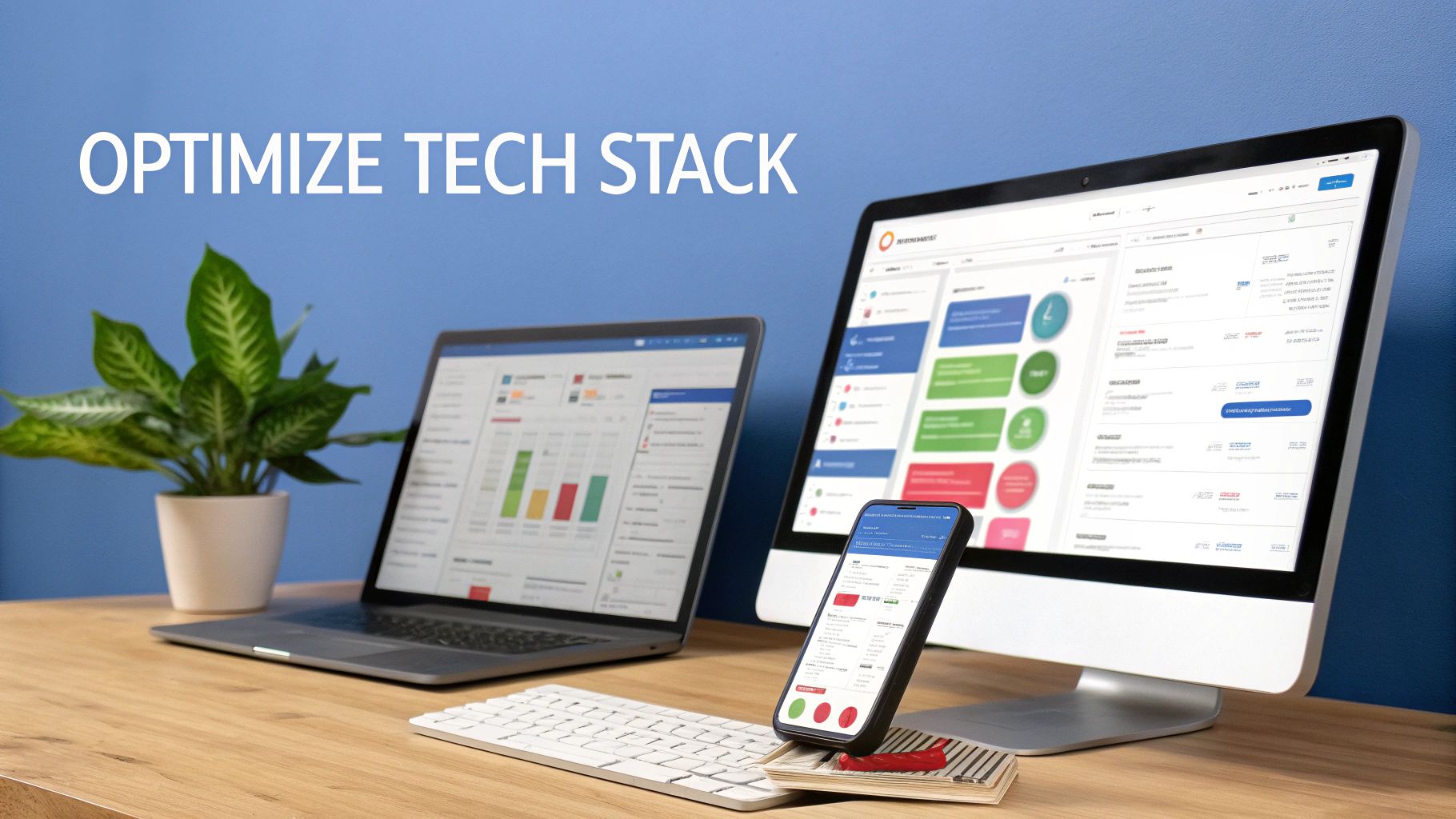
The ideal setup, such as one built within HubSpot Sales Hub, allows a rep to manage their entire workflow from a single screen. This is the core principle of a well-tuned inside sales tech stack.
Key optimizations include:
- Sales Engagement Platforms: Tools like SalesLoft, Outreach, or HubSpot’s native Sales Hub Sequences are essential. They empower reps to execute sophisticated, multi-channel cadences of calls, emails, and social touches with precision.
- Automated Nurture Sequences: Integrating your CRM with a marketing automation platform—such as Salesforce Marketing Cloud Account Engagement (formerly Pardot) or HubSpot Marketing Hub—is crucial. This enables you to build intelligent lead nurturing paths that warm up prospects before a rep makes the first contact.
- Robust Dashboards and Analytics: Inside sales is a numbers game. You need real-time dashboards in Salesforce or HubSpot tracking key metrics: call volume, email open rates, connection rates, and pipeline velocity.
A well-configured tech stack does more than just support a sales team; it actively shapes their behavior. For outside sales, it removes administrative barriers to data entry. For inside sales, it creates a structured, data-rich environment that drives consistent, high-volume activity.
The following table breaks down how you might configure your platform for each team’s specific needs.
Salesforce and HubSpot Tech Stack Configuration
| Requirement | Outside Sales Configuration | Inside Sales Configuration |
|---|---|---|
| Core CRM View | Mobile-first dashboard showing today’s appointments, key account details, and nearby prospects. | Desktop dashboard focused on task queues, lead response times, and daily activity metrics (dials, emails). |
| Key Integration | Expense tracking (e.g., Expensify, SAP Concur) and mapping software (e.g., Google Maps API). | Sales engagement platform (e.g., SalesLoft, Outreach) and a power dialler. |
| Automation Focus | Geolocation-based activity logging and automated trip reports. | Automated lead routing, email sequencing, and task creation based on prospect behaviour. |
| Reporting Priority | Visit frequency per account, travel costs per deal, and pipeline by territory. | Conversion rates by cadence, rep activity leaderboards, and sales cycle velocity. |
Ultimately, the goal is to equip each team with a purpose-built toolkit. While both operate from the same central CRM, the features, integrations, and dashboards they use daily should be tailored to their unique roles.
For a deeper look at the fundamentals of this process, check out our guide on how to choose the right CRM for your business.
Engineering Your Go-To-Market Motion in Salesforce and HubSpot
Choosing between an outside and inside sales model is just the beginning. The real challenge—and where many strategies fail—is embedding that choice into the very architecture of your CRM. Your go-to-market (GTM) motion should not just be a concept on a slide deck; it must be a living, breathing system within Salesforce or HubSpot.
This operational blueprint dictates how leads flow, how territories are defined, and how performance is measured. It is what transforms a high-level sales structure into predictable revenue.
Without a solid technical foundation, even the most brilliant GTM strategy will crumble. You risk inside reps drowning in unqualified leads while your outside reps waste valuable time and resources on accounts that don’t justify an in-person visit. A properly configured CRM acts as the central nervous system for your entire sales organization, enforcing rules, automating workflows, and providing the clarity needed for execution.
Designing Intelligent Lead and Territory Assignment
The first step is to define the rules of engagement. In both Salesforce Sales Cloud and HubSpot Sales Hub, this starts with building intelligent assignment logic that automatically routes leads to the right team based on predefined criteria. This is more than a simple round-robin; it’s strategic segmentation.
Common routing rules for a hybrid model include:
- Firmographics: Automatically route leads from companies with over 1,000 employees or those in key verticals like manufacturing or healthcare directly to the outside sales team.
- Geographic Territories: Assign leads based on postal code, province, or country to the rep who owns that physical territory.
- Lead Score: Once a lead reaches a certain score in Marketing Cloud Account Engagement (formerly Pardot) or HubSpot, instantly assign it to the inside sales team for immediate follow-up.
- Product Interest: Funnel inquiries for complex, high-value products to your field team, while routing those for more transactional products to the inside sales desk.
In Salesforce, this can be achieved with a combination of Lead Assignment Rules and, for more complex logic, Apex triggers. In HubSpot, workflows built around contact properties are the primary tool for creating these automated routing paths.
Tracking Distinct Activities with Custom Objects
Once leads are assigned, you must track each team’s activities without compromising data integrity. A common mistake is to categorize an outside rep’s on-site visit and an inside rep’s discovery call as the same generic “Activity.” This makes accurate reporting nearly impossible.
A cleaner approach is to create custom objects or dedicated activity types:
- For Outside Sales: In Salesforce, build a “Site Visit” or “Field Meeting” custom object. This gives reps a specific place to log crucial details like travel time, expenses, and meeting outcomes, keeping it separate from standard calls and emails.
- For Inside Sales: Use tailored activity types within the standard Task object, such as “Discovery Call,” “Virtual Demo,” or “Qualification Call,” to properly segment their high-volume digital interactions.
This level of data hygiene is non-negotiable. It enables you to build dashboards that can accurately compare the cost and effectiveness of a field visit against a digital sales cadence.
Building Purpose-Built Reporting Dashboards
Finally, each team needs its own command center—a dashboard built specifically for the KPIs that define their success. A one-size-fits-all report creates noise and distracts from the metrics that actually drive performance for each unique sales motion.
Consider building two distinct sets of dashboards in Salesforce or HubSpot:
| Dashboard Focus | Outside Sales KPIs | Inside Sales KPIs |
|---|---|---|
| Deal Metrics | Average Deal Size, Win Rate by Territory, Account Penetration | Pipeline Velocity, Sales Cycle Length, Conversion Rate (Lead to Opportunity) |
| Activity Metrics | Number of Site Visits per Quarter, Travel & Entertainment Spend per Deal | Dials per Day, Emails Sent, Demos Completed per Week |
| Pipeline Health | Pipeline Coverage by Region, High-Value Opportunities ($100k+) | New Opportunities Created, Lead Response Time, MQL to SQL Rate |
By engineering these distinct operational structures within your CRM, you elevate your GTM strategy from theory to an executable playbook. This technical groundwork ensures data integrity, facilitates change management, and delivers the visibility required to scale your revenue engine. To get an even bigger lift in your B2B efforts as you engineer this motion, check out this proven guide to LinkedIn for B2B lead generation.
For B2B companies in California, the line between an outside and inside sales role isn’t just strategic—it’s a critical legal and financial distinction. Misclassification can lead to significant penalties, quickly turning a payroll oversight into a major liability. For RevOps and Sales Ops leaders, this means your setup in Salesforce or HubSpot must do more than drive performance; it must ensure compliance with California’s strict labor laws.
The issue hinges on overtime eligibility. Inside sales reps are almost always classified as non-exempt, meaning they are covered by minimum wage, overtime, and meal break regulations. Outside sales, however, can be exempt, but this is where California’s regulations become particularly stringent, demanding meticulous tracking and proof.
The Critical 50 Percent Rule
The key is California’s “outside sales exemption.” To qualify as exempt and not be eligible for overtime, an employee must spend more than half of their working hours away from the office, actively engaged in sales activities. State law is unequivocal: outside salespeople are only exempt if they spend over 50% of their time in the field, selling products or securing orders. This rule applies to reps aged 18 or older whose primary duty is selling away from a central office. For a deeper dive into California’s wage orders and sales salaries, ZipRecruiter.com is a valuable resource.
This is not just an HR problem—it’s a data and systems challenge for RevOps. Your CRM must be configured to precisely track where your outside sales team spends their time and what they are doing. This data is your primary defense against a misclassification claim.
Making Compliance a Reality in Your CRM
To mitigate risk, your CRM must function as more than a sales tool; it must be a compliance engine. This requires moving beyond basic activity logging to build a clear, auditable trail of where the work is happening. For B2B teams on Salesforce or HubSpot, this is entirely achievable with the right configuration.
Here’s how to put this into practice:
- Log Activities with Location Data: Configure the Salesforce or HubSpot mobile app to use geolocation. When a rep logs a meeting, it should capture a timestamp and location, creating a definitive record of their time in the field.
- Use Specific Activity Types: Do not just log a generic “meeting.” Create distinct categories like “On-Site Client Visit,” “Virtual Demo,” and “In-Office Prospecting.” This detail makes it easy to run reports that separate outside sales work from inside tasks.
- Build a Compliance Dashboard: Create a dashboard in your CRM dedicated to tracking the percentage of time each outside rep spends in the field. You can even set up alerts to notify a manager if a rep is consistently falling below the 50% threshold, allowing for proactive intervention.
By building these safeguards directly into your CRM, you are not just managing sales; you are creating a robust compliance system that protects your business from expensive legal battles.
Building a Winning Hybrid Sales Strategy
The “outside vs. inside sales” debate often misses the point. The most successful B2B sales organizations rarely adhere to a single model. Instead, they build a strategic, hybrid approach that deploys the right salesperson for the right opportunity. It’s about creating a flexible and powerful revenue engine that recognizes different deals require different playbooks.
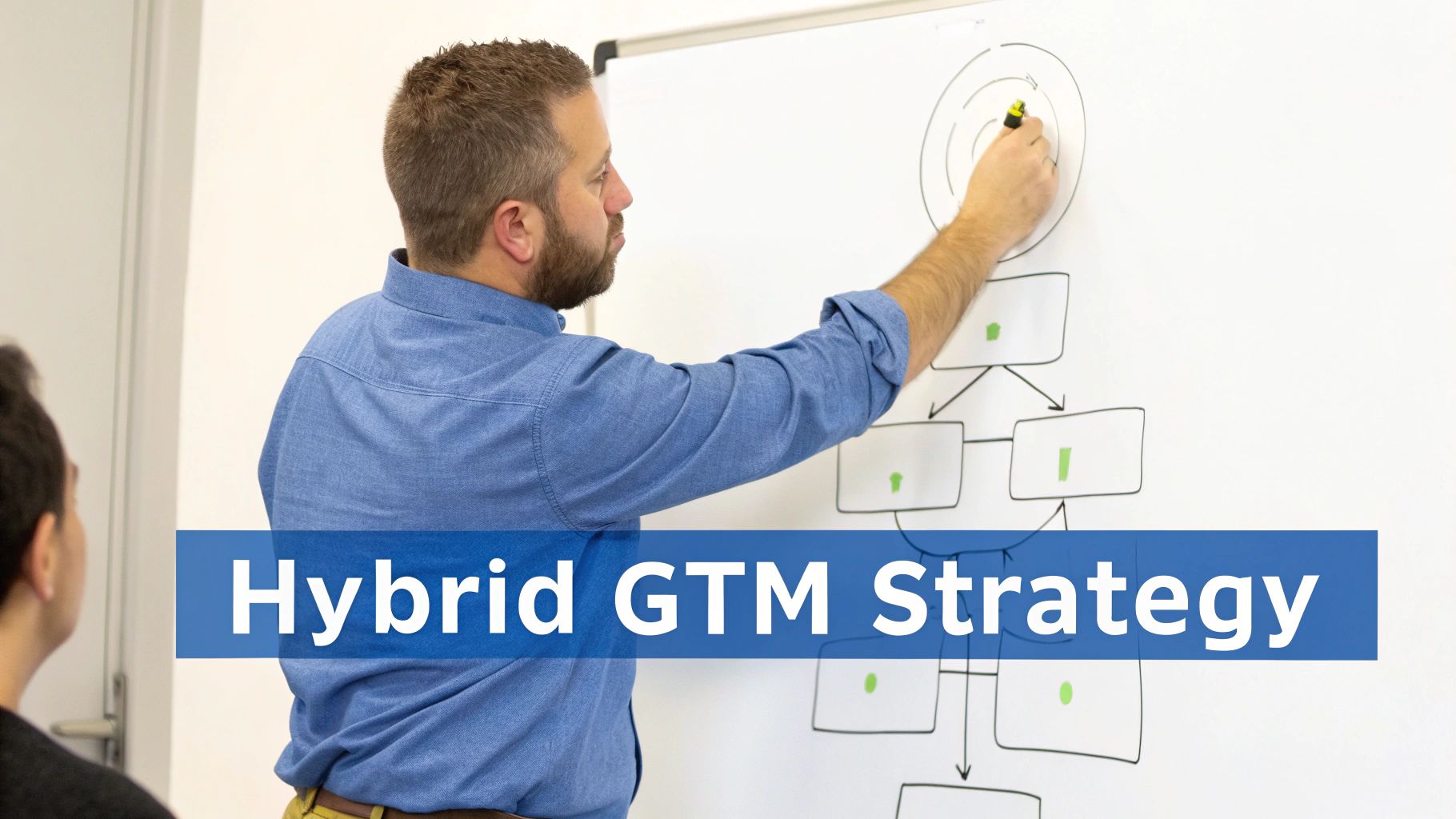
A well-architected hybrid model is not about having two teams working in silos. It is a single, unified system where each function enhances the other. This allows your business to efficiently capture high-velocity SMB deals with an inside team, while your field reps can dedicate their high-touch, resource-intensive efforts to securing major enterprise accounts. The result is maximum market coverage without an unsustainable customer acquisition cost (CAC).
Aligning Sales Models with GTM Objectives
Clarity is paramount. You must define the precise triggers for when each model is deployed and then engineer those rules directly into your CRM workflows in Salesforce or HubSpot. This ensures operational efficiency and prevents conflicts between your teams.
Here’s a practical framework for segmenting responsibilities:
- Unleash Outside Sales For:
- High-Value Enterprise Deals: This is their core function. Focus them on accounts with a potential lifetime value above a defined threshold, such as $100,000+.
- Complex Product Demos: If you are selling sophisticated hardware or software that requires a hands-on, on-site demonstration, a field rep is essential.
- Strategic Account Management: Nurturing and expanding relationships with your most critical, high-revenue clients is a prime responsibility for an outside sales professional.
- Deploy Inside Sales For:
- SMB and Mid-Market Segments: This team is built for speed and scale, perfectly suited to manage shorter sales cycles and more transactional deals.
- High-Volume Lead Qualification: Position your inside reps (or SDRs) as the gatekeepers to qualify all inbound leads before passing larger, more strategic opportunities to the field team.
- Expansion and Renewal Revenue: Task them with managing renewals and identifying upsell opportunities within your existing customer base—often the fastest path to new revenue.
A hybrid model is the backbone of a modern go-to-market motion. It forces you to move beyond a rigid “either/or” mindset and instead focus on matching the cost, skills, and sales cycle of each team with what the customer actually needs.
Achieving this alignment is crucial, especially in dynamic markets. For example, recent California economic data highlighted how sector-specific trends can favor one model. A 5% growth in the medical and biotech sectors presents a prime opportunity for outside reps to close large, in-person deals. Simultaneously, shifts in the housing market could significantly impact lead flow for inside teams. You can read more about these California economic drivers and their impact on sales tax.
By thoughtfully architecting a hybrid structure, you are not just building a sales team; you are building a resilient and adaptable sales organization. It is the most effective way to ensure you can penetrate all target markets, from fast-moving small businesses to complex enterprise accounts. To delve deeper into this, check out our guide on building a successful go-to-market strategy framework.
At MarTech Do, we specialize in engineering the exact RevOps frameworks and CRM configurations that make winning hybrid sales models tick. If you’re ready to get your sales teams aligned, optimize your GTM motion, and drive predictable revenue growth, let’s talk. Learn more at https://www.martechdo.com.