Creating a campaign in Salesforce isn’t just about clicking “New Campaign.” True revenue operations excellence, and the accurate reporting that comes with it, begins before you create the first record. The key is laying a solid strategic foundation.
Building Your Salesforce Campaign Foundation
Treat your campaigns not as one-off tactics, but as interconnected components of a larger Go-to-Market (GTM) strategy. To achieve this, you need a robust framework. A consistent approach to campaign types, naming conventions, and hierarchy is what separates a messy, unusable campaign history from a powerful reporting engine that drives business decisions.
Here’s a look at where campaigns live within the Salesforce UI, giving you context for the fields and relationships we’re about to discuss.

To build a foundation that scales, focus on these critical areas:
- Define Standardized Campaign Types: Ensures every campaign is categorized correctly for accurate channel performance reporting.
- Establish a Short, Scalable Naming Convention: Eliminates guesswork so stakeholders can understand a campaign’s purpose at a glance.
- Map Parent and Child Campaign Relationships: Crucial for rolling up metrics and understanding program-level ROI.
- Align Campaign Goals with GTM Objectives: Every campaign must have a clear purpose tied to a measurable business goal.
Establish Campaign Types
The “Type” field is one of the most important (and most often misused) fields on the campaign object. It is your primary tool for categorizing marketing efforts for performance analysis.
For instance, a major annual conference might have a parent campaign with the Type “Conference.” Underneath, child campaigns would track specific tactics like “Email Promotion,” “Paid Social,” or “Webinar.”
Pro Tip: Ensure every campaign type maps directly to a specific channel or tactic in your marketing plan. This discipline is the bedrock of clean reporting.
Set Naming Conventions
Without a clear naming convention, your campaign list becomes a liability. A solid framework prevents confusion and enables quick, efficient searching and reporting.
A simple, effective naming structure might look like this:
- Date or Quarter: e.g., 2024-Q4 or YYYY-MM
- Channel or Region: e.g., LI-Ads or EMEA
- Initiative or Asset: e.g., Ebook-Launch or Annual-Conf
- Keep it concise: Aim for names under 50 characters to avoid truncation in reports.
Structure a Logical Hierarchy
This is where your strategy materializes. Using parent-child relationships allows you to group individual tactics under a single, overarching program. All costs, members, and influenced revenue from child campaigns automatically roll up to the parent.
Returning to our conference example, the “Conference 2024” parent campaign would house the high-level budget and goals. The child campaigns—email drips, social ads, and a post-event webinar—would track the performance of each specific tactic. This structure provides a clean, unified source for analyzing the entire program’s success.
To maximize this structure, it’s essential to understand broader B2B marketing strategies. This modern B2B lead generation playbook provides valuable context. A solid campaign structure is only effective with clean data; regular CRM data hygiene is a non-negotiable part of any RevOps function.
Get your hierarchy right from the start. Planning it out early saves significant headaches and reporting errors down the road.
The Impact of a Structured Approach
When teams commit to this disciplined framework, the benefits are immediate and tangible.
- Campaigns are launched faster and more consistently.
- Performance metrics become reliable and trustworthy.
- Cross-team collaboration between marketing and sales operations improves.
- Your entire marketing model becomes more scalable and predictable.
In a recent engagement, we helped a client optimize their annual conference setup. By implementing this framework, they cut campaign creation time by 40%. Their Marketing Ops team was freed from manual tracking to focus on high-impact strategic initiatives.
Next Steps for RevOps Leaders
As a RevOps leader, your role is to operationalize this framework. Document the campaign types and naming rules in a shared playbook accessible to all stakeholders.
Then, implement guardrails to maintain data integrity.
- Use Validation Rules in Salesforce to enforce the naming convention.
- Run Campaign Hierarchy reports monthly to identify and correct orphaned or miscategorized campaigns.
- Train your marketing and sales teams on the playbook.
- Periodically review and update campaign types as your GTM tactics evolve.
With this foundation, you are positioned for advanced ROI analysis and multi-channel attribution. It also streamlines the integration of powerful tools like Account Engagement (Pardot) or Marketing Cloud.
A Real-World Scenario
I once worked with an enterprise technology company that had lost all visibility into its social media spend due to inconsistent campaign categorization.
After implementing a structured type and hierarchy system, they were able to consolidate $500K in disparate ad spend under a single parent program. The result? Attribution accuracy increased by 25%, and their quarterly reports to leadership became significantly more credible and insightful.
Starting with this foundation enables similar gains across any B2B program, helping you avoid common pitfalls and ensuring your dashboards are accurate from day one.
Alright, you’ve completed the strategic heavy lifting—you have standardized types, a rock-solid naming convention, and a clear hierarchy mapped out. Now it’s time to translate that strategy into action within Salesforce. Creating the actual campaign record is where planning becomes a tangible, trackable asset.
This is the tactical execution, and every field you populate has a downstream effect on your ability to track performance, measure impact, and report on business value.
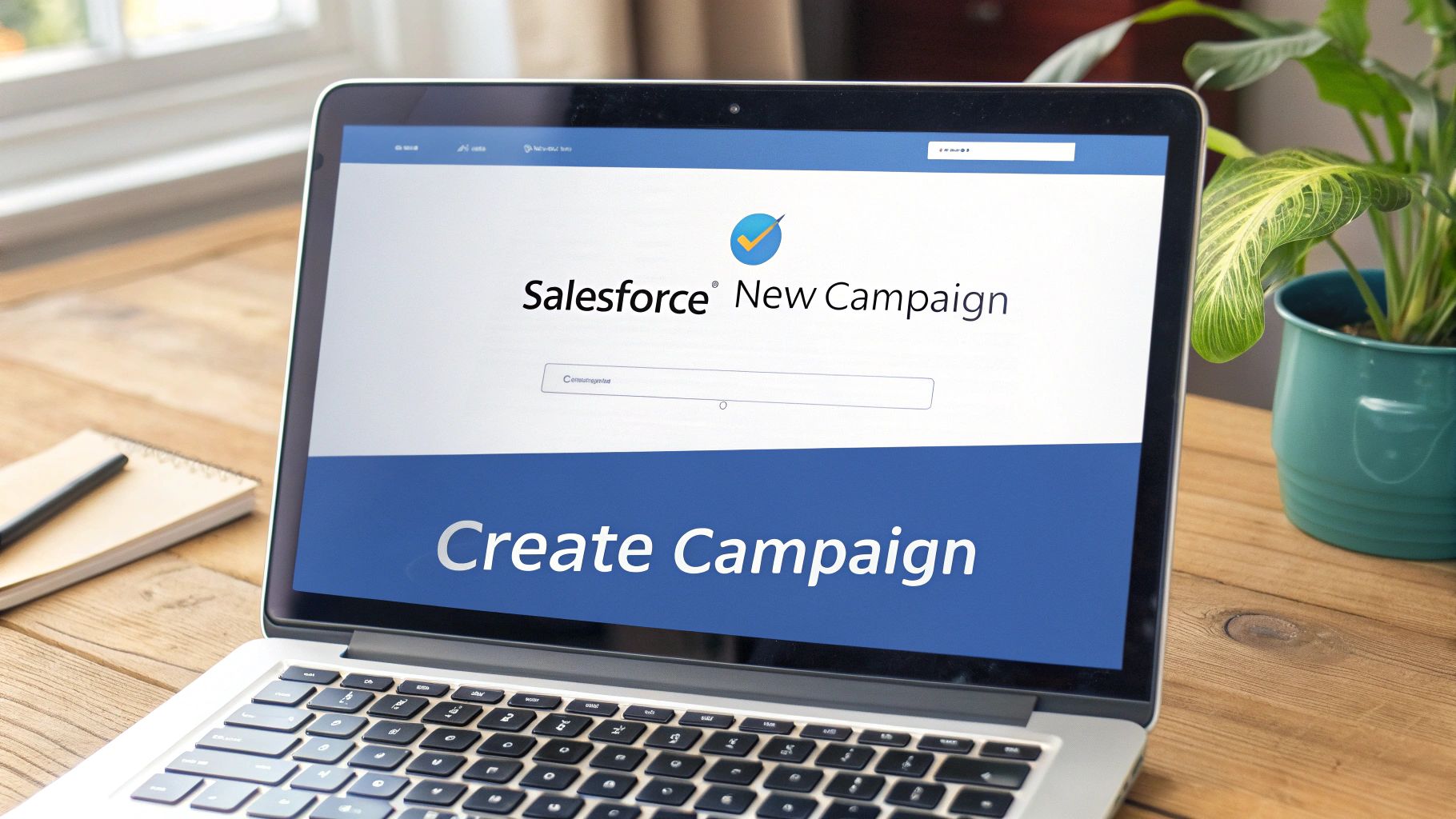
Let’s walk through the essential fields on the campaign object. We’ll cover not just what to enter, but why it’s critical for a high-performing RevOps function.
Getting to the Campaign Creation Screen
First, let’s navigate to the correct location. From your main Salesforce dashboard, click on the Campaigns tab. If it’s not visible, click the App Launcher (the nine-dot grid in the top-left corner) and search for “Campaigns.”
Once on the Campaigns homepage, click the “New” button. This opens the new campaign screen—your blank canvas.
Filling Out the Core Campaign Fields
The initial fields are the bedrock of your campaign. Accuracy here is non-negotiable for clean data and reliable reporting.
- Campaign Name: This is where your standardized naming convention becomes muscle memory. A name like
2024-Q4-Webinar-ProductLaunch-NAinstantly communicates the what, when, and where, cutting through clutter. - Active: This checkbox is deceptively important. It controls whether the campaign appears in lookup fields, such as when a sales development representative adds a contact. Our best practice: keep this box checked from planning through execution. Only uncheck it once the campaign is officially archived.
- Parent Campaign: Is this campaign part of a larger initiative, like a product launch or a quarterly demand generation program? Use this lookup field to link it to the main “Parent” campaign. This single step enables Salesforce to automatically roll up all key metrics—costs, members, opportunities, and ROI—to the parent level.
Nailing these initial fields ensures your campaign is properly classified and connected within your marketing ecosystem from the outset.
Choosing the Right Salesforce Campaign Type
Let’s focus on one of the most crucial fields: Campaign Type. This is your primary categorization tool, defining the channel or tactic used. Getting this right is fundamental to comparing the performance of different channels, such as determining whether webinars or paid social ads are driving more qualified pipeline.
Here’s a quick guide to help you select the right type for your initiative.
| Campaign Type | Primary Use Case | Key Metrics to Track | Example |
|---|---|---|---|
| Webinar | Educational or promotional online events. | Registrants, Attendees, Attendee Engagement, Pipeline Influenced. | A live demo of a new product feature. |
| Conference/Trade Show | In-person events for lead generation and networking. | Booth Visitors, Leads Scanned, Meetings Booked, Opportunities Created. | Your company’s booth at Dreamforce. |
| Targeted email blasts or nurture sequences. | Open Rate, Click-Through Rate (CTR), Conversion Rate, Unsubscribes. | A monthly newsletter sent to existing customers. | |
| Paid Social | Advertising on platforms like LinkedIn, Facebook, etc. | Impressions, Clicks, Cost Per Lead (CPL), ROAS (Return On Ad Spend). | A LinkedIn campaign targeting VPs of Marketing. |
| Direct Mail | Sending physical items to prospects or customers. | Delivery Rate, Response Rate, Pipeline from Responders. | Sending a high-value gift box to a list of target accounts. |
| Content/eBook | Gated content used for lead capture. | Downloads, Form Submissions, MQLs Generated. | A downloadable guide on “The Future of AI in Marketing.” |
Selecting a standardized type from a picklist isn’t just about filling a field; it’s about structuring data for true apples-to-apples performance comparisons.
A common pitfall is creating overly specific, one-off campaign types. Resist this temptation. Stick to a core list that reflects your primary go-to-market channels to keep high-level reports clean and meaningful.
Budgeting for ROI
Finally, let’s address the financial data. These next fields are what enable Salesforce to calculate the ultimate metric leadership cares about: return on investment (ROI).
- Budgeted Cost in Campaign: This is your planned total spend. Populate this as early as possible to establish a baseline for tracking budget versus actuals.
- Actual Cost in Campaign: This is where you log real-world costs as they are incurred. For a digital ad campaign, this might be updated monthly. For a trade show, you would likely update it after all vendor invoices have been paid.
- Expected Revenue in Campaign: This is your forecast. Based on historical performance of similar campaigns, how much pipeline do you realistically expect this initiative to generate? Setting this goal provides a benchmark against which to measure final results.
Disciplined data entry in these three fields powers Salesforce’s most valuable out-of-the-box report: the Campaign ROI Analysis. This report directly translates your team’s efforts into financial impact, proving marketing’s contribution to revenue.
Managing Campaign Members and Statuses
Once your campaign record is created, its value is realized by connecting it to people. A campaign without members is merely an empty container; the process of adding Leads and Contacts and meticulously tracking their engagement is where strategic setup pays off. This is how you map each individual’s journey from their first touchpoint through to conversion.
Adding members to a campaign is not a one-size-fits-all process. Salesforce provides several methods, and knowing which one to use in different situations is a key operational skill. For a targeted ABM play, you might manually add a handful of key contacts. For broader outreach, you’ll rely on more scalable, automated methods.
How to Add Campaign Members
Your approach to adding members should align with the scale and nature of your campaign. As a RevOps professional, mastering several methods is essential.
- Directly from Lead or Contact Records: This is the most straightforward option. Navigate to a Lead or Contact record, find the “Campaign History” related list, and click “Add to Campaign.” This is ideal for one-off additions, such as when a sales representative adds a new contact to a follow-up sequence after a meeting.
- Using List Views: This is the go-to method for batch-adding segmented groups. Create a filtered list view of Leads or Contacts based on specific criteria (e.g., all VPs of Marketing in the software industry in Canada). From there, select multiple records and use the “Add to Campaign” button.
- Importing with Data Loader: For large-scale uploads, such as a list of thousands of trade show attendees, the Data Loader is indispensable. A CSV file with two columns,
CampaignIdandLeadId(orContactId), allows you to bulk-add members efficiently. - From a Salesforce Report: This is arguably the most powerful native method. Build a highly specific report of Leads and Contacts that meet your exact target criteria, then use the “Add to Campaign” button directly from the report interface. This allows for incredibly granular segmentation.
Here’s a look at the “Campaign History” related list on a Contact record, which serves as a central hub for viewing every campaign a person is associated with.

This view provides an instant history of every marketing touchpoint for an individual, offering invaluable context for both sales and marketing teams.
Customizing Campaign Member Statuses
This is where you graduate from basic tracking to insightful analysis. Out-of-the-box, Salesforce provides two member statuses: “Sent” and “Responded.” For any serious B2B marketing operation, this is insufficient. The real power lies in customizing these statuses to mirror the actual engagement journey of each specific campaign.
Forget the defaults. Customizing member statuses is the single most important step for granular engagement tracking and accurate multi-touch attribution. It’s what tells the true story of your campaign.
Consider a webinar campaign. The status “Responded” is ambiguous. Did they simply click a link, or did they attend the live session? A much more effective set of statuses would be:
- Invited: The initial status for everyone in the target audience.
- Registered: They completed the registration form, indicating interest.
- Attended: They joined the live webinar—a critical conversion point.
- No-Show: They registered but did not attend. This segment is a prime target for a follow-up nurture campaign with the recording.
- Viewed On-Demand: They engaged with the content after the live event.
With these statuses, you can build reports that show not just how many people “responded,” but the precise conversion rate from registration to attendance. This level of detail allows you to calculate a true cost-per-attendee and understand the event’s real impact.
To configure these statuses, navigate to your campaign record and click the “Advanced Setup” button. From that screen, you can add, edit, and reorder the Campaign Member Status values. Remember to mark one status as the default (e.g., “Invited”) and check the “Responded” box for any status that signifies a successful conversion, such as “Attended.” That checkbox is what drives many of Salesforce’s standard campaign performance reports.
Taking ROI Tracking to the Next Level with Campaign Hierarchies
Tracking standalone campaigns provides tactical data, but misses the strategic picture. The real business intelligence emerges when you connect individual marketing tactics to overarching initiatives using Salesforce Campaign Hierarchies. This is how you transition from measuring activity to understanding program-level ROI.
Think of it this way: a major product launch is the “parent” campaign. Underneath it are several “child” campaigns—the announcement webinar, a targeted email nurture, and a LinkedIn ad push. By linking them, Salesforce automatically rolls up all key metrics.
- Budgeted Cost: The planned spend from every child campaign aggregates to the parent, showing the total budget for the entire program.
- Actual Cost: As you incur expenses, the real costs from each tactic are summed up, giving you a clear, real-time view of your program’s burn rate.
- Influenced Revenue: All revenue from opportunities linked to any child campaign is aggregated at the parent level, showing the total financial impact of the initiative.
How the Hierarchy Actually Works
The system is powered by a single lookup field: Parent Campaign. When you populate this field on a child campaign, you instruct Salesforce to roll its metrics up to the designated parent. This is an automated, background process.
You can visualize this structure in the Campaign Hierarchy related list on any campaign record, which provides a clean, tree-like view of parent, child, and even grandchild relationships.
Setting it up is a simple three-step process:
- Open the record for the campaign you want to designate as a child.
- Locate the Parent Campaign field and search for the main program campaign.
- Click Save. Salesforce handles the rest.
Our Recommendation: Make consistent naming a non-negotiable rule for your team. A clear convention like “[Parent Program Name] – [Tactic]” for child campaigns simplifies searching and prevents campaigns from being miscategorized.
A Real-World Tracking Example
Let’s analyze a tech company that used a hierarchy for a major product launch. They had a total budget of $50,000 and an actual cost of $47,000 across all efforts. The result was $320,000 in influenced revenue rolled up to the parent campaign.
Here’s how each child campaign contributed to that total before Salesforce aggregated the data:
| Campaign | Budgeted Cost | Actual Cost | Influenced Revenue |
|---|---|---|---|
| Announcement Webinar | $15,000 | $14,200 | $80,000 |
| Email Nurture Series | $10,000 | $9,500 | $120,000 |
| LinkedIn Ad Campaign | $25,000 | $23,300 | $120,000 |
This automatic roll-up eliminates manual spreadsheet work to determine program performance. You can see exactly which channels are driving results and make smarter, data-driven budget decisions.
A few tips from our RevOps experts:
- Link child campaigns to their parent immediately upon creation.
- Maintain strict naming conventions to simplify reporting.
- Conduct a monthly review of major hierarchies to identify and fix any broken links or miscategorized campaigns.
We’ve seen organizations that implement this correctly analyze their ROI up to 30% faster and maintain much cleaner, more trustworthy dashboards.
Common Pitfalls to Sidestep
The most common mistake is failing to link a child campaign. An “orphaned” tactic becomes a data black hole—its costs and results never contribute to the parent’s metrics, leading to an incomplete performance picture.
Watch out for these classic blunders:
- Activating a child campaign before setting the Parent Campaign field.
- Renaming a parent campaign but forgetting to update the links on its children.
- Creating excessively deep hierarchies (more than 3-4 levels can become unwieldy and make reports difficult to interpret).
A simple Salesforce report that flags any active campaign where the ParentId is blank can be a lifesaver. Run it weekly to catch these issues before they skew your data.
Building Custom Hierarchy Reports
Once your hierarchies are in place, reporting on them is straightforward. Begin with the standard “Campaigns with Campaigns” report type.
- Add the Parent Campaign field as a column to see the roll-up metrics clearly.
- Group your report by the parent campaign to view all child tactics nested underneath.
- Use charts to create a powerful visual of cost vs. influenced revenue at the program level.
Schedule this report to be delivered to stakeholders’ inboxes every Monday morning. They receive the performance updates they need without manual intervention.
For a truly hands-off setup, pair your hierarchies with automation. A simple Salesforce Flow can automatically populate the Parent Campaign field when a new child campaign is created from a parent’s record, virtually eliminating orphaned campaigns.
When your hierarchies, automation, and reporting work in concert, marketing and RevOps achieve that coveted single source of truth. Stakeholders can drill down into a specific tactic or zoom out to see the big-picture ROI in seconds. This clarity drives faster, smarter decisions and can reduce manual spreadsheet work by over 60%. The next step is to document your hierarchy model in your team’s playbook and train all relevant users on the standard process.
For more advanced strategies, check out our complete guide to Salesforce campaign hierarchies.
Bringing Your Campaigns to Life with Pardot and Data Cloud
Creating campaigns and managing members manually is a solid starting point, but it doesn’t scale for a modern marketing operation. To run an efficient, high-growth engine, you must integrate your Salesforce Campaigns with marketing automation tools. For B2B teams, this means establishing a seamless connection with Marketing Cloud Account Engagement (Pardot) and leveraging the power of Salesforce Data Cloud.
This integration transforms campaigns from static records into dynamic components of your marketing engine. Forget manual CSV uploads from your webinar platform. Imagine a world where a prospect completes a form and is instantly added to the correct campaign with the appropriate status. This is the power of automation.
Let Pardot Handle the Heavy Lifting
The integration between Salesforce and Pardot is the foundation of a B2B marketing tech stack. It allows prospect actions in Pardot—like submitting a form or clicking a link—to instantly update their Campaign Member status in Salesforce. This connection ensures data synchronization and eliminates countless hours of manual work. For a detailed guide on optimizing this connection, review our article on the Pardot Salesforce integration.
You can achieve this automation with two key Pardot features:
- Completion Actions: These are simple, immediate “if-then” rules. When a prospect interacts with a specific marketing asset, a completion action fires. For example, on your webinar registration form, you can add an action that says, “Add to Salesforce Campaign: Q4 Webinar” with the status “Registered.”
- Automation Rules: These are your always-on, criteria-based processes running in the background. You could build a rule that states, “If a prospect’s score reaches 100 and their grade is B+ or higher, add them to the ‘MQL Nurture’ Salesforce Campaign.”
By implementing these automated triggers, you ensure every meaningful touchpoint is logged in Salesforce in near real-time. This not only improves data quality but also provides the sales team with a real-time view into their leads’ interests and engagement.
As you mature your use of automation, it’s beneficial to understand how to implement a broader marketing automation strategy to connect all your systems.
Get Hyper-Specific with Salesforce Data Cloud
While Pardot handles immediate, action-based automation, Data Cloud elevates your strategy with sophisticated segmentation. Data Cloud’s purpose is to consolidate all customer data—from your CRM, website analytics, support tickets, and external sources—into a single, unified profile for every individual.
This unified view enables powerful audience creation based on a combination of behavioral and firmographic data.
For example, you could create a segment of:
- All contacts from enterprise-level accounts in the manufacturing industry.
- Who have attended at least two of your webinars in the last six months.
- And have visited your pricing page more than three times.
This is a high-intent audience. Once you build this hyper-targeted segment in Data Cloud, you can push it directly into a new Salesforce Campaign for a highly personalized nurture program or an exclusive event invitation.
Tapping into first-party data is a game-changer for Canadian businesses creating campaigns in Salesforce. Using Salesforce’s Data Cloud, marketers can pinpoint their most valuable customers based on actual behaviours and preferences, then spin up lookalike segments in minutes with a simple drag-and-drop tool. This isn’t just theory; it directly leads to lower acquisition costs and better ROI. In fact, Salesforce has reported that Canadian campaigns built on first-party data have seen up to a 30% increase in conversion rates compared to those relying on third-party data alone. You can read more in the Salesforce report on data-driven advertising.
This capability extends beyond your owned channels. You can use these rich segments to build powerful lookalike audiences for paid ad campaigns on platforms like Google and Meta, ensuring your ad spend is laser-focused on prospects who mirror your best customers. This transforms campaign creation from a simple administrative task into the central nervous system of a data-driven growth machine.
Measuring Success With Campaign Reports And Dashboards
Creating a campaign in Salesforce is only half the battle. Without robust performance tracking, you are operating without the ability to demonstrate wins or optimize your strategy. Salesforce’s reporting suite is indispensable for translating raw data into actionable insights that prove marketing’s contribution to revenue.
It’s time to move beyond vanity metrics like clicks and opens. RevOps leaders must focus on KPIs that resonate with the C-suite: pipeline generated, revenue influenced, and return on investment. Reports and dashboards in Salesforce provide the toolkit to tell this financial story effectively.

Building Your Essential Campaign Reports
You don’t need to be a data scientist to extract value from Salesforce’s standard report types. Start with the Campaign ROI Analysis Report—it pulls in both Budgeted Cost and Actual Cost, then compares them against the revenue tied to your campaign. It instantly answers the critical question: “Did we earn more than we spent?”
Next, leverage the Campaigns With Campaign Members report type. Use it to drill down into engagement journeys, such as tracking conversion rates from webinar registration to attendance. This granular view highlights where prospects drop off and where to focus follow-up efforts.
Key Metrics To Focus On
It’s easy to get lost in the data. Maintain focus on these core indicators that truly measure business impact:
- Total Opportunities: The number of sales opportunities generated from your campaign.
- Value Of Opportunities: The total pipeline dollar value influenced.
- Win Rate: The percentage of campaign-influenced opportunities that reach Closed-Won.
- Cost Per Lead: Your Actual Cost divided by the number of new leads generated.
- Cost Per Response: A more precise metric—divide Actual Cost by the number of “Responded” members.
Always tailor reports to your audience. Share a concise ROI summary with executives while providing the marketing team with a detailed engagement breakdown for optimization.
Canadian marketers are increasingly data-driven. According to Salesforce’s State of Marketing Report, 91% of Canadian marketing leaders now segment campaigns based on insights, driving an average 22% boost in conversion rates over the last two years. Discover more insights about how Canadian marketers are using campaign data on Salesforce.com.
Visualizing Performance With Dashboards
Reports provide the details; dashboards tell the story at a glance. Group related metrics, add charts for a quick visual pulse, and apply filters so stakeholders can drill down into specific time periods or campaign types.
Once your dashboard is built, use the scheduling feature to email it weekly to leadership and marketing peers. For a deep dive on crafting dashboards that drive action, see our guide on how to create dashboards in Salesforce. Proactive delivery keeps all stakeholders aligned and consistently highlights the impact of your team’s efforts.
At MarTech Do, we transform your Salesforce instance from a basic CRM into a revenue-generating powerhouse. If you’re ready to scale your reporting, streamline campaign workflows, and prove marketing ROI, Schedule a consultation with our RevOps experts today.