Inbound lead generation is a strategic approach for attracting qualified prospects to your business. Instead of broadcasting generic messages with outbound tactics, you create valuable content and experiences that your ideal customers are actively searching for. This methodology transforms your digital channels into a powerful magnet for high-intent buyers, positioning your brand as a trusted resource.
Defining Inbound Lead Generation for B2B

At its core, the inbound method inverts the traditional sales model. It replaces interruptive, outbound tactics like cold calling and email blasts with a customer-centric strategy. The objective is to draw prospects in by offering expert solutions to the problems they are actively trying to solve within their organizations.
The underlying philosophy is to earn attention, not buy it. By publishing insightful blog posts, comprehensive guides, or engaging webinars, you build trust and establish industry authority. When a potential buyer is ready to evaluate solutions, your company is already a familiar, credible resource. This established trust is often the deciding factor in a competitive sales cycle.
For Marketing and Revenue Operations professionals managing systems like Salesforce and HubSpot, this approach is transformative. It generates a consistent flow of higher-quality leads that have self-qualified by engaging with your content, enabling more efficient GTM execution.
Inbound vs Outbound Methodologies
The primary difference lies in who initiates the conversation. Inbound pulls customers toward your brand, while outbound pushes your message at them. This distinction impacts everything from budget allocation to the quality of leads generated. To understand the complete landscape, it’s valuable to explore the full spectrum of proven B2B lead generation strategies that incorporate both philosophies.
Inbound lead generation isn’t just a marketing tactic; it’s a revenue operations philosophy. It aligns your entire GTM motion around the buyer’s journey, ensuring marketing efforts produce leads that sales can efficiently convert.
The following table clarifies the key differences.
Inbound vs Outbound Lead Generation At a Glance
| Metric | Inbound Lead Generation | Outbound Lead Generation |
|---|---|---|
| Approach | Attracts buyers with helpful content (blogs, SEO, social media) | Interrupts prospects with direct outreach (cold calls, email blasts) |
| Initiator | The prospect initiates contact by seeking out information | The seller initiates contact to push a message |
| Lead Quality | Generally higher intent; leads are actively researching solutions | Can be lower intent; leads are often unaware of their need |
| Cost-Per-Lead | Typically lower over the long term as content assets scale | Often higher and less predictable, relying on paid channels |
| Scalability | Highly scalable; content works for you 24/7 | Limited by team size and budget for direct outreach |
As illustrated, the inbound model focuses on building a sustainable engine for growth, while outbound relies on direct, shorter-term initiatives.
In Canada, this strategic shift is prominent. A significant 84% of Canadian SMEs view their website as a critical engine for business development. Furthermore, B2B content marketing generates approximately three times more leads than traditional outbound tactics while costing 60-65% less per lead.
This trend underscores the importance of aligning your CRM and marketing automation platforms, such as Salesforce and HubSpot, to capture and act on these inbound signals effectively. For a deeper analysis of how these concepts fit into a broader strategy, review our guide on demand generation vs lead generation.
Building Your Strategic Inbound Foundation
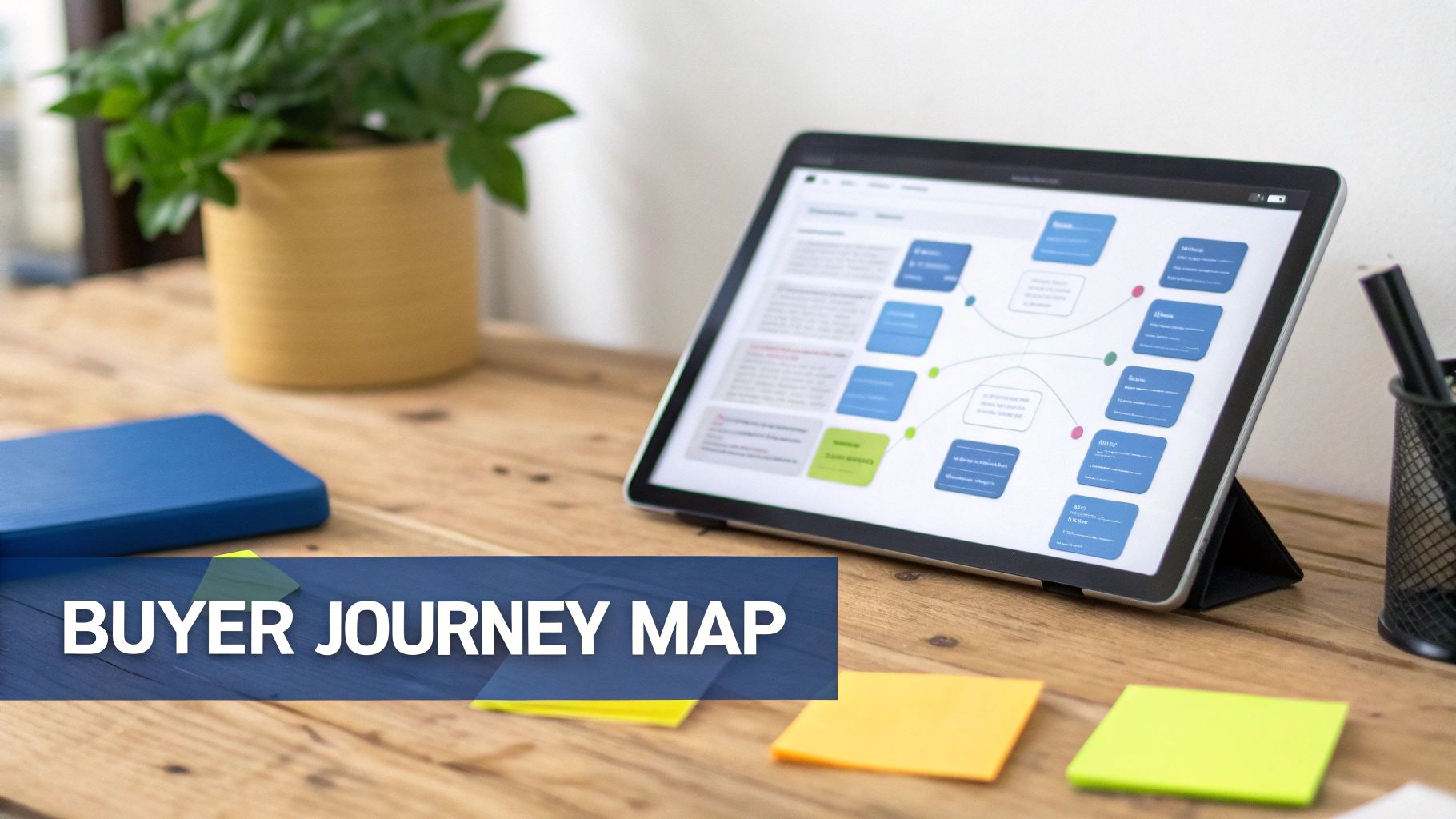
An effective inbound program is not built on random acts of marketing. It is a deliberate, strategic system engineered around the modern B2B buyer’s decision-making process. The goal is to design a pathway that naturally guides qualified prospects toward a sales conversation.
The cornerstone of this approach is a deep understanding of the buyer’s journey. This map traces every step a potential customer takes, from initial problem awareness to a final purchase decision. For RevOps professionals, mapping this journey is non-negotiable. It is the framework for delivering the right information at the right time, building trust with every interaction.
Mapping Content to the Buyer Journey
The B2B buyer’s journey is not linear, but it generally unfolds across three key stages. Each stage represents a different mindset and requires a distinct type of content to maintain engagement and guide the prospect forward.
1. The Awareness Stage
At the top of the funnel, prospects are experiencing the symptoms of a problem but may not have a name for it. They seek educational content, not a sales pitch. Your content should focus on their challenges, not your product features.
- Content Examples: Blog posts (“5 Signs Your Lead Routing Is Inefficient”), infographics, short explainer videos, or downloadable checklists.
- Goal: Attract a broad segment of your Ideal Customer Profile (ICP) and help them diagnose their core problem.
2. The Consideration Stage
Having defined their problem, prospects now actively research potential solutions. They are comparing different approaches and methodologies. At this point, you can introduce your company as a viable solution, positioning yourself as a helpful expert.
- Content Examples: In-depth guides, expert-led webinars, detailed case studies, or solution comparison sheets.
- Goal: Nurture leads by providing solution-focused content that establishes your credibility and expertise.
3. The Decision Stage
At the bottom of the funnel, the prospect has a shortlist and is ready to make a purchase decision. Content must be laser-focused on your solution, addressing any final concerns and demonstrating clear value.
- Content Examples: Product demonstrations, free trial offers, implementation guides, and transparent pricing pages.
- Goal: Convert highly qualified leads into customers by clearly articulating the value and ROI of your solution.
Aligning content to the buyer journey creates a seamless, logical progression that nurtures prospects from initial awareness to a final decision.
Building Authority with Pillar Pages and Topic Clusters
To dominate search results for topics relevant to your buyers, scattered blog posts are insufficient. The pillar page and topic cluster model is a powerful content architecture that signals deep expertise to both users and search engines.
This strategy transforms your website from a collection of articles into a meticulously organized knowledge hub. You establish your brand as the definitive resource on core subjects, making your site the first destination for your ICP’s most critical questions.
Here’s the breakdown of this SEO-driven model:
- Pillar Page: A comprehensive, in-depth guide covering a broad topic central to your business (e.g., “The Ultimate Guide to Revenue Operations”).
- Topic Clusters: A collection of more targeted articles that explore specific subtopics related to the pillar (e.g., “Lead Scoring Best Practices,” “Building Salesforce Dashboards,” “Marketing Attribution Models”).
Each cluster article links back to the central pillar page, creating a dense network of internal links that signals authority to search engines like Google. A robust search engine optimization (SEO) strategy is the engine of inbound lead generation, and this content model is a critical component. It helps your most important content rank for high-value keywords, driving a steady stream of qualified traffic and improving user experience.
Putting Your Lead Capture and Management into Action
A powerful content strategy is only effective if supported by robust backend systems for capturing, processing, and managing leads. For Revenue Operations, this is where strategy translates into revenue. The objective is to build a seamless, automated system that guides a prospect from website visitor to sales-ready opportunity with minimal manual intervention.
This process is the critical bridge between marketing engagement and sales conversation. A slow, clunky, or broken process means even the highest-quality leads will go cold. Data confirms this: a follow-up delay of just five minutes can reduce the odds of qualifying a lead by 10 times.
Designing High-Converting Forms and Landing Pages
Your forms and landing pages are the primary conversion points for your inbound lead generation engine. Every element must be optimized to encourage action. A cluttered landing page or an overly long form will deter even the most interested prospects.
The goal is to create a frictionless value exchange. An effective landing page has a single, clear purpose driven by a compelling call-to-action (CTA). Its messaging must align perfectly with the ad or link that brought the visitor there. All distractions—such as main navigation, social media icons, or extraneous links—should be removed.
When designing forms, less is more, especially at the first touchpoint. For teams using platforms like HubSpot or Salesforce Marketing Cloud Account Engagement (MCAE), progressive profiling is a critical feature. It allows you to request new information each time a known contact engages, enabling you to build a rich profile over time without overwhelming them.
- First Touch (e.g., Blog Subscription): Request only an email address.
- Second Touch (e.g., Webinar Registration): Request first name, last name, and company.
- Third Touch (e.g., Gated Guide Download): Request job title and company size.
This phased approach respects the visitor’s time while systematically gathering the data your sales team needs for effective qualification.
Automating Lead Enrichment and Data Hygiene
When a lead submits a form, the operational clock starts. The initial information provided is just a starting point. To properly qualify and route that lead, you need additional context, such as company size, industry, revenue, and technology stack. Requiring your sales development representatives (SDRs) to manually research this information is an inefficient use of their time.
This is where automated lead enrichment tools are essential. By integrating solutions like ZoomInfo, Clearbit, or a flexible data orchestration platform like Clay, you can append valuable data points to new lead records in your CRM the moment they are created.
A lead with just a name and email is a mystery. An enriched lead with firmographic and demographic data is an opportunity. Automation makes this happen in seconds, not hours.
This process is not just about adding data; it’s about ensuring data quality. Automated workflows can standardize job titles, format addresses, and validate company domains, resulting in a clean, reliable dataset that fuels your entire operational flow.
Implementing Robust Lead Scoring and Routing
Not all inbound leads are created equal. Some are casually browsing, while others are prepared for an immediate sales conversation. Lead scoring is the system that differentiates them. By assigning points based on demographic fit and behavioral engagement, you can establish a clear threshold that defines a Marketing Qualified Lead (MQL).
A well-designed scoring model evaluates both explicit and implicit signals:
- Explicit Scoring (Fit): Points are awarded for data that aligns with your Ideal Customer Profile (ICP), such as job title (+20 for “VP of Marketing”), industry (+15 for “SaaS”), or company size (+10 for “100-500 employees”).
- Implicit Scoring (Engagement): Points are assigned for actions demonstrating buying intent, such as visiting the pricing page (+10), downloading a case study (+15), or attending a product webinar (+25).
To refine your scoring model, review our guide on lead scoring best practices.
Once a lead reaches the MQL threshold (e.g., 100 points), automation takes over. This is the handoff. In your CRM, whether it’s Salesforce or HubSpot, a workflow should instantly change the lead’s status, create a task, and assign it to the correct sales representative based on predefined rules like territory, industry, or company size. This ensures your highest-intent leads are actioned in real-time, maximizing conversion potential.
Integrating Your MarTech Stack for Seamless Data Flow
The effectiveness of your inbound lead generation engine depends on its technical foundation. A collection of powerful but disconnected systems creates data silos, inaccurate attribution, and a disjointed customer experience. To build a scalable inbound program, a tightly integrated MarTech stack is essential for ensuring a free and accurate flow of information between platforms.
Your marketing automation platform and CRM are the core of your revenue operations. A seamless connection ensures that marketing activities directly inform sales conversations, creating a single source of truth for every prospect and customer interaction. This is a strategic necessity, not just a technical convenience. Synchronized data allows marketing to measure pipeline contribution, sales to gain real-time context, and leadership to trust revenue forecasts.
Mastering the HubSpot and Salesforce Connector
For B2B companies utilizing both HubSpot and Salesforce, the native connector is the critical bridge between marketing and sales. When configured correctly, it establishes a powerful bidirectional sync that maintains data alignment across both systems. However, a “set it and forget it” approach can lead to significant data integrity issues.
The first step is meticulous object mapping. You must define precisely how HubSpot Contacts, Companies, and Deals correspond to Salesforce Leads, Contacts, Accounts, and Opportunities.
Key mapping considerations include:
- Inclusion Lists: Use active lists in HubSpot to control exactly which records sync to Salesforce. This is your primary defense against populating the CRM with low-quality or unengaged marketing contacts.
- Field Mappings: Ensure custom properties in HubSpot are correctly mapped to their corresponding fields in Salesforce. This is vital for transferring critical context like lead scores and original source data.
- Sync Rules: Determine which system serves as the source of truth in case of a data conflict. For example, you might decide that once a lead is in Salesforce, updates from the sales team should always take precedence.
Aligning MCAE with Sales Cloud for Campaign Cohesion
For teams embedded in the Salesforce ecosystem, integrating Marketing Cloud Account Engagement (MCAE, formerly Pardot) with Sales Cloud is fundamental. This native connection is designed to create a cohesive go-to-market motion where marketing and sales activities are tightly aligned.
The objective is to provide sales representatives with a complete view of a prospect’s marketing engagement directly within the Salesforce interface. This involves configuring the Engagement History component on Lead and Contact page layouts, allowing reps to see every email open, form submission, and content download at a glance.
A successful integration empowers sales with marketing intelligence. When a rep can see that a prospect just attended a webinar on a specific feature, their follow-up call transforms from a cold interruption into a relevant, timely conversation.
Properly configuring Connected Campaigns is also non-negotiable. This feature links Pardot campaigns to Salesforce campaigns, which is essential for accurate ROI reporting and multi-touch attribution. It allows RevOps leaders to track how marketing investments translate into pipeline and closed-won revenue, all within Salesforce. If you need to optimize this connection, our experts can guide you through the complexities of CRM and marketing automation integration.
Leveraging APIs for a Complete Customer View
While native connectors manage your core CRM and marketing automation platforms, your inbound ecosystem often includes other critical tools. Webinar platforms, event management software, or third-party data enrichment sources like Clay all contain valuable prospect data.
This is where custom Application Programming Interface (API) integrations become essential. An API acts as a secure data messenger, enabling different applications to communicate and share information automatically. For example, an API connection could instantly create a campaign member in Salesforce whenever someone registers for a webinar.
This level of integration allows you to build a true 360-degree view of the customer journey. Every touchpoint, whether on your website or a third-party platform, is captured and centralized in your CRM. This unified dataset is the foundation for accurate reporting, sophisticated segmentation, and a personalized customer experience.
Measuring Inbound Performance and Proving ROI
For RevOps professionals, vanity metrics like clicks and impressions are insufficient. The primary goal is revenue. If your inbound lead generation program cannot demonstrate a clear connection between its activities and the bottom line, it is not delivering strategic value. This requires a shift from surface-level metrics to the KPIs that define Go-to-Market (GTM) success.
Your dashboards, whether in Salesforce or HubSpot, must tell a story about pipeline generation, deal velocity, and cost-efficiency. This approach transforms marketing from a cost center into a predictable revenue engine, providing the data needed to optimize investments and scale successful initiatives.
From Vanity Metrics to Revenue KPIs
To demonstrate inbound’s true value, you must connect marketing actions directly to sales outcomes. These are the metrics that resonate with the C-suite and justify further investment in your inbound strategy.
Every RevOps team should prioritize these KPIs on their main dashboard:
- Marketing Qualified Lead (MQL) to Sales Qualified Lead (SQL) Conversion Rate: This is the ultimate test of lead quality. A high conversion rate indicates that marketing is attracting the right audience and the sales handoff is efficient.
- Pipeline Velocity: This measures the speed at which deals move from creation to closed-won. Effective inbound content should educate prospects, shortening the sales cycle and increasing velocity.
- Customer Acquisition Cost (CAC): Analyze CAC by inbound channel (e.g., organic search vs. paid social) to identify the most efficient sources. The objective is to consistently lower this cost without compromising lead quality.
- Lead-to-Close Rate by Channel: This metric reveals where your best customers originate. Knowing that leads from organic search close at a 14.6% rate, compared to just 1.7% for outbound leads, provides a clear directive for budget allocation.
Focusing on these metrics provides a robust business case for your inbound program.
RevOps isn’t just about reporting on what happened last quarter. It’s about engineering a more profitable future. The right metrics are the blueprint for optimising every single stage of the funnel.
Choosing the Right Attribution Model
Attribution is the methodology for assigning credit to the marketing touchpoints a prospect interacts with before becoming a customer. Selecting the right model in your CRM or marketing automation platform is crucial for understanding the ROI of your inbound efforts. Given the complexity of B2B sales cycles, a simple single-touch model is often inadequate.
Here are the most common attribution models:
| Attribution Model | How It Works | Best For |
|---|---|---|
| First-Touch | Gives 100% of the credit to the very first interaction, such as a blog post that brought a new contact into your database. | Understanding which channels are most effective at generating new top-of-funnel leads. |
| Last-Touch | Assigns 100% of the credit to the final interaction before conversion, such as a demo request form submission. | Identifying your most powerful bottom-of-funnel conversion assets. |
| Multi-Touch (e.g., U-Shaped, W-Shaped) | Distributes credit across multiple key milestones, such as the first touch, lead creation, and opportunity creation. | Gaining a balanced and realistic view of the entire buyer journey, valuing both awareness and conversion tactics. |
For most B2B organizations, a multi-touch attribution model is the recommended approach. It reflects the reality that multiple marketing efforts contribute to closing a deal. This holistic view enables smarter budget decisions and continuous optimization of your inbound engine.
Avoiding Common Inbound Lead Generation Pitfalls
Even well-designed inbound strategies can fail. Common, avoidable mistakes can derail a potentially powerful lead generation engine, resulting in wasted budget, frustrated teams, and missed revenue targets. By understanding these potential pitfalls, you can build a more resilient and scalable inbound program from the outset.
Misaligning Content and Journey
A frequent error is creating content in a vacuum, disconnected from the buyer’s journey stage. Teams often produce content they find interesting rather than what prospects need to advance. This leads to top-of-funnel blog posts with premature sales pitches or generic bottom-of-funnel case studies that fail to influence a decision.
The solution is disciplined content mapping. Before writing, define three key elements for each asset:
- Target Persona: Who is the specific audience for this piece?
- Journey Stage: Is this person in the awareness, consideration, or decision stage?
- Key Question: What specific problem does this content solve for that persona at that stage?
This framework ensures every asset has a clear purpose, transforming your content from a random collection of articles into a cohesive pathway that guides prospects through the funnel.
Tolerating a Sloppy Handoff
The transition of a lead from marketing to sales is a critical moment where opportunities are won or lost. A slow, manual, or poorly defined handoff process can cause high-intent leads to go cold. This is the operational black hole where a significant number of viable opportunities disappear.
To eliminate this friction, establish a formal Service-Level Agreement (SLA) between marketing and sales. An SLA is a clear contract that defines marketing’s deliverable (e.g., a sales-ready MQL) and sales’ commitment to act on it within a specified timeframe.
An SLA isn’t just a document; it’s a pact between marketing and sales. It turns the handoff from a hopeful toss over the fence into a precise, automated, and measurable process built on mutual accountability.
This agreement should be operationalized in your CRM through automation. As soon as a lead meets the MQL criteria, a workflow should trigger instantly—assigning the lead, creating a task for the representative, and starting the SLA timer. This removes ambiguity and ensures no inbound lead is neglected.
Frequently Asked Questions
When implementing an inbound lead generation strategy within a tech stack like Salesforce and HubSpot, practical questions inevitably arise. Here are answers to some of the most common inquiries from RevOps professionals.
How Long Does Inbound Lead Generation Take to Show Results?
This is a critical question that requires managing expectations. While paid campaigns can generate leads quickly, a true inbound marketing strategy is a long-term investment.
Initial traction, such as an increase in organic traffic and a small flow of leads, can often be seen within 3-6 months as content begins to rank. However, building a predictable, scalable engine that consistently delivers qualified leads typically takes 6-12 months of consistent, high-quality effort. Inbound marketing is about building a valuable asset, not just running a short-term campaign.
Is HubSpot or Salesforce More Important for B2B Inbound Success?
This question frames the platforms as competitors, which is an inaccurate perspective. They are complementary systems, each excelling in different areas of the customer lifecycle. HubSpot is a dominant force at the top and middle of the funnel, excelling at attracting website visitors and converting them into marketing-qualified leads (MQLs).
Conversely, Salesforce is the industry standard for managing the bottom of the funnel. It is purpose-built for handling complex sales cycles, pipeline management, and customer relationships once a lead becomes sales-qualified. The optimal strategy is not to choose one over the other but to integrate them tightly to ensure a seamless data flow from marketing to sales.
How Can a Small RevOps Team Manage a Full Inbound Program?
For small teams, success depends on strategic focus and intelligent automation. You cannot afford to be everywhere at once.
Instead of attempting to master every channel and content format, concentrate your efforts. Identify one or two channels where your ideal customers are most active—such as LinkedIn and organic search—and commit to dominating them. Create a comprehensive “pillar” content asset, like an in-depth guide, and then repurpose it into smaller assets like blog posts, social media updates, and email content.
Leverage the automation capabilities within your marketing platform. Use workflows for lead nurturing, scoring systems to identify engagement, and automated alerts to notify sales when a lead is ready for a conversation. A few efficient, repeatable processes will always outperform numerous scattered and incomplete initiatives.
Ready to build a high-performance inbound engine that delivers measurable ROI? The team at MarTech Do specializes in auditing, implementing, and optimizing the Salesforce and HubSpot stacks that power B2B growth. Schedule a consultation with us today.