

In Revenue Operations, a metric in marketing is a quantifiable measure of performance. It's the data that validates whether your GTM strategy is hitting its mark, from initial lead generation to closed-won revenue. For B2B companies using platforms like Salesforce and HubSpot, the only metrics that truly matter are those directly traceable to revenue.
Moving Beyond Vanity Numbers in B2B Marketing

If you're leading a B2B RevOps team, you know there's a critical difference between being busy and being productive. Clicks, likes, and social media followers—what are often called vanity metrics—can create a dangerous, false sense of progress. They demonstrate activity, but they don't confirm if that activity generates pipeline or revenue.
Think of it this way: reorganizing files on a desktop is not the same as closing a deal. The challenge for modern marketing operations is to shift focus from metrics that feel good to metrics that do good for the bottom line. It's time to stop asking, "How many people saw our ad?" and start asking, "How much qualified pipeline did that ad create?"
In a sophisticated B2B operation, every metric should be a navigational instrument pointing toward predictable revenue. Everything else is noise.
Adopting a Revenue-Centric Measurement Mindset
Adopting a revenue-centric approach transforms the entire go-to-market function. It aligns marketing, sales, and service teams around shared objectives, measuring success in terms that directly impact the business. This is where your tech stack—specifically your CRM and marketing automation platforms like Salesforce and HubSpot—becomes your operational command center.
Instead of analyzing isolated data points, you begin connecting activities along the entire buyer's journey. A properly engineered measurement framework helps you answer critical business questions:
- Which campaigns generate leads that sales can actually close?
- How efficiently are we moving deals through our pipeline, from initial lead to signed contract?
- What is marketing's impact on customer lifetime value?
A practical first step away from vanity metrics is to focus on how to improve website conversion rates. This simple shift moves your attention from raw traffic volume to the quality of that traffic and how effectively you're engaging it.
When you configure your systems to track these deeper, more meaningful metrics, you convert a jumble of data into a clear roadmap for growth. This is the foundation of modern RevOps—turning insights into decisions that drive revenue.
How to Build a Full-Funnel RevOps Metrics Framework
An effective metrics strategy provides a complete, panoramic view of the customer journey, not just isolated snapshots. To achieve this, you need a structured framework that connects every marketing metric to the full lifecycle, from the first touchpoint to the final sale and beyond. This ensures every marketing dollar and effort ties directly back to a revenue outcome.
Your customer journey is an operational process. Prospects enter as inputs, and loyal customers emerge as outputs. A full-funnel framework acts as your quality control system, with checkpoints at every stage. It helps pinpoint exactly where processes are slowing down or breaking, providing the visibility needed to fine-tune your entire revenue engine.
This approach organizes your Key Performance Indicators (KPIs) into logical categories that map directly to your Revenue Operations (RevOps) goals. By aligning metrics with specific funnel stages, you create a shared language between marketing and sales, ensuring all teams are working toward the same objective.
Top-of-Funnel (ToFu): Demand Generation Metrics
The top of the funnel is about casting a precise net to attract your ideal customer profile and generate initial interest. The primary objective is to build awareness and capture new leads. Success is measured by how well you attract qualified traffic and convert anonymous visitors into known contacts within your CRM, whether it's Salesforce or HubSpot.
However, volume alone is not the goal; you are pursuing the right kind of attention. Every ToFu metric should signal quality and relevance, not just empty activity.
Key ToFu metrics to watch:
- Website Sessions by Source: This reveals how visitors find you (e.g., Organic Search, Paid Social, Referral). It’s your compass for understanding which channels are performing.
- Cost Per Lead (CPL): This calculates the marketing spend required to acquire one new lead, providing a clear indicator of campaign efficiency.
- Lead Volume: The total number of new contacts generated in a specific period, which should always be segmented by campaign or channel to understand what's driving growth.
Middle-of-Funnel (MoFu): Lead Qualification Metrics
Once a lead is in your system, the focus shifts to nurturing and qualification. The middle of the funnel is where you determine who is genuinely interested and ready for a sales conversation. This is a critical handoff point, and your metrics must reflect tight alignment between your marketing and sales teams.
This is where platforms like Salesforce Marketing Cloud Account Engagement (MCAE) or HubSpot truly shine, with lead scoring and automated nurturing workflows. The goal is to efficiently guide prospects from initial interest to being fully sales-ready.
MoFu metrics that matter most:
- Marketing Qualified Leads (MQLs): The number of leads meeting predefined criteria—such as firmographics, engagement levels, or intent signals—deemed ready for sales engagement.
- MQL-to-SQL Conversion Rate: The percentage of MQLs that sales accepts as Sales Qualified Leads (SQLs). This is a crucial health check on lead quality and the marketing-sales handoff process.
- Lead Nurture Engagement Rate: Analyze metrics like email open rates, click-throughs, and content downloads within your nurture sequences as indicators of continued interest.
Bottom-of-Funnel (BoFu): Conversion and Revenue Metrics
This is where marketing efforts translate into revenue. Bottom-of-the-funnel metrics provide the ultimate proof of marketing's impact by directly connecting campaigns to closed business. For any B2B RevOps leader, this is the most critical stage because it demonstrates undeniable ROI.
These BoFu metrics are tracked directly within your CRM, linking marketing activities to specific sales opportunities and revenue. A well-optimized tech stack, like an integrated Salesforce and HubSpot environment, makes this level of tracking possible. Our clients often see sales increases of 40-300% within months, driven by refined conversion funnels and high-quality leads from these tightly integrated systems. You can learn more about how top digital marketing agencies drive growth.
Essential BoFu metrics you can't ignore:
- Pipeline Velocity: This measures the speed at which deals move through your sales pipeline from creation to close. Higher velocity indicates a more efficient and predictable revenue cycle.
- Customer Acquisition Cost (CAC): The total sales and marketing cost required to acquire a new customer.
- Closed-Won Revenue: The ultimate marketing metric. This is the total revenue generated from new customers within a specific timeframe, proving the value of your work.
To consolidate this, the following table breaks down metrics by their place in the funnel.
The B2B RevOps Metrics Funnel
This table breaks down key metrics by funnel stage to help teams align their measurement strategy with the customer journey.
| Funnel Stage | Objective | Key Metrics (Examples) | Relevant Platform |
|---|---|---|---|
| Top-of-Funnel (ToFu) | Build awareness & capture new leads | Website Sessions, Cost Per Lead (CPL), Lead Volume by Source | Google Analytics, HubSpot, SEMrush |
| Middle-of-Funnel (MoFu) | Nurture leads & identify sales-readiness | MQLs, MQL-to-SQL Rate, Nurture Engagement Rates | HubSpot, MCAE (Pardot) |
| Bottom-of-Funnel (BoFu) | Convert opportunities & generate revenue | Pipeline Velocity, Customer Acquisition Cost (CAC), Closed-Won Revenue | Salesforce, HubSpot CRM |
Using this funnel-based approach ensures that no part of the customer journey is left unmeasured, giving you a clear path from initial click to closed deal.
Bringing Your KPIs to Life in Salesforce and HubSpot
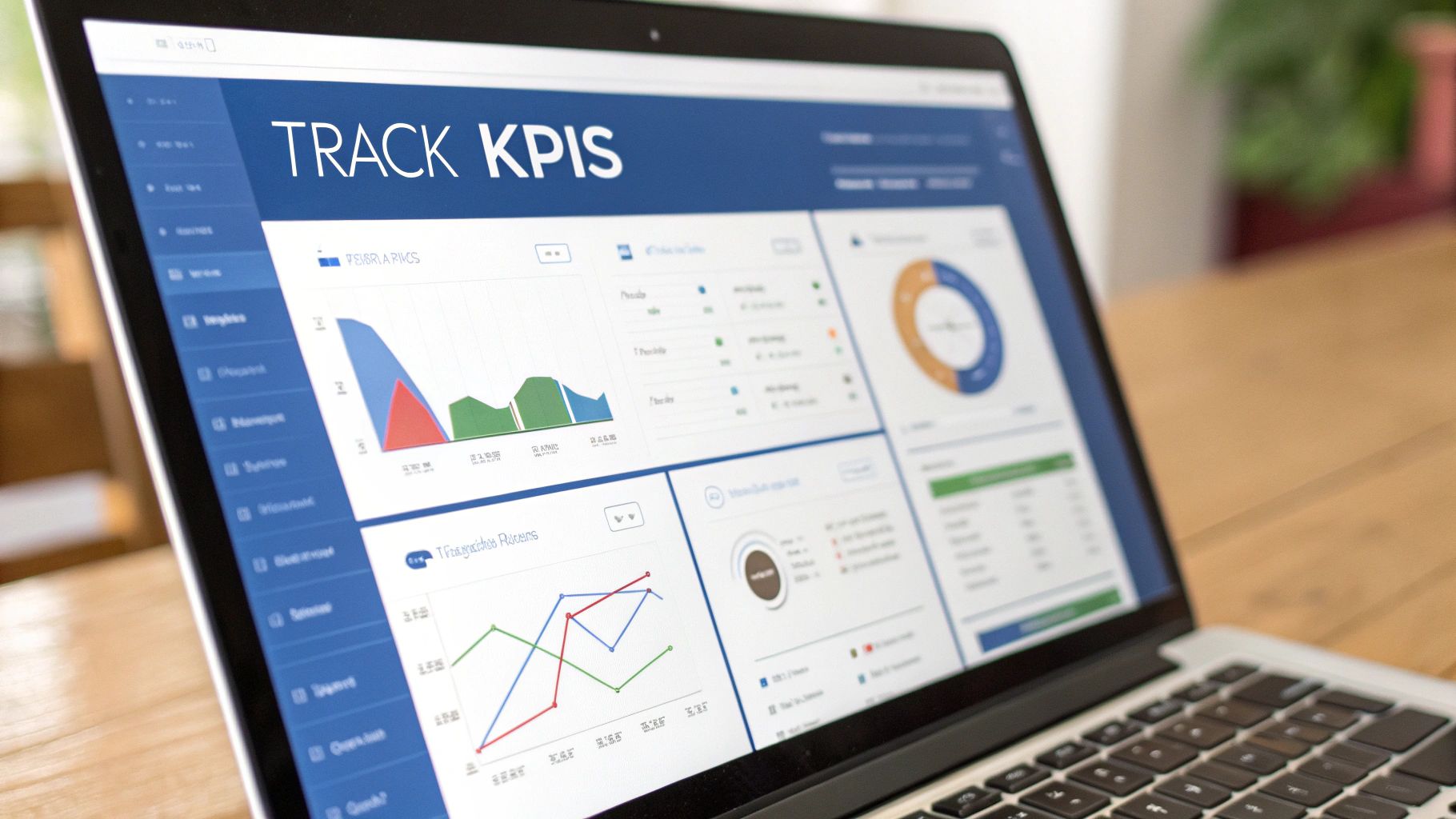
A solid metrics framework is one thing on paper, but operationalizing it within your tech stack is another. Your Salesforce and HubSpot platforms are more than digital filing cabinets—they are powerful analytics engines awaiting the right instructions. This is where strategy becomes execution, turning abstract goals into tangible, trackable KPIs.
The real value is realized when you move beyond default settings to build reports and dashboards that directly answer your most pressing business questions. A well-configured CRM doesn't just store data; it tells a story about what’s working, what isn’t, and where your next revenue opportunity lies.
Building Your Foundation in Salesforce
For most B2B revenue teams, Salesforce is the system of record. It is the ideal platform for measuring bottom-of-funnel activity, where marketing efforts convert into revenue. However, a word of caution: inconsistent data entry is the number one killer of reliable dashboards. Before building a single report, ensure your data is clean and your processes are standardized.
With data hygiene established, you can connect marketing campaigns to sales outcomes. This requires understanding how objects like Campaigns, Leads, Contacts, and Opportunities interrelate.
Here are a few reports you absolutely must have:
- Leads by Source Over Time: A foundational marketing report showing which channels (e.g., Organic Search, Paid Social, Events) are generating inbound leads. It guides decisions on where to allocate marketing spend.
- Campaign Influence Reports: This is how you prove marketing’s direct contribution to pipeline. By properly associating contacts with campaigns, you can build reports showing which initiatives influenced or sourced the most valuable deals.
- MQL to Closed-Won Conversion Rates: This report tracks the entire journey from a marketing-qualified lead to a closed deal. It’s a critical metric in marketing that reveals not just the quantity of your leads, but their quality and the efficiency of your sales process.
Getting the Full Picture with HubSpot's Reporting
While Salesforce excels at bottom-of-funnel metrics, HubSpot’s reporting tools are ideal for tracking top- and middle-funnel activities. Its strength lies in connecting website behavior, email engagement, and content performance.
Within HubSpot, you can quickly build custom reports that provide a clear pulse on your marketing engine’s health. The platform's analytics are designed for accessibility, enabling you to identify high-performing blog posts or landing pages without a data science background.
The goal is to create a seamless data flow from the first website visit in HubSpot to the final closed deal in Salesforce. This closed-loop reporting is the foundation of any successful RevOps strategy.
A few essential HubSpot reports to add to your dashboard:
- Landing Page Performance: Monitor views, form submissions, and conversion rates for key landing pages. This data indicates which offers and CTAs are resonating with your audience.
- Contact Creation by Source: Similar to the Salesforce report, this metric in marketing helps you understand which channels are most effective at converting anonymous website visitors into known contacts.
- Email Marketing Performance: Look beyond open rates. Analyze click-through rates and, more importantly, the number of new contacts or MQLs generated from specific email campaigns or nurture sequences. This data is invaluable for optimizing your communication strategy.
Ultimately, tracking every important metric in marketing within your tech stack creates a single source of truth. When Salesforce and HubSpot are configured correctly and integrated seamlessly, they provide a 360-degree view of the entire customer journey. This visibility empowers your team to make smarter, data-driven decisions that accelerate growth.
If you want to translate these numbers into financial impact, our guide on how to measure marketing ROI is the perfect next read.
Choosing the Right Attribution Model to Credit Revenue
You’re tracking all the right metrics. But now for the critical question: which marketing interaction gets credit when a deal closes? This is where attribution modeling comes in—a step where many RevOps strategies falter.
An incorrect attribution model can lead to misallocated budgets, where you overinvest in campaigns that look good on the surface while underfunding those quietly driving results.
Attribution is the process of assigning value to the marketing touchpoints—a blog post, a webinar, a paid ad—that influenced a prospect's decision to buy. It's about understanding the "why" behind a conversion.
Comparing Common Attribution Models
Different models tell different stories about the customer journey. Some are simple and immediate, while others provide a richer, more accurate picture. The key is to select the model that aligns with your customer's buying process.
For a deeper dive into the mechanics, you can explore this guide on Attribution Modeling.
Let's use a relay race analogy:
First-Touch Attribution: This model gives 100% of the credit to the first interaction—the initial blog post read or the first ad clicked. It’s effective for understanding what captures initial attention but ignores all subsequent engagement.
Last-Touch Attribution: The opposite approach, giving 100% of the credit to the final touchpoint before conversion, such as a demo request. This model is useful for identifying what closes deals but overlooks the nurturing that brought the lead to that point.
While simple, single-touch models like First-Touch or Last-Touch often paint a dangerously incomplete picture. They completely ignore the crucial nurturing and engagement that happens in the middle of a long B2B buying journey.
- Multi-Touch Attribution: This is where you gain a true understanding of teamwork. Multi-touch models distribute credit across multiple touchpoints, recognizing that it takes several interactions to win a deal. This approach provides a more honest and complete view of marketing performance. For a more detailed breakdown, we have a comprehensive guide on what is multi-touch attribution.
Putting Your Model into Action in Salesforce and HubSpot
The good news is that these models can be implemented directly within your core platforms.
In Salesforce, you’ll want to utilize Campaign Influence reports. This feature allows you to associate multiple campaigns with a single opportunity, enabling you to build custom models. For instance, you could create a model that gives more weight to the campaign that created the lead and the one that was touched just before the deal was won.
In HubSpot, the attribution reporting tools are incredibly powerful for connecting marketing activities directly to revenue. You can build reports using various models like Linear (even credit to all), U-shaped (credit to first and last), or W-shaped (credit to first, middle, and last touches). This is perfect for seeing which blog posts, landing pages, or social campaigns are actually influencing your pipeline.
Ultimately, selecting an attribution model is a strategic decision, not just a technical one. A company with a short sales cycle might find Last-Touch sufficient. However, for a complex, year-long buying process, a multi-touch model is essential to see the full story.
The goal is to gain a clear, defensible understanding of which marketing efforts are driving business forward. That's how you make smarter investments and more confident decisions.
Designing RevOps Dashboards That Actually Drive Action

Raw data is useless on its own. A spreadsheet full of numbers, while technically accurate, won't inspire your team or guide executive strategy. The value of RevOps lies in transforming that raw data into clear, compelling visual dashboards that stakeholders want to use.
A great dashboard is more than a report card on past performance. It’s a real-time command center for your entire revenue team, providing a clear view of the present and helping you navigate what's next. Whether you're in Salesforce or HubSpot, this is where critical business questions should be answered at a glance.
The most common mistake is the "one-size-fits-all" data dump. To make dashboards effective, you must build them for the end-user. It’s about delivering the right information to the right person at the right time.
Tailoring Dashboards to Your Audience
Every role in your revenue engine has a different function, which means they need to view performance through a different lens. A dashboard that tries to serve everyone serves no one. The first rule of effective dashboard design is simple: build for a specific user.
Consider the distinct perspectives of your key stakeholders:
- For the CMO: They require a big-picture view of marketing's overall business contribution. Their dashboard should highlight metrics like Marketing ROI, Customer Lifetime Value (LTV), and Pipeline Sourced by Marketing.
- For the Sales Manager: They are focused on team performance and pipeline health. Their view must be tactical, zeroing in on MQL-to-SQL Conversion Rates, Pipeline Velocity, and Team Quota Attainment.
- For the Marketing Ops Manager: This role is focused on the underlying systems—campaign execution and data integrity. Their dashboard tracks operational metrics like Lead Source Accuracy, Database Growth, and Lead Response Time.
When you design for the end-user, every chart and report has a purpose. It directly supports their goals, making the data relevant and immediately useful. This is how you shift reporting from a backward-looking chore to a forward-looking tool for decision-making.
Structuring Dashboards for Clarity and Insight
Once you know who you're building for, the next step is structuring the information to tell a coherent story. A well-designed dashboard guides the eye from high-level outcomes down to the individual drivers, making it easy to spot trends and diagnose problems before they escalate.
A simple yet powerful way to organize your dashboard is to follow the funnel. Place top-level outcomes in the top-left corner, then move to more granular, diagnostic metrics as you go down and to the right.
An effective dashboard doesn't just present data; it answers questions. It should anticipate the user's next thought, providing the context they need to understand not just 'what' happened, but 'why'.
Picture a sales manager's dashboard laid out this way:
- Top-Level Outcome: A prominent KPI showing the team's progress toward the quarterly quota.
- Pipeline Health: Charts breaking down Open Pipeline by Stage and Pipeline Velocity, answering, "Do we have enough in the works to hit our number?"
- Leading Indicators: Reports on New Opportunities Created and MQLs Accepted, which represent tomorrow's pipeline.
- Activity Metrics: A leaderboard tracking calls, emails, and meetings logged by each rep, providing a clear view of effort and engagement.
This logical flow allows a manager to see in seconds if they are on track and, if not, to drill down instantly to identify the problem. The reporting engines in Salesforce and HubSpot are built for this kind of customization. For a deep dive, check out our specialized guide on building a dashboard in Salesforce.
And don't forget content marketing—it remains a massive engine for B2B lead generation, and its metrics deserve a spot on your dashboards. In fact, a staggering 87% of marketers say content is a key driver of demand and leads. With global content revenue projected to rocket from $72 billion in 2023 to over $140 billion by 2026, you simply can't afford to ignore its impact.
By designing dashboards with intent and purpose, you bring your whole revenue team together around a single source of truth. You empower them to make the data-driven decisions that fuel real, sustainable growth.
Common Measurement Pitfalls and How to Avoid Them
Even the most sophisticated RevOps teams can fall into common measurement traps. These aren't minor errors; they are systemic issues that drain budgets, misalign teams, and lead to flawed strategic decisions. Recognizing these pitfalls is the first step toward building a measurement framework you can trust to guide your growth.
The goal is to build a measurement system so reliable and insightful that it becomes a genuine competitive advantage.
Pitfall 1: The Vanity Metrics Trap
This is a classic pitfall for a reason. Chasing numbers that look impressive in a presentation but lack substance—like raw website traffic or social media followers—is a recipe for inefficiency. This is where you mistake activity for progress, focusing on metrics with no clear connection to revenue. Celebrating a spike in website visitors is meaningless if none of them convert into qualified leads.
What to do instead: Every metric in marketing you track must have a clear, direct line to a business outcome.
- Stop obsessing over total website traffic and start measuring Marketing Qualified Leads (MQLs) generated by source.
- Forget celebrating social media likes and focus on the conversion rate from social campaigns to demo requests.
- Move past reporting on email open rates and track the pipeline influenced by specific nurture sequences.
If you can't tie a metric back to pipeline or revenue, it's not an indicator of success—it's a distraction. Your dashboards in Salesforce and HubSpot should reflect this relentless focus on the bottom line.
Pitfall 2: Tolerating Dirty CRM Data
Your entire measurement strategy is built on the quality of your CRM data. If your Salesforce or HubSpot instance is plagued by duplicate records, inconsistent lead source values, or incomplete contact profiles, your reports are unreliable. The principle is simple: garbage in, garbage out. This fundamental issue undermines countless RevOps initiatives before they can even begin.
This is a strategic crisis, not just a technical headache. Poor data hygiene makes accurate attribution impossible, skews every conversion rate, and erodes trust between marketing and sales. The demand for professionals who can manage this complexity is surging. For example, California now leads the U.S. in marketing job demand, with a significant need for metrics-savvy experts who can master Salesforce, HubSpot, and attribution to maintain clean, actionable data. You can see more on this trend in this 2025 marketing jobs report.
Pitfall 3: Disconnected Marketing and Business Goals
The final major pitfall is failing to connect marketing's KPIs to the overarching business objectives. When the marketing team operates in a silo, its achievements can seem irrelevant to the C-suite. Reporting a high volume of MQLs is one thing; demonstrating how that volume directly contributed to hitting the quarterly revenue target is far more powerful.
What to do instead: Start with the company's financial goals and work backward. If the business needs to grow revenue by 20%, your role is to translate that into specific, measurable marketing objectives. This alignment ensures your work is always relevant and proves that marketing is not a cost center—it's an essential engine for growth.
Your Top Marketing Metrics Questions, Answered
Let's address some of the most common questions we hear from B2B teams working to refine their marketing measurement. These are the hurdles that frequently arise when implementing a RevOps framework.
What’s the Single Most Important Marketing Metric for a B2B Company?
If you must choose only one, it is the Customer Lifetime Value (LTV) to Customer Acquisition Cost (CAC) ratio. This is not just another metric; it's the ultimate health indicator for your entire go-to-market engine.
It answers the most fundamental business question: are we acquiring customers profitably? A healthy ratio, ideally 3:1 or higher, demonstrates that the value derived from a customer significantly exceeds the cost of acquiring them. It proves your GTM strategy is sustainable and focused on long-term, bottom-line impact.
How Often Should We Be Looking at Our Marketing Dashboards?
The answer depends on the metric. Not all data points require the same level of monitoring. Think of it like driving a car: you check your speedometer constantly, but you only check the engine oil periodically.
Your tactical metrics, like MQL volume or ad clicks, are your speedometer. They change quickly. A weekly review is appropriate for spotting trends and making near-term campaign adjustments.
However, your strategic metrics require a longer-term perspective.
- Pipeline Velocity
- Stage Conversion Rates
- Marketing ROI
These are your engine oil. Daily monitoring will only lead to reactive, and often incorrect, decisions based on normal fluctuations. A monthly or quarterly review provides a clearer picture, enabling meaningful strategic adjustments.
Our Salesforce Data Is a Mess. Where on Earth Do We Start?
This is a common challenge, and the solution is to start with a small, focused scope. Do not attempt to fix everything at once. First, conduct a system audit to understand the current state of your data and processes. You cannot build a reliable dashboard on a shaky foundation.
Identify the most critical data points for your primary KPIs. This includes fields like Lead Source, Opportunity Stage, and Close Date.
You don't need to boil the ocean. Focus on cleaning and standardizing these essential fields first. This targeted approach delivers the fastest impact on reporting accuracy.
Once you have a prioritized list, implement data hygiene processes. Establish validation rules in Salesforce or use de-duplication tools in HubSpot. By prioritizing the data that feeds your most important revenue metrics, you build a foundation of trust and begin generating numbers you can act on with confidence.
Ready to build a measurement framework that drives predictable revenue? The team at MarTech Do specializes in system audits and RevOps implementation for B2B companies using Salesforce and HubSpot. We help you clean up your data, connect your tech stack, and build dashboards you can trust. Get in touch to optimise your revenue operations.