
Before you commit significant budget and team hours to a new MarTech project, you need to answer one critical question: Will this actually work in our environment?
That’s where a Proof of Concept (POC) comes in. It’s a small, controlled experiment designed to test the technical feasibility of a core idea within your specific tech stack. It’s not about building the entire solution; it’s about proving the central hypothesis is viable before committing to a full-scale implementation.
What a Proof of Concept Actually Means in MarTech
In the context of Revenue Operations, a POC is a strategic imperative, not just a technical checkpoint. It’s the difference between a vendor demo in a perfect environment and a real-world test drive in your specific instance of Salesforce or HubSpot.
For B2B teams running on platforms like Salesforce Sales Cloud or HubSpot, a POC validates whether a proposed technology or process change can integrate and perform as expected. This step is non-negotiable when evaluating tools that claim to transform your go-to-market (GTM) strategy, especially those that need to connect with your core CRM and marketing automation platforms like Account Engagement (formerly Pardot).

The Strategic Value of a POC in RevOps
A well-executed POC delivers more than a simple “yes” or “no” on technical viability. It’s a foundational component of effective RevOps management that provides clarity, mitigates risk, and builds stakeholder confidence.
A POC will help you:
- Validate Technical Feasibility: Can that new data enrichment tool sync with your custom objects in Salesforce without data conflicts? A POC provides the definitive answer.
- Mitigate Financial Risk: It prevents significant investment in a platform that is incompatible with your unique business logic or existing MarTech integrations. This saves budget, time, and internal political capital.
- Secure Stakeholder Buy-In: Nothing persuades leadership like empirical data. A successful POC allows you to present evidence of value, replacing vendor promises with tangible results from your own environment.
- Uncover Hidden Complexities: You will almost always discover unexpected system limitations, API constraints, or process gaps during a POC. Identifying these on a small scale is far more manageable than post-launch.
A Proof of Concept provides the hard data needed to make confident, ROI-driven decisions. It shifts the conversation from speculation about what a new solution could do to evidence of what it will do for your revenue engine.
Imagine you’re considering a complete overhaul of your lead nurturing framework in Account Engagement. Instead of rebuilding everything at once, a POC could test a single, high-impact automation path. This isolated test validates the new logic, provides data on its potential impact, and de-risks the larger project.
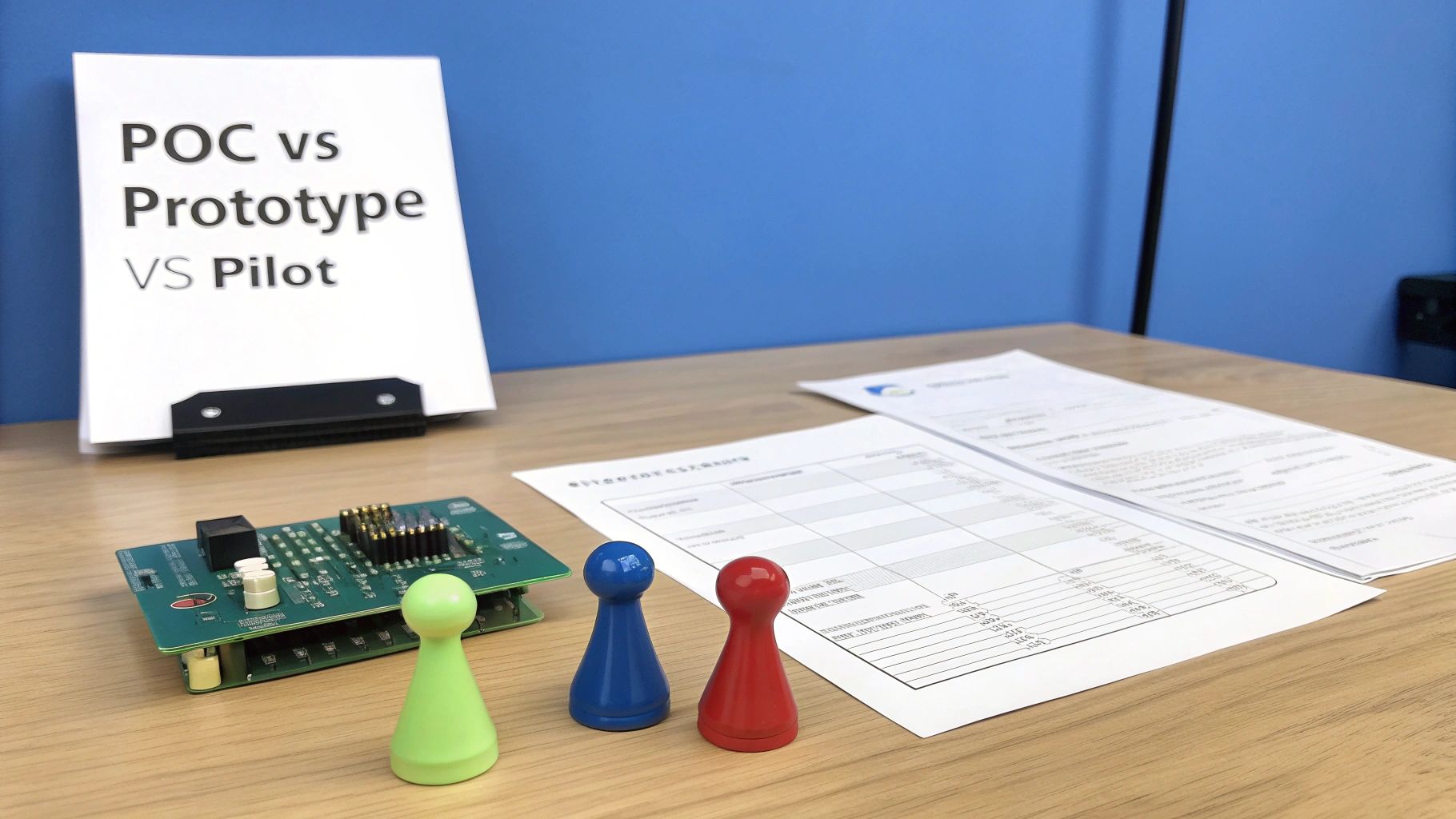
POC vs Prototype vs Pilot: What Is the Difference?
In RevOps and MarTech, precise terminology is critical. Confusing terms like “proof of concept,” “prototype,” and “pilot” leads to misaligned expectations, budget overruns, and failed projects.
Each term answers a distinct question on the journey from idea to implementation. A POC asks, “Is this technically feasible?” A prototype asks, “What will this look and feel like to a user?” And a pilot asks, “How does this solution perform in a real-world operational setting with our team?”
Understanding these distinctions is the first step toward making smarter technology investments and avoiding project failures.
Unpacking the Proof of Concept (POC)
A Proof of Concept (POC) is focused exclusively on technical feasibility. It is a small, controlled experiment, typically conducted by a technical team, to answer a binary yes-or-no question about whether a specific technology or integration can function as required.
It is not designed for end-users and lacks polished UI. Its sole mission is to prove that a critical technical function is achievable before further resources are invested.
- The Core Question: Can this function be built and integrated into our stack?
- A Real-World Example: You want to enrich new leads from your website forms with firmographic data from a third-party tool. The POC would focus only on testing if the tool’s API can successfully connect to your HubSpot instance, retrieve the required data, and write it back to the correct contact properties without errors.
Demystifying the Prototype
Once you have confirmed technical feasibility, the next step is to visualize the user experience. This is the role of a prototype. A prototype is a tangible mockup—a visual or interactive model—that demonstrates the final product’s look and feel to stakeholders.
Prototypes are often non-functional. Users can click buttons and navigate screens, but there is no live data or backend functionality. Its purpose is to gather feedback on usability and design before development begins.
- The Core Question: What will this look and feel like for the user?
- A Real-World Example: Your sales team needs a more intuitive pipeline view. A prototype would be a clickable design of a new dashboard in Salesforce. Sales leaders can interact with the charts and layouts, providing critical feedback on the design before your developers build the complex reports and Lightning components that will power it.
Rolling Out a Pilot Program
After validating the technology (POC) and refining the user experience (prototype), you are ready for a pilot program. This is a limited, live production test.
A pilot involves deploying a fully functional, near-final version of the solution to a small, controlled group of end-users. Their objective is to use it in their daily workflows to identify practical issues, process gaps, and training needs.
- The Core Question: How does our solution perform in a real work environment?
- A Real-World Example: You have built a new automated lead routing system in Salesforce. You would launch a pilot by rolling it out to a single sales team for a 30-day period. Their real-world usage and feedback will uncover hidden process flaws or user adoption challenges, preventing a disruptive company-wide launch.
Understanding the distinction is non-negotiable for effective project management. Launching a pilot when a quick POC would suffice wastes resources. Conversely, relying solely on a POC provides no insight into whether the final product will be adopted by users.
This table clarifies the key differences in a typical RevOps project.
POC vs Prototype vs Pilot Key Differences
| Term | Primary Question Answered | Scope | Typical Output |
|---|---|---|---|
| POC | “Can we technically achieve this?” | Narrow; tests a single, core function. | A technical report or demo confirming viability. |
| Prototype | “What will this look like?” | Visual; focuses on user interface and experience. | A non-functional mockup or wireframe. |
| Pilot | “How will this work for our team?” | Broad; a full-featured solution for a small group. | A working product with user feedback and performance reports. |
By having a firm grasp of the proof of concept meaning and how it differs from a prototype and a pilot, you can set clear objectives, manage stakeholder expectations, and significantly increase your project’s likelihood of success.
When to Run a POC in Your RevOps Strategy
A proof of concept is a strategic decision, not a routine technical check. While not required for minor configuration changes, a POC is indispensable for high-stakes scenarios common in Revenue Operations. It is your primary tool for de-risking major investments in your GTM technology stack.
You initiate a POC when the financial commitment is high, the technology is new to your stack, or the potential impact on revenue-critical processes is significant. It is how you test foundational assumptions safely without disrupting your entire GTM motion.
High-Stakes Integration Projects
Connecting a new platform to your core CRM—whether Salesforce Sales Cloud or HubSpot—is a prime scenario for a POC. The risk extends beyond basic connectivity to the quality, reliability, and performance of the integration under the stress of your specific business processes.
Key examples include:
- Integrating GTM Engineering Tools: Before committing to a platform like Clay.com to orchestrate complex data enrichment and outbound sequences, a POC is essential. It validates that the tool can reliably sync data with Salesforce Leads and Contacts at the required scale and accuracy.
- Connecting Financial and CRM Systems: When implementing a tool like Salesforce Revenue Cloud (CPQ & Billing), a POC is critical. You must confirm that product catalog data, pricing rules, and subscription information flow seamlessly between your ERP and Salesforce before it affects live quotes and contracts.
Implementing Complex New Models or Migrations
Any project that fundamentally alters your data architecture or operational workflows demands a POC. This is especially true for large-scale data migrations or the implementation of sophisticated new models.
A POC is your safeguard when you’re:
- Launching a New Attribution Model: Before rebuilding your entire marketing attribution framework in Account Engagement or HubSpot, use a POC to test the tracking logic on a select group of campaigns. This confirms the model attributes touchpoints correctly without corrupting historical reporting data.
- Migrating from a Legacy System: Moving from an old CRM to a new instance of HubSpot or Salesforce is notoriously complex. A POC allows you to validate data mapping and migration for a representative subset of records, identifying potential data loss or corruption issues before the full migration.
Securing Executive Buy-In and Forecasting Accurately
Beyond technical validation, a POC is a powerful tool for building a business case. It provides the empirical data needed to justify investment and set realistic project expectations.
A well-executed POC transforms your project pitch from, “We believe this will work,” to, “We have proven this works in our environment, and here is the data.” This evidence is invaluable for securing budget and aligning stakeholders.
Understanding how automating business processes works in your specific context is key. A successful test provides a data-driven baseline, allowing you to forecast project timelines, resource requirements, and potential ROI with much greater accuracy, turning a hypothesis into a credible business plan.
Your Framework for a Successful MarTech POC
Executing a Proof of Concept without a structured framework is a recipe for wasted resources and inconclusive results. A repeatable process ensures your POC remains focused on answering the one critical question: Will this solution deliver the required technical outcome in our RevOps environment?
This framework is designed to gather the hard evidence necessary for a confident go/no-go decision.

Stage 1: Define Precise Success Criteria
Before any technical work begins, you must define what a successful outcome looks like. Vague goals like “improve data quality” are insufficient. You need specific, measurable, achievable, relevant, and time-bound (SMART) criteria that leave no room for ambiguity.
Success criteria should be directly tied to the business problem. Use metrics that are clearly understood by both technical and business stakeholders.
Practical Examples:
- For a HubSpot to Salesforce data sync: “Achieve 99.5% data sync accuracy for new MQLs from the contact object to the lead object, with a maximum sync latency of under five minutes.”
- For an AI lead scoring tool: “The model must identify leads that convert to opportunity at a rate 20% higher than our existing rule-based model, tested against the last quarter’s data.”
- For a new data enrichment platform: “The tool must successfully enrich 90% of new lead records in Salesforce with accurate
IndustryandEmployee Countfield data within one hour of record creation.”
Stage 2: Isolate a Manageable Test Case
A common mistake is attempting to replicate the entire production environment. A POC should test one core function in a controlled, isolated manner. Select a small, representative segment of a process to prove the concept without introducing unnecessary complexity.
This narrow scope prevents project bloat and ensures clear, interpretable results. A clear use case definition is critical at this stage to maintain focus.
Examples of well-scoped test cases:
- The lead flow from a single marketing campaign: Instead of your entire lead management process, focus only on leads generated from a specific webinar or content download.
- A subset of API integrations: Test a new data tool’s ability to connect to and update the Salesforce Account and Contact objects, rather than all standard and custom objects.
- One specific automated workflow: Test a new lead assignment automation in Account Engagement without altering other active engagement programs.
Stage 3: Set a Firm Timeline and Budget
A POC requires strict boundaries. Without a defined timeline and budget, it can become a perpetual R&D project. A constrained timeframe—typically two to six weeks—creates urgency and forces the team to focus on the primary objectives.
The budget must account for all costs: software licenses, developer time, and the hours your internal team will dedicate to the project. Defining these limits upfront manages expectations and prevents scope creep.
The purpose of a POC is to obtain a fast, data-backed answer. A firm timeline and budget are the guardrails that ensure you achieve this efficiently.
Stage 4: Document Everything and Communicate Results
Rigorous documentation distinguishes a professional POC from informal testing. Every configuration step, test result, API call, and error must be logged. This record forms the basis of your final analysis and the evidence presented to stakeholders.
This meticulous approach is standard in high-stakes projects. For example, in a system audit, every finding is documented with evidence to support the final recommendations. This same rigor in a MarTech POC can uncover critical integration flaws or attribution gaps that impact ROI.
Stage 5: Conduct a Thorough Review for a Go/No-Go Decision
The final stage is a formal review meeting with all stakeholders. Present the documented results against the predefined success criteria. This is the moment of truth, requiring an objective, data-driven discussion aimed at a clear go or no-go decision.
If the POC met its targets, you have a validated business case to proceed. If it fell short, the POC was still a success—it saved you from a poor investment. This review provides the closure and data-backed clarity needed to move forward with confidence.
How to Measure POC Success with the Right KPIs
A Proof of Concept’s value is determined by the data it produces. Without clear Key Performance Indicators (KPIs), you are conducting an experiment, not a strategic business validation. Defining and tracking the right KPIs provides the empirical evidence needed to determine if an idea is a viable solution or a dead end.
Establishing KPIs upfront aligns all stakeholders on the definition of success. It moves the evaluation from subjective opinions (“I think it went well”) to objective facts (“We reduced average data sync latency by 85%”). Categorizing KPIs helps build a comprehensive business case grounded in proof.
Technical Feasibility Metrics
These KPIs address the core question: does the technology function correctly within our specific environment? They measure the raw performance, stability, and compatibility of the solution with core systems like Salesforce Sales Cloud or HubSpot.
- API Call Success Rate: What percentage of API calls between systems are completed successfully? A benchmark of 99.5% or higher is essential for a reliable integration.
- Data Sync Error Rate: How frequently do errors occur during record synchronization (e.g., from a HubSpot contact to a Salesforce lead)? A low error rate is critical for maintaining data integrity.
- API Latency: How long does it take for one system to respond to a request from another? For real-time processes like lead routing, latency should be well under 500 milliseconds.
Business Impact Metrics
While technical metrics confirm a solution can work, business impact KPIs demonstrate why it should be implemented. These are the metrics that resonate with leadership, as they connect directly to operational efficiency, revenue, and process improvement. For a deeper look at connecting technology to revenue, our guide on how to measure marketing ROI offers valuable insights.
A POC that is technically flawless but fails to impact key business metrics is not a success. The ultimate goal is to drive tangible improvements for marketing, sales, or revenue operations.
Key business impact KPIs include:
- Time Saved on Manual Processes: Quantify the reduction in manual effort. For example, a POC for an automated data cleansing tool should aim to reduce the RevOps team’s manual data correction time by 5-10 hours per week.
- Improvement in Data Accuracy: Measure the reduction in duplicate, incomplete, or inaccurate records. A successful data enrichment POC might demonstrate a 40% increase in lead record completeness within Salesforce.
- Potential Conversion Rate Lift: While a POC won’t definitively prove a revenue increase, it can provide strong leading indicators. For example, testing a predictive lead scoring model might show that AI-qualified leads convert from MQL to SQL at a 15% higher rate than those scored by the existing rules-based system.
Scalability and Performance Metrics
Finally, you must determine if the solution can perform under pressure as your business grows. These KPIs are designed to simulate a high-volume environment to identify potential breaking points before a full-scale deployment.
- System Performance Under Load: Test the system with a high volume of data. For example, can a new integration sync 10,000 records in one hour without degrading the performance of your Salesforce or HubSpot instance?
- Resource Consumption: Monitor the CPU and memory usage of the new tool. A resource-intensive solution could negatively impact your entire tech stack and increase long-term operational costs.
Real-World POCs in Salesforce and HubSpot
Theoretical frameworks are useful, but real-world examples demonstrate the practical application of a proof of concept in B2B RevOps. These two scenarios, one for Salesforce and one for HubSpot, illustrate how a focused, data-driven POC delivers tangible value and strategic clarity.
This level of precision is not just for internal RevOps projects. At MarTech Do, we apply the same rigorous, evidence-based approach when conducting comprehensive system audits for clients, identifying critical gaps in their marketing and sales funnels before they escalate into significant revenue problems.
Boosting Conversions with an AI Lead Scoring POC in Salesforce
A B2B SaaS company was struggling with a high volume of Marketing Qualified Leads (MQLs) but a stagnant MQL-to-SQL conversion rate. They were considering an AI-powered lead scoring tool with a significant six-figure price tag.
To de-risk the investment, they executed a focused, six-week POC.
- The Goal: Determine if the AI tool could identify high-intent leads more effectively than their existing rules-based model in Salesforce.
- The Success Metric: Achieve a 20% lift in the MQL-to-SQL conversion rate for AI-scored leads compared to a control group.
- The Outcome: The results were conclusive. Leads scored by the AI tool converted at a rate 22% higher than the control group. Armed with this definitive data, the RevOps team secured executive approval for a full rollout.
This is a perfect example of a business-focused proof of concept. The objective was not merely to test the technology but to prove its direct impact on a critical revenue metric, making the investment decision straightforward.
Slashing Response Times with a HubSpot Automation POC
A mid-market tech firm knew their slow lead response time was costing them deals. They designed a complex lead routing workflow in HubSpot to instantly assign new leads based on territory and industry. The primary concern was the risk of disrupting their entire lead management process.
They launched a POC targeting leads from a single, high-volume marketing campaign.
- The Goal: Validate that the new workflow could reduce lead response times without misrouting leads.
- The Success Metric: Achieve a 30% reduction in average lead response time for the test campaign while maintaining a routing accuracy of 98% or higher.
- The Outcome: The POC was highly successful, delivering a 35% reduction in response time with near-perfect accuracy. It also uncovered a critical flaw in their territory assignment data, which they corrected before the company-wide deployment.
These scenarios illustrate how a well-executed POC provides clarity and builds confidence. For organizations considering similar projects, exploring a potential Salesforce-HubSpot integration is an excellent candidate for a high-impact POC.
Common Questions About MarTech POCs
Even with a robust framework, questions inevitably arise when planning a proof of concept. Here are answers to common queries from RevOps leaders to help you proceed with clarity.
How Do I Figure Out a Realistic Budget?
Budgeting for a POC requires looking beyond the software license fee. The most significant cost is often the internal team’s time—the “soft costs.”
A reliable method is to calculate the fully-loaded hourly cost for each team member involved (e.g., RevOps Manager, Salesforce Admin, Sales Ops Analyst) and multiply it by their estimated time commitment.
Ensure your budget covers these three core areas:
- Software Costs: Fees for trial licenses or sandboxed environment access.
- Internal Resource Costs: The time your team will spend on planning, configuration, testing, and analysis.
- External Expertise: Costs for third-party consultants or developers if specialized skills are needed for complex integrations.
How Long Should a POC Actually Take?
The optimal duration for most MarTech POCs is between two and six weeks. This timeframe is sufficient to gather meaningful data without losing project momentum.
A POC shorter than two weeks is unlikely to yield reliable results. If it extends beyond six weeks, you risk scope creep, where the POC begins to morph into an unplanned implementation project.
Establish a firm end date from the outset. This creates a sense of urgency and maintains focus on answering the core technical question.
Think of a POC as a sprint, not a marathon. The goal is to get a quick, data-driven answer so you can make a confident go or no-go decision and move on.
What if the POC Doesn’t Work Out?
A POC that fails to meet its predefined success criteria is not a failure; it is a success. It has fulfilled its primary purpose: preventing the organization from investing significant time, budget, and resources into a solution that is not a good fit.
When a POC “fails,” follow this process:
- Conduct a Root Cause Analysis: Document precisely why the POC did not succeed. Was it a technical limitation, an incompatibility with existing workflows, or a user adoption issue?
- Communicate the Findings: Present the results to stakeholders, framing the outcome as a successful de-risking exercise that prevented a costly mistake.
- Refine Requirements: Use the lessons learned to refine your solution requirements. You now have a much clearer understanding of your actual needs, which will inform a more effective vendor evaluation process moving forward.
This outcome provides invaluable institutional knowledge that strengthens all future technology assessments.
Ready to stop speculating and start proving the value of your next MarTech investment? The team at MarTech Do specializes in designing and executing targeted POCs for B2B companies running on Salesforce and HubSpot. Let’s build your business case with data.