

Sales operations management is the engine room of your B2B sales team, driving efficiency and predictability. It’s the strategic function that refines processes, technology, and data, empowering your sales reps to focus exclusively on what they do best: selling.
The Engine Room of Your Revenue Strategy

Think of Sales Ops as the air traffic control for your go-to-market (GTM) strategy. Your reps are the pilots, focused on landing the next deal. Sales Ops manages the entire operational ecosystem—from pipeline architecture to tech stack integration—to ensure every sales motion is smooth and successful. It is the central nervous system connecting high-level strategy to daily execution, transforming individual efforts into a coordinated revenue machine.
This function has evolved far beyond its administrative roots. Today’s Sales Ops team is a strategic partner to sales leadership, engineering the framework that makes scalable growth possible. Its mission is to make the entire sales organization more intelligent, efficient, and effective.
Core Responsibilities of Modern Sales Ops
Effective sales operations management influences every stage of the sales cycle. The primary objective is to remove operational burdens from sellers, allowing them to dedicate their time to building relationships and closing revenue.
Key responsibilities fall into several core domains:
- Process Optimization: Designing and refining the end-to-end sales process. This includes meticulously mapping the buyer’s journey within your CRM—whether it’s Salesforce or HubSpot—to ensure pipeline stages accurately reflect customer progression.
- Technology Management: Owning the sales tech stack. Sales Ops evaluates, implements, and manages the tools your team relies on, from core CRM platforms like Salesforce Sales Cloud and HubSpot Sales Hub to critical solutions for data enrichment (ZoomInfo) and GTM engineering (Clay.com).
- Data Analysis and Reporting: Translating raw CRM data into actionable business intelligence. Sales Ops builds dashboards that track essential KPIs like quota attainment, win rates, and sales cycle length to identify performance trends and inform strategic decisions.
- Sales Strategy and Planning: Supporting leadership with data-driven territory planning, quota setting, and compensation plan design. They use data modeling to ensure sales targets are both ambitious and achievable.
From Cost Center to Revenue Driver
Ultimately, the value of sales operations is measured in revenue growth. By engineering efficient workflows and equipping reps with the right data and tools, a strong Sales Ops function enhances team productivity. This operational excellence also drives alignment across marketing, sales, and service—a hallmark of high-performing Revenue Operations (RevOps) teams.
A high-functioning sales operations team is a non-negotiable partner for growth. High-growth B2B companies invest in their sales operations function at a rate 1.4x greater than their low-growth counterparts, proving its direct link to scalable success.
Sales Ops ensures your revenue goals are not just aspirations but predictable outcomes. It builds the operational framework that supports every seller, every deal, and every dollar of revenue.
Building Your Sales Operations Dream Team

A top-tier sales operations function is built on talent, not just technology. The distinction between basic CRM administration and strategic revenue engineering lies in the expertise of your team. Structuring this team and filling key roles are critical investments in your company’s capacity for predictable growth.
For an early-stage company implementing Salesforce or HubSpot, a single Sales Ops generalist may suffice. However, as your GTM strategy scales, specialized roles become necessary to drive strategic value and manage increasing complexity.
Key Roles in a High-Performing Sales Ops Team
A mature sales operations management team comprises specialized experts who blend analytical rigor, process expertise, and technical acumen.
- Sales Operations Manager: The strategic leader who collaborates with sales leadership on GTM strategy, territory planning, and forecasting. They own the operational roadmap and ensure its alignment with business objectives.
- Salesforce/HubSpot Administrator: The technical expert responsible for CRM health and optimization. This role manages user permissions, builds automations, ensures data integrity, and customizes the platform to support the sales process.
- Sales Analyst: The data storyteller who dives deep into performance metrics. This individual builds insightful dashboards, analyzes pipeline health, and uncovers the “why” behind the data to guide strategic decisions.
Choosing the Right Organizational Model
The structure of your Sales Ops team significantly impacts its effectiveness. The optimal model depends on your company’s size, complexity, and strategic goals.
- Centralized Model: A single Sales Ops team supports the entire global sales organization. This model excels at enforcing standard processes, maintaining data consistency, and driving efficiency at scale.
- Decentralized Model: Sales Ops professionals are embedded within specific business units, regions, or product lines. This fosters close alignment with team-specific needs but risks creating process and data silos.
- Hybrid Model: This approach combines the benefits of both. A central team sets global standards and manages core systems like Salesforce, while dedicated analysts support individual business units with focused expertise.
The demand for skilled sales operations professionals is high, and their compensation reflects their strategic importance in optimizing B2B revenue engines. In California, for example, the average base salary for a Sales Operations Manager in Los Angeles is $111,503, with top earners reaching up to $142,000 annually. To explore more salary data for this role, you can find additional details on PayScale.
Building a complete in-house team is a significant undertaking, as competition for top talent can prolong the hiring process. Partnering with a specialized RevOps consultancy like MarTech Do provides immediate access to expert skills without the long-term overhead of full-time employees. For more on this, our guide on how to structure a modern revenue operations team is an excellent resource.
Mastering Core Processes for Predictable Revenue

Effective sales operations management translates strategy into tangible results by building and refining the core processes that govern daily sales activities. Mastering these processes creates a predictable system for revenue generation, shifting your organization from reactive selling to proactive, data-driven execution.
These processes function as the operating system for your sales organization. A well-designed OS runs smoothly and empowers your team to perform at their best. The goal is a framework where sellers know precisely what to do at each deal stage and leadership has clear pipeline visibility. This requires mastering four essential pillars.
Architecting a Pipeline That Reflects Reality
Your sales pipeline is more than a series of stages in Salesforce or HubSpot; it is a direct reflection of your buyer’s journey. A common mistake is designing a pipeline around internal seller activities, which creates a disconnect from the prospect’s actual experience.
World-class pipeline architecture requires you to:
- Define clear entry and exit criteria for each stage. What specific, verifiable action must a prospect take to advance? This removes subjectivity and ensures your pipeline data is trustworthy.
- Align stages with buyer milestones, not seller activities. Instead of a stage like “Sent Proposal,” use a buyer-centric milestone like “Mutual Action Plan Agreed.” This subtle shift focuses the team on customer progress.
- Automate stage progression where possible. Leverage workflows in your CRM to automatically update opportunity stages based on key events, such as a signed NDA or a completed technical demo.
Moving Sales Forecasting from Guesswork to Science
An accurate sales forecast is a critical output of a strong Sales Ops function, enabling the business to plan investments and set realistic targets. However, many organizations still rely on the subjective judgment of sales reps.
A data-driven approach is non-negotiable for predictable revenue. Companies that invest in robust, data-informed sales operations see 15% higher quota attainment and 20% faster sales cycles compared to those that don’t. This advantage is built on a foundation of reliable forecasting.
To improve accuracy, modern Sales Ops teams blend several methodologies:
- Weighted Pipeline Forecasting: This method applies a historical win rate percentage to the value of deals in each pipeline stage. For instance, if you historically close 25% of deals in the “Proposal” stage, a $100,000 opportunity there has a weighted forecast value of $25,000.
- Length of Sales Cycle Forecasting: This approach analyzes the age of an opportunity. Any deal that exceeds your average sales cycle length can be flagged as at-risk, providing a more realistic view of the forecast.
- Judgment-Based Forecasting: While data is foundational, the qualitative insights from experienced sales leaders remain invaluable. This method layers managerial judgment over quantitative data to account for deal-specific nuances.
Standardizing the Deal Desk and Quoting Process
For complex or high-value deals, the approval and quoting process can become a significant bottleneck. A well-run deal desk function, managed by Sales Ops, streamlines this motion to ensure consistency, protect margins, and accelerate deal velocity.
The primary role of a deal desk is to serve as the central point for non-standard deal approvals, including special pricing requests, custom contract terms, or unique service-level agreements. By standardizing the approval workflow, you ensure every deal adheres to company policy without getting delayed in manual processes.
Maintaining Impeccable CRM Data Hygiene
Every report, automation, and strategic decision depends on clean, accurate CRM data. Without it, forecasts are unreliable, and your understanding of the business is flawed. Data hygiene is not a one-time project; it is an ongoing discipline owned by Sales Ops.
A robust data hygiene program includes:
- Standardized Data Entry: Implement validation rules and required fields in your CRM to enforce consistent data capture from the outset.
- Regular Audits and Cleanup: Schedule quarterly initiatives to merge duplicate records, update outdated information, and enrich accounts with fresh data from tools like ZoomInfo.
- Ownership and Accountability: Assign clear ownership for data quality. While Sales Ops leads the effort, every CRM user is responsible for maintaining a clean system.
The KPIs That Actually Matter
In sales operations, you can’t improve what you don’t measure. However, tracking too many metrics creates noise. The key is to identify the vital signs—the handful of Key Performance Indicators (KPIs) that provide an accurate health check of your sales organization.
When built into reporting dashboards in platforms like Salesforce or HubSpot, these KPIs offer a real-time picture of performance. This empowers everyone, from the CRO to the newest rep, to make smarter, data-backed decisions.
How Productive Is Your Sales Team?
Productivity is about how efficiently your team converts effort into revenue. These metrics measure that output directly.
- Quota Attainment: The ultimate measure of sales team performance. Tracking the percentage of reps hitting their target provides direct insight into the effectiveness of your sales process, coaching, and compensation plan.
- Win Rate: Calculated by dividing closed-won deals by the total number of closed deals (won and lost). This powerful metric reveals how effectively your team competes and closes opportunities.
- Sales Cycle Length: The average time required to move a deal from creation to close. A decreasing sales cycle indicates you are successfully removing friction from the buying process.
How Healthy Is Your Pipeline?
A predictable revenue stream begins with a healthy pipeline. These KPIs offer a forward-looking view of your sales funnel and help validate your forecast.
- Pipeline Coverage: The ratio of your open pipeline value to your sales quota. For example, a 3x coverage ratio means you have three dollars in the pipeline for every one dollar of your target, indicating whether you have enough opportunities to meet your goal.
- Stage Conversion Rates: By tracking the percentage of deals that advance from one sales stage to the next, you can identify bottlenecks in your process. Consistently losing deals after the proposal stage, for instance, signals a clear area for improvement.
- Forecasting Accuracy: This metric compares your team’s forecasted sales to actual results. High accuracy is the product of a disciplined sales process and a deep, data-driven understanding of the pipeline.
Tracking the right metrics is fundamental to building a high-performing sales machine. Below is a table breaking down some of the most critical KPIs by their strategic focus.
Key Sales Operations KPIs By Focus Area
| Focus Area | Primary KPI | What It Measures | Example Target |
|---|---|---|---|
| Team Productivity | Quota Attainment % | The percentage of the sales team achieving their sales target. | >80% of reps at quota |
| Sales Efficiency | Win Rate | The percentage of opportunities that result in a closed-won deal. | 25% |
| Process Velocity | Average Sales Cycle Length | The average time from opportunity creation to closing the deal. | < 60 days |
| Pipeline Health | Pipeline Coverage Ratio | The ratio of open pipeline value to the remaining sales quota. | 3x to 4x quota |
| Lead Generation | MQL to SQL Conversion % | The percentage of marketing-qualified leads that become sales-qualified. | >15% |
| Forecast Reliability | Forecast Accuracy | The variance between forecasted sales and actual sales results. | +/- 10% |
This table serves as a starting point. The key is to select KPIs that align directly with your company’s revenue goals and operational priorities.
Effective sales operations management directly influences financial results by creating efficient, data-driven processes. Even broader economic trends reflect this link. For instance, California’s sales tax trends in 2025 show how operational excellence impacts fiscal outcomes for B2B firms. A report from HdL Companies revealed that statewide sales tax grew by a modest 0.7% in Q1 2025, yet specific sectors like medical/biotech saw a 5% expansion. These figures highlight the need for B2B companies to audit their processes to close gaps in areas like lead scoring and automation. You can discover more insights from the California sales tax report here.
By focusing on these essential KPIs, you move beyond guesswork and start managing by fact. For a deeper dive into this topic, check out our guide on the most important sales performance metrics to track.
Building Your Modern Sales Operations Tech Stack
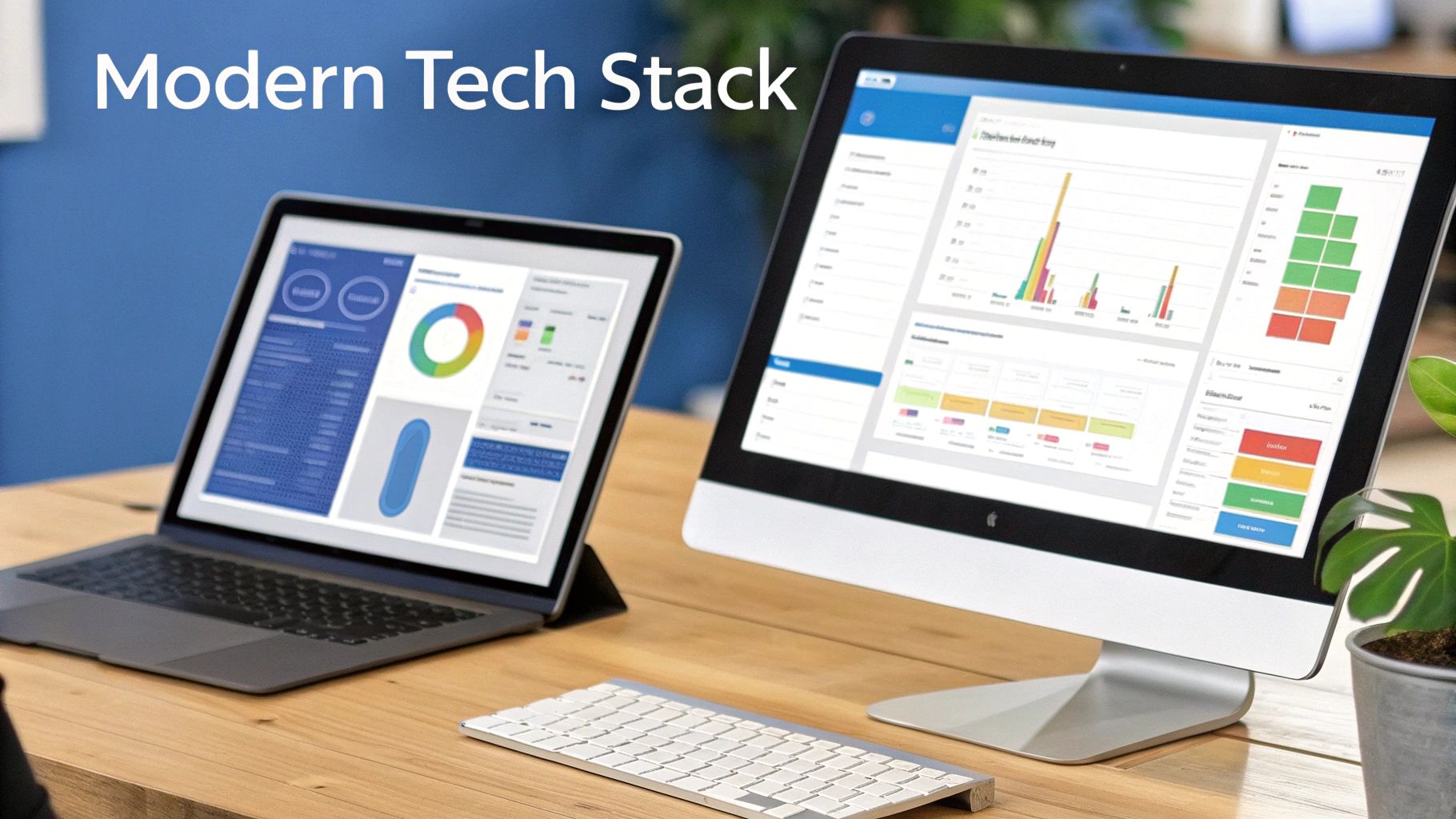
Technology is the central nervous system of a high-performing Sales Ops function. The right tech stack does more than store data; it reduces friction, automates low-value work, and delivers the insights needed for strategic decision-making. It is the engine that powers sales team execution.
A robust stack begins with a foundational CRM as the single source of truth for all customer interactions. From there, you can layer on specialized tools for data enrichment, sales engagement, and workflow automation. The goal is to create a seamless ecosystem where information flows freely, breaking down the data silos that hinder B2B growth.
The Core Platforms: Salesforce and HubSpot
For most B2B companies, the core CRM platform is either Salesforce Sales Cloud or HubSpot Sales Hub. A strategic sales operations management team transforms these CRMs from simple databases into powerful revenue-driving assets.
- Salesforce Sales Cloud: The industry standard for enterprise and mid-market companies, Salesforce offers unparalleled customization and a vast ecosystem of third-party applications. It is engineered for businesses with complex sales cycles that require granular control over workflows and advanced reporting.
- HubSpot Sales Hub: Known for its intuitive interface and all-in-one platform, HubSpot is a popular choice for startups and scaling businesses. Its strength lies in simplifying the customer journey by tightly integrating sales, marketing, and service functionalities.
Choosing a CRM is a foundational decision that shapes your entire GTM strategy. If you need guidance, our article on how to choose the right CRM can help.
Powering Engagement with Marketing Cloud Account Engagement
Once your CRM is established, a marketing automation platform like Marketing Cloud Account Engagement (MCAE) (formerly Pardot) becomes a critical next layer. MCAE’s tight integration with Salesforce directly links marketing activities to sales outcomes. It provides clear visibility into prospect engagement—tracking email opens, website visits, and content downloads—right within the CRM contact record.
This marketing and sales alignment is essential. When a lead is passed to sales, it arrives with a complete engagement history, equipping the sales rep with the context needed for a timely and relevant conversation.
The Rise of GTM Engineering and Orchestration
A new discipline is transforming outbound strategy: GTM Engineering. This practice involves using sophisticated platforms to automate complex data enrichment and outbound campaigns at scale. Tools like Clay.com are at the forefront of this shift, moving beyond simple automation to true GTM orchestration.
These platforms can chain together multiple data sources and logical steps, automating what was once a manual research process. This enables teams to build hyper-personalized outreach campaigns that were previously impossible to execute efficiently.
By 2025, it’s expected that 80% of B2B sales engagements will happen through digital channels, with technology and automation becoming even more central to success. Sales teams that adopt AI-powered tools report a 47% increase in productivity, saving an average of 12 hours weekly on repetitive administrative tasks. This shift underscores the growing importance of building an intelligent, automated tech stack.
Building a modern sales operations tech stack is about creating a cohesive system where every tool serves a clear purpose. Together, these technologies provide your revenue team with the data, automation, and insights needed to execute flawlessly and drive predictable growth.
Frequently Asked Questions
Still have some questions about sales operations management? We get it. Here are some plain-language answers to the questions we hear most often from B2B leaders in marketing, sales, and RevOps.
What’s The Difference Between Sales Operations And Revenue Operations?
Think of Sales Operations as a specialized function focused exclusively on optimizing the sales department. Its domain includes managing the sales funnel, maintaining CRM data integrity in platforms like Salesforce, defining territories, and ensuring forecast accuracy. Its purpose is to make the sales team more efficient and effective.
Revenue Operations (RevOps) takes a broader, holistic view of the entire customer lifecycle. It is a strategic function that aligns marketing, sales, and customer success to optimize the end-to-end revenue process. Sales Ops is a critical component within the larger RevOps framework, ensuring the sales function operates seamlessly within the unified customer journey.
How Do I Justify The Investment In A Sales Operations Team?
Justify the investment by framing it as a direct driver of revenue growth. A strong Sales Ops function delivers a clear and measurable ROI by enhancing sales productivity, improving forecast accuracy, and accelerating the sales cycle.
It boosts productivity by removing administrative tasks from reps, freeing them to focus on selling. It sharpens forecast accuracy, which is vital for strategic business planning. It also actively works to shorten the time it takes to close deals by streamlining processes and removing bottlenecks.
To build your business case, start with simple math. What’s the value of giving each salesperson just one extra hour of selling time per day? What would a 10% improvement in your team’s win rate mean for the bottom line? An expert agency can also provide this impact without the overhead of another full-time salary.
What Are The First Steps To Improving Our Sales Operations?
Begin with a comprehensive audit of your current state to identify the most significant pain points and quick wins. This initial diagnostic phase is crucial for focusing your efforts where they will have the maximum impact.
Here’s where to begin:
- Map out your current sales process. Identify where deals stall and where friction exists.
- Check your CRM data quality. Review your HubSpot or Salesforce instance. Is the data complete, accurate, and reliable?
- Review your tech stack. Are you paying for underutilized tools? Are there critical gaps in your team’s technology?
- Talk to your sales reps. Go directly to the front line and ask about their biggest daily operational challenges and frustrations.
This discovery process will illuminate your most pressing needs, whether it’s automating a manual task, cleaning up your contact data, or redesigning your pipeline stages for better visibility.
Ready to build a revenue engine that drives predictable growth? The team at MarTech Do specialises in auditing, optimising, and managing the sales operations processes and technologies that high-performing B2B companies rely on. Schedule a consultation with us today.