

In today’s competitive B2B landscape, marketing automation is the engine that drives scalable revenue operations. But selecting the right platform—one that seamlessly integrates with your CRM like Salesforce or HubSpot and aligns with your GTM strategy—is critical. Choosing incorrectly leads to wasted budget, frustrated teams, and disjointed customer experiences. This guide moves beyond generic feature lists to provide a detailed, experience-grounded analysis of the top marketing automation platforms. We’ll examine each tool through the lens of a RevOps professional, focusing on practical implementation, strategic value, and honest limitations to help you make a confident, informed decision that accelerates growth.
Our goal is to equip marketing operations managers, RevOps leaders, and CMOs with the actionable insights needed to audit their current systems or select a new one. This comprehensive resource digs into the key differentiators that matter for B2B success, from native CRM integration depth to the flexibility of lead scoring and campaign attribution models. To maximize the impact of your chosen platform, it’s essential to understand and implement various marketing automation best practices.
Inside this guide, you will find a detailed breakdown of each platform, including HubSpot, Salesforce Marketing Cloud Account Engagement, Marketo Engage, and others. We provide specific use cases, pros and cons, and pricing considerations to streamline your evaluation process. Each entry includes screenshots and direct links, giving you everything you need to compare solutions effectively. We’ve done the deep-dive analysis so you can focus on finding the platform that will truly serve as your company’s growth engine.
1. HubSpot Marketing Hub
HubSpot Marketing Hub earns its top spot by offering a powerful, all-in-one CRM and marketing automation suite that prioritizes usability and fast time-to-value. It’s an ideal solution for B2B companies seeking to align their marketing, sales, and service functions on a single, unified platform. The platform excels at providing a seamless user experience, making it accessible for teams without deep technical expertise while still offering advanced functionality for seasoned marketing operations professionals.
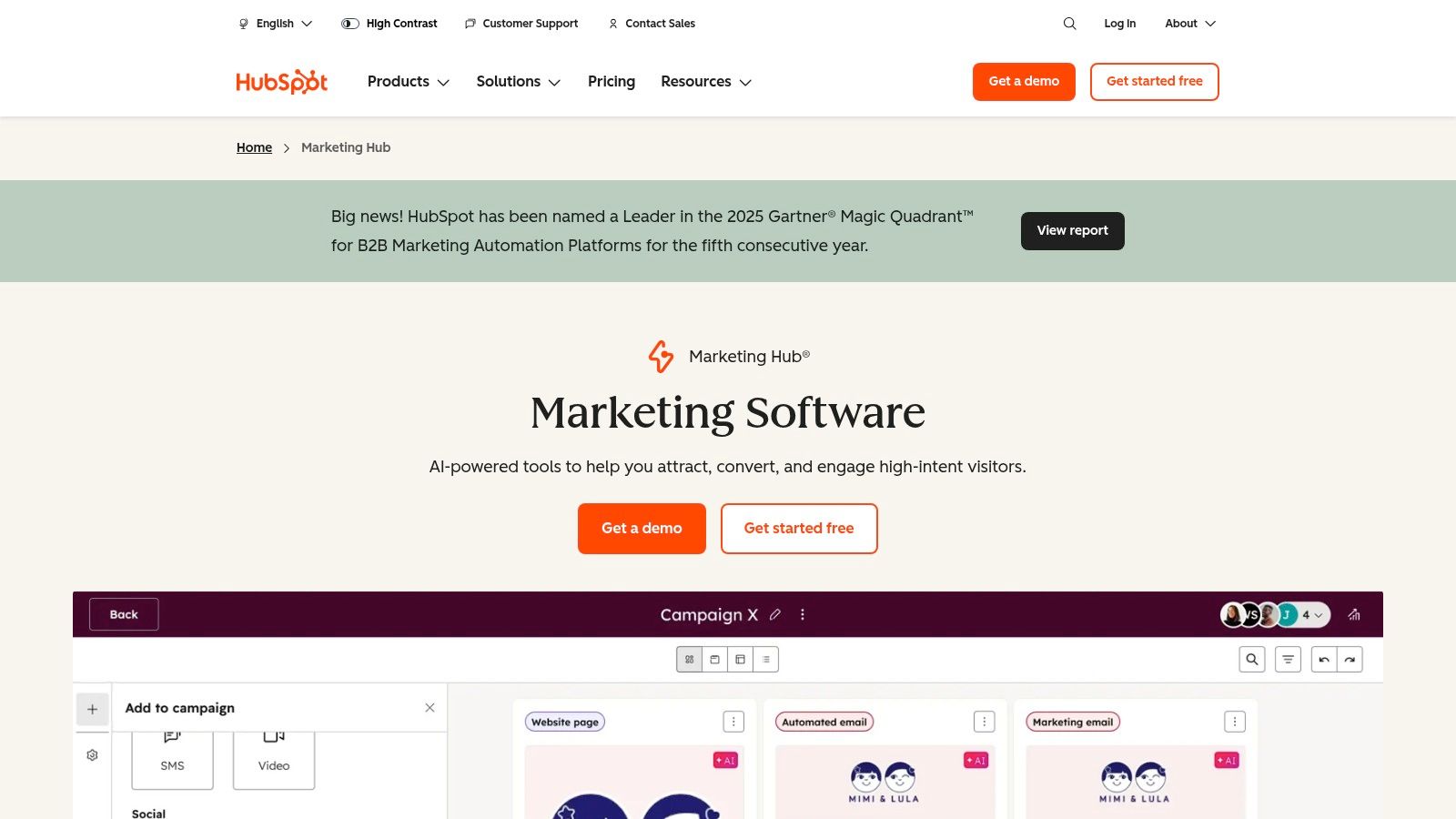
What truly sets HubSpot apart is its native integration with its CRM. This tight coupling ensures data flows seamlessly between departments, providing a single source of truth for every customer interaction. This is critical for effective revenue operations, as it enables marketing to create highly personalized campaigns based on sales activities and service history. To better understand the strategic benefits, explore this detailed guide on the value of CRM and marketing automation integration. The platform’s visual journey builder allows marketers to design and execute sophisticated, multi-channel workflows across email, SMS, and ads with ease.
Key Considerations
- Ideal Use Case: Mid-market B2B companies looking for a comprehensive platform that scales from simple email marketing to advanced, multi-channel automation without requiring extensive technical overhead.
- Pricing: HubSpot offers transparent, tiered pricing starting with robust free tools. Paid plans (Starter, Professional, Enterprise) are based on the number of marketing contacts, which can become a significant cost factor as your database grows.
- Onboarding: Professional and Enterprise tiers require a one-time, mandatory onboarding fee, which provides guided implementation and strategic support.
| Pros | Cons |
|---|---|
| Excellent user experience and fast adoption. | Contact-based pricing can get expensive at scale. |
| Native, deeply integrated CRM. | Mandatory, paid onboarding for Pro/Enterprise plans. |
| Extensive integration marketplace. | Advanced reporting is gated in higher-tier plans. |
Website: https://www.hubspot.com/products/marketing
2. Salesforce Marketing Cloud Account Engagement (Pardot)
Salesforce Marketing Cloud Account Engagement (formerly Pardot) is an essential platform for B2B organizations deeply embedded in the Salesforce ecosystem. It is purpose-built for aligning marketing and sales teams by providing robust lead management, sophisticated nurturing capabilities, and detailed campaign attribution, all natively connected to Salesforce CRM. Its strength lies in its ability to manage the long, considered sales cycles typical of B2B, helping marketing operations teams deliver high-quality, sales-ready leads.
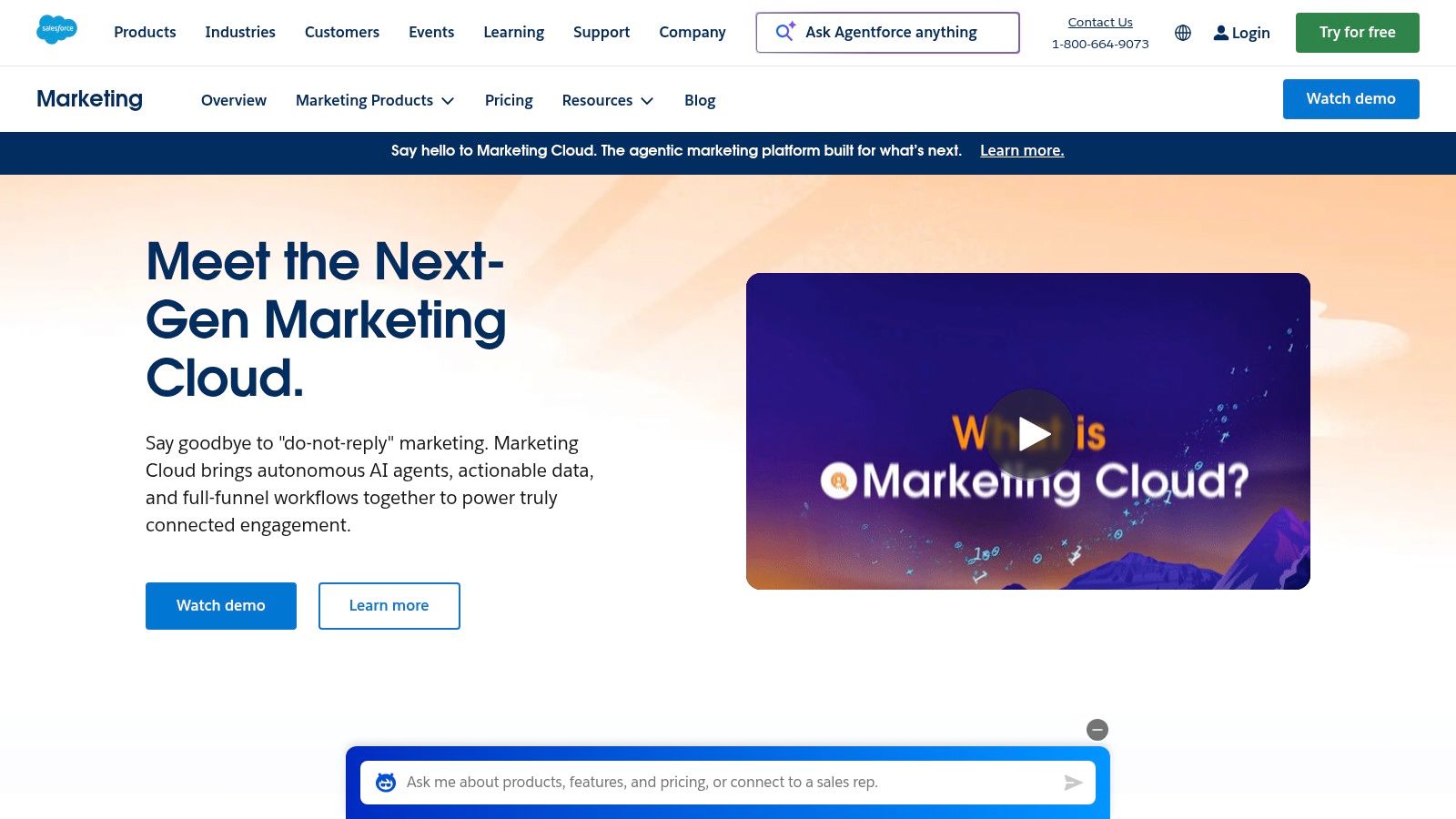
The defining feature of MCAE is its seamless, bi-directional sync with Salesforce Sales Cloud. This native integration provides sales teams with unparalleled visibility into marketing engagement directly on lead and contact records, while empowering marketers to build dynamic automation rules based on CRM data. This tight alignment is fundamental to an effective RevOps strategy. To fully leverage its capabilities, teams should follow established marketing automation best practices for Salesforce. The platform’s Engagement Studio provides a powerful canvas for designing complex, logic-driven nurturing paths that guide prospects through the buying journey.
Key Considerations
- Ideal Use Case: B2B companies using Salesforce CRM who need advanced lead scoring, grading, and nurturing capabilities to manage complex, multi-touch sales cycles.
- Pricing: Pricing is based on tiers (Growth, Plus, Advanced, Premium) that are determined by contact database size and feature set. It is a premium-priced solution designed for committed Salesforce users.
- Onboarding: Successful implementation requires a clear understanding of the Salesforce data model and often benefits from certified partners or a dedicated internal administrator to ensure proper configuration and alignment.
| Pros | Cons |
|---|---|
| Deepest native integration with Salesforce CRM. | Higher price point compared to non-Salesforce native tools. |
| Powerful B2B features like lead grading and scoring. | Implementation requires Salesforce expertise. |
| Strong analytics and campaign influence reporting. | User interface can be less intuitive than modern competitors. |
Website: https://www.salesforce.com/marketing/
3. Adobe Marketo Engage
Adobe Marketo Engage stands as a dominant force among top marketing automation platforms, designed for the complex needs of enterprise-level B2B organizations. It excels at managing the entire customer lifecycle, from initial acquisition to advocacy, with a powerful focus on lead management, account-based marketing (ABM), and sophisticated journey orchestration. Its architecture is built for scale, providing the robust governance and control necessary for large, multi-divisional marketing teams operating globally.
What truly differentiates Marketo is its depth in analytics and attribution. The platform offers advanced journey analytics and multi-touch attribution models that allow marketers to connect initiatives directly to revenue, providing clear visibility into ROI. This is critical for RevOps leaders who need to justify marketing spend and optimize GTM strategies. The platform’s ability to create smart campaigns and dynamic engagement programs enables marketers to build highly personalized, behavior-driven experiences for both individual leads and target accounts.
Key Considerations
- Ideal Use Case: Enterprise B2B companies with complex sales cycles and a need for deep account-based marketing, robust analytics, and scalable governance across multiple teams or business units.
- Pricing: Marketo Engage utilizes opaque, custom pricing. You must contact their sales team for a quote, which is tailored to your database size, feature requirements, and usage.
- Onboarding: The platform has a significant learning curve, often requiring dedicated administrators or external expertise for implementation and ongoing management to unlock its full potential.
| Pros | Cons |
|---|---|
| Enterprise-grade scalability and governance. | Opaque pricing requires a direct sales quote. |
| Powerful ABM and multi-touch attribution features. | Steep learning curve and complex interface. |
| Tight integration with Adobe Experience Cloud. | Can be overly complex for smaller marketing teams. |
Website: https://business.adobe.com/products/marketo/marketo-engage.html
4. Mailchimp
Mailchimp has cemented its position as one of the top marketing automation platforms by offering an accessible, user-friendly solution tailored for small to medium-sized businesses. It provides a low-barrier entry point into email marketing and automation, allowing teams to quickly launch campaigns, build subscriber lists, and track performance without a steep learning curve. The platform’s strength lies in its simplicity and focus on core marketing functions, making it a go-to choice for businesses prioritizing ease of use and rapid implementation.
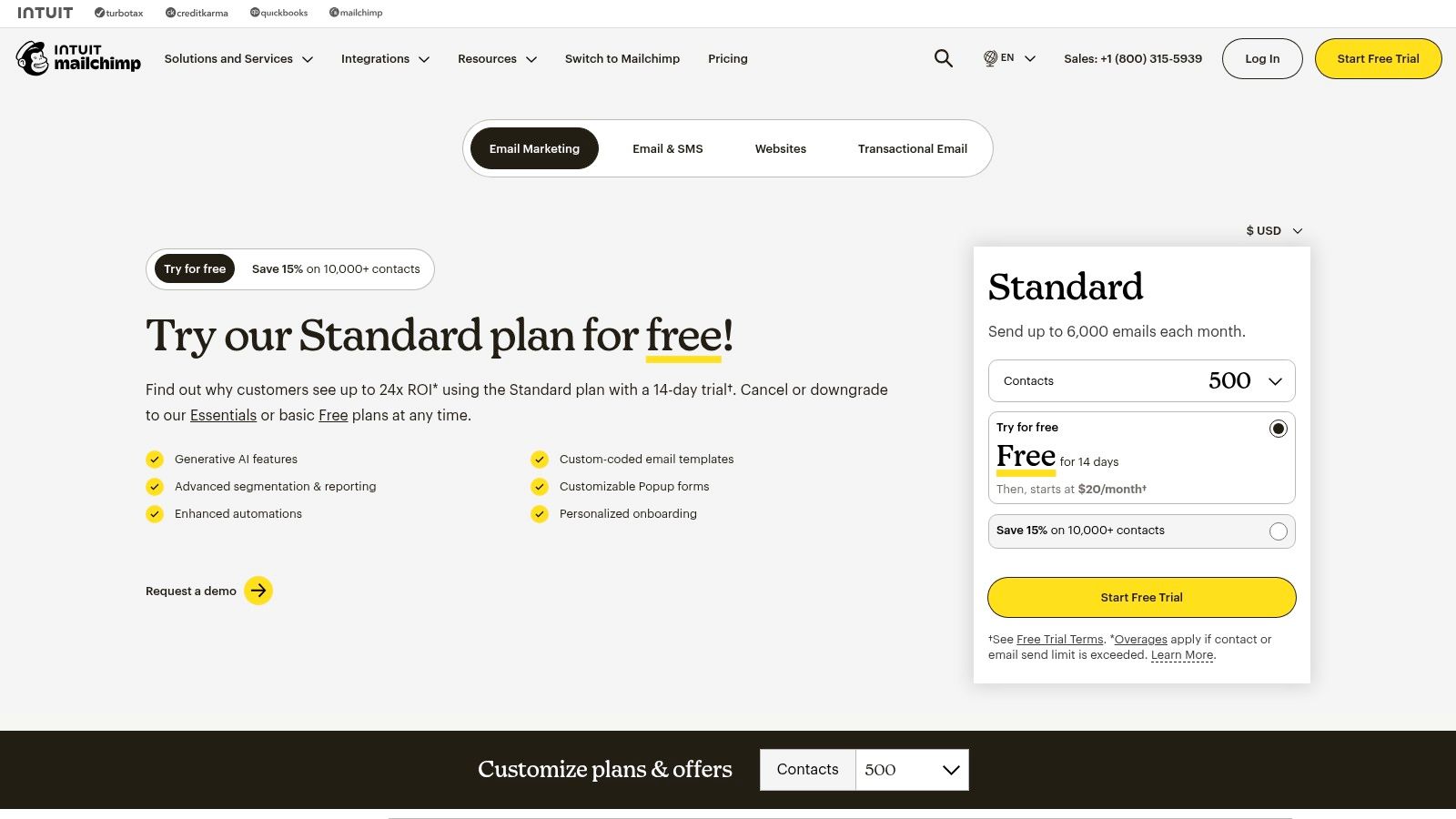
What makes Mailchimp particularly appealing is its combination of a generous free plan and a vast library of professionally designed templates for emails, landing pages, and forms. This allows resource-strapped teams to create polished, on-brand assets quickly. As businesses grow, they can scale into paid tiers to unlock more sophisticated features like multi-step customer journey automation and A/B testing. For a deeper dive into how it stacks up against other options, explore this analysis of marketing automation tools for small businesses. The platform’s flexible pricing, including pay-as-you-go credits, offers a predictable cost model that aligns with fluctuating marketing needs.
Key Considerations
- Ideal Use Case: Small to medium-sized businesses, particularly in e-commerce and B2C, that need a straightforward, all-in-one platform for email marketing, list management, and basic automation.
- Pricing: Mailchimp offers a free plan with basic features, followed by tiered monthly plans (Essentials, Standard, Premium). Pricing is based on both contact count and email send volume, with potential overage charges for exceeding limits.
- Onboarding: Self-serve onboarding with extensive documentation and support resources. Higher-tier plans include more personalized support options.
| Pros | Cons |
|---|---|
| Low-barrier free plan for initial testing. | Possible overage charges if usage limits are exceeded. |
| Wide range of integrations and strong educational content. | Advanced automation features require higher-tier plans. |
| Transparent and flexible pricing information. | Less focused on deep B2B sales cycle alignment. |
Website: https://mailchimp.com/pricing/marketing/
5. ActiveCampaign
ActiveCampaign secures its position by delivering a robust and accessible marketing automation platform tailored for SMBs and mid-market businesses. It bridges the gap between simple email tools and enterprise-level suites, offering powerful automation, a built-in CRM, and cross-channel orchestration at a competitive price point. The platform is designed for rapid implementation, making it an excellent choice for teams needing to demonstrate value quickly without a heavy upfront investment in setup or training.
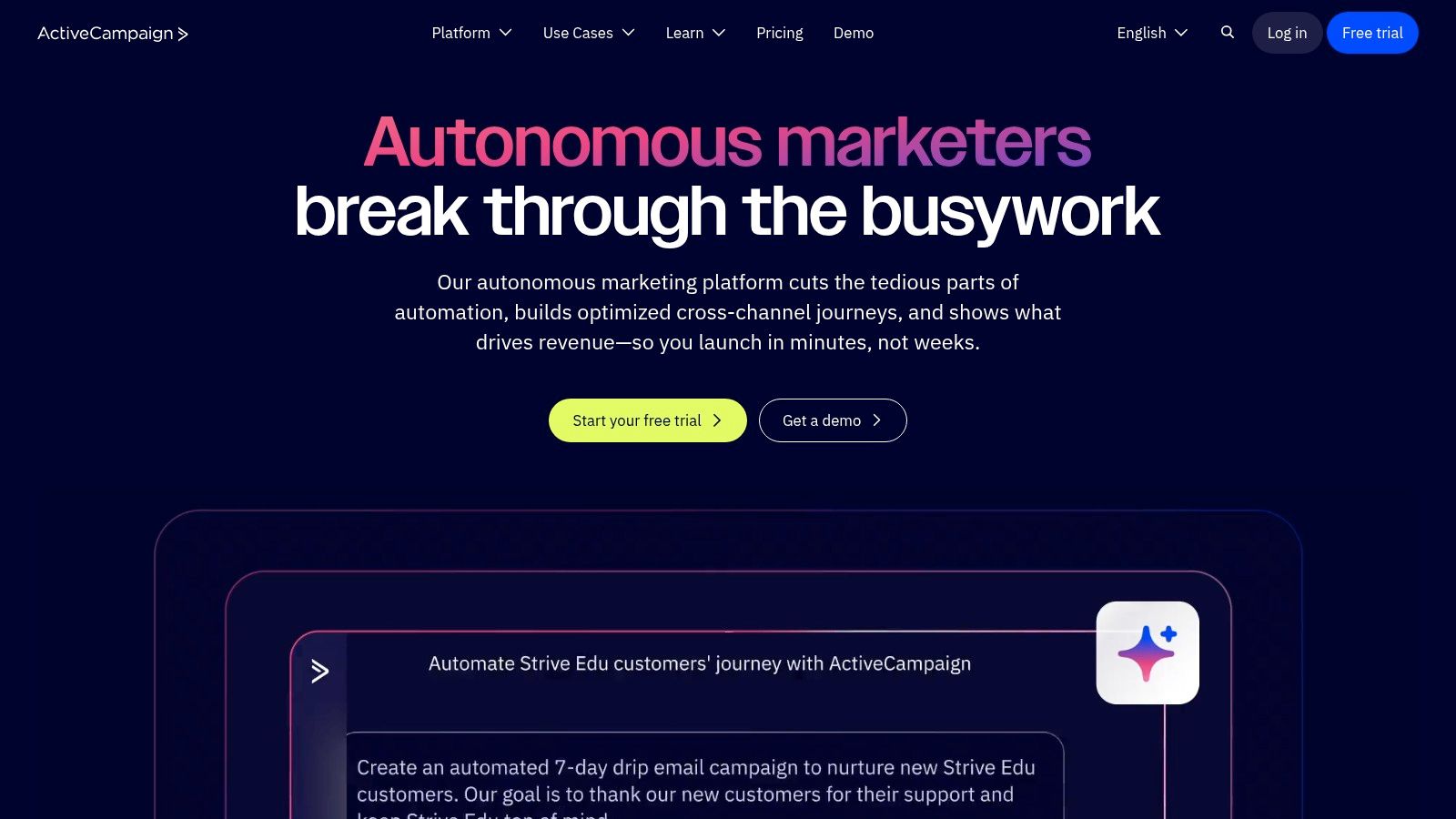
What makes ActiveCampaign a standout among top marketing automation platforms is its focus on customer experience automation. Its visual journey builder is intuitive yet powerful, enabling marketers to craft sophisticated workflows that span email, SMS, and website personalization. The platform also emphasizes support and onboarding, offering free migrations and personalized 1:1 coaching, which significantly lowers the barrier to entry for businesses transitioning from other systems. This combination of powerful features, user-centric support, and flexible pricing makes it a compelling option for growing companies.
Key Considerations
- Ideal Use Case: Small to mid-market B2B and B2C companies seeking powerful automation and CRM functionality without enterprise-level complexity or cost. It is particularly effective for businesses focused on lead nurturing and customer lifecycle marketing.
- Pricing: ActiveCampaign uses a contact-and-feature-based pricing model with flexible month-to-month plans and a 14-day free trial. There are no mandatory setup fees, but costs increase as your contact list and feature requirements grow.
- Onboarding: The platform is known for its supportive onboarding, including complimentary migration services and access to one-on-one strategy sessions, which helps new users achieve a faster return on investment.
| Pros | Cons |
|---|---|
| Very competitive entry-level pricing. | Some advanced analytics require additional add-ons. |
| Quick implementation with migration assistance. | Pricing scales significantly with contact count. |
| Extensive integration catalog with over 900 apps. | Built-in CRM is less robust than standalone platforms like Salesforce. |
Website: https://www.activecampaign.com/
6. Klaviyo
Klaviyo has carved out a dominant position among top marketing automation platforms by focusing squarely on the needs of e-commerce and direct-to-consumer (D2C) brands. The platform is engineered to transform first-party customer data into highly targeted revenue-generating campaigns across email and SMS. Its core strength lies in its deep, native integrations with e-commerce platforms like Shopify, BigCommerce, and Magento, allowing marketers to build sophisticated segments and automated flows based on real-time browsing behavior, purchase history, and even predictive analytics.
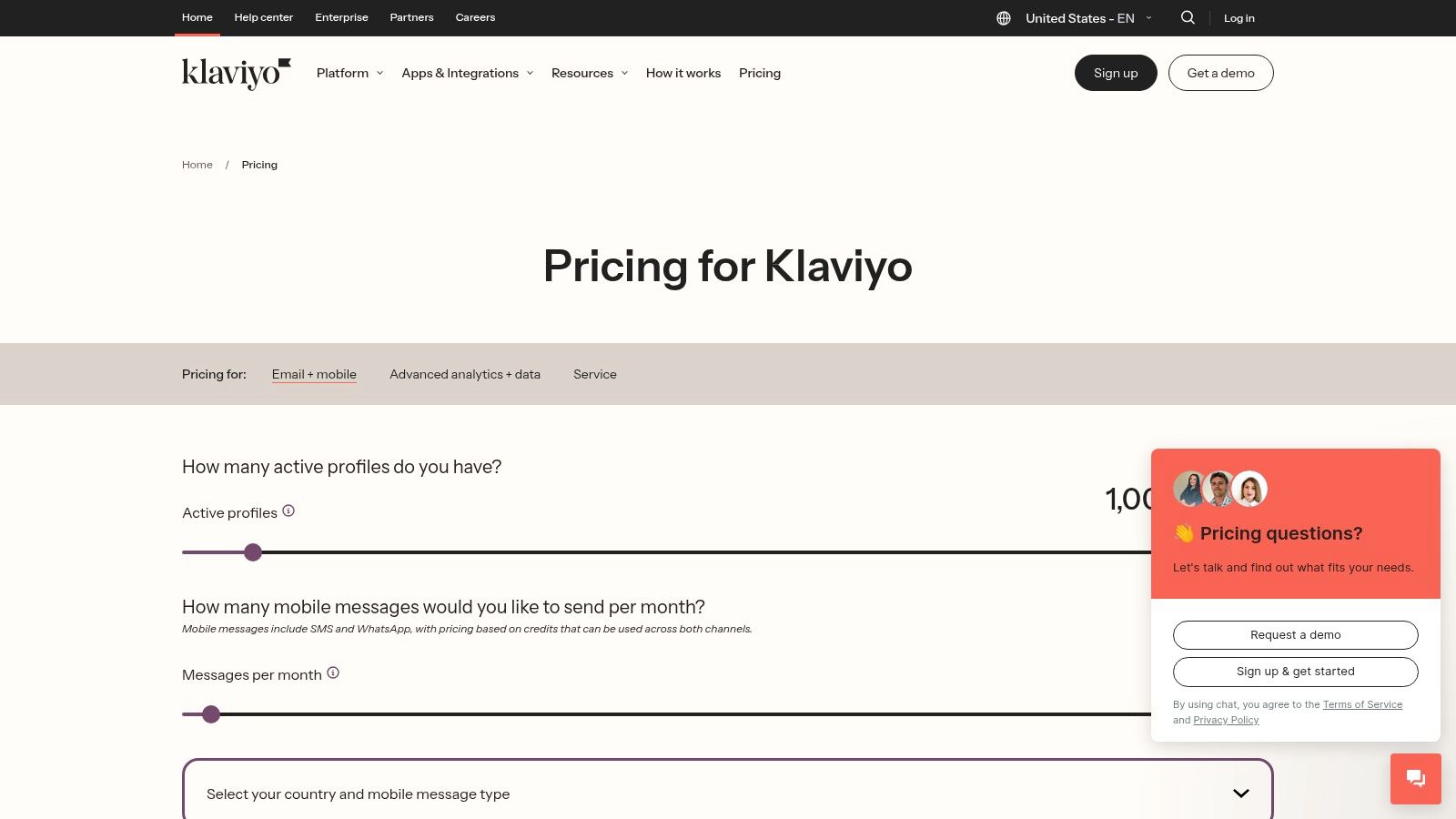
What truly distinguishes Klaviyo is its data-centric model that centralizes customer event data without heavy reliance on third-party systems. This enables powerful automation for critical e-commerce scenarios like abandoned cart recovery, browse abandonment, and post-purchase follow-ups. Unlike many B2B-focused platforms, Klaviyo’s interface and feature set are optimized for the high-volume, transactional nature of consumer marketing. The platform’s flexible credits model for messaging provides a scalable approach, ensuring businesses only pay for what they use as their audience grows.
Key Considerations
- Ideal Use Case: E-commerce and D2C brands of all sizes seeking to maximize customer lifetime value through data-driven email and SMS marketing. It is less suited for complex, long-cycle B2B sales processes.
- Pricing: Klaviyo offers a flexible model based on the number of active profiles and message credits for email and SMS/MMS. A free plan is available for up to 250 contacts, with paid plans scaling from there.
- Onboarding: The platform is known for its user-friendly onboarding process, with extensive documentation and a strong user community making self-service implementation accessible for most businesses.
| Pros | Cons |
|---|---|
| Strong ROI for D2C and e-commerce. | Less ideal for complex B2B sales cycles or ABM. |
| Deep e-commerce platform integrations. | SMS credit pricing can be complex across countries. |
| Scales effectively from small shops to large brands. | Feature set is heavily skewed toward e-commerce use cases. |
Website: https://www.klaviyo.com/pricing
7. Braze
Braze carves out its space as an enterprise-grade customer engagement platform, built for real-time, cross-channel messaging at a massive scale. It is an exceptional choice for B2B companies, especially those with mobile-first products or significant app-based user interactions, who need to orchestrate complex user journeys. The platform is engineered to handle and act on streaming data, allowing for immediate, context-aware communication across push notifications, in-app messages, email, and SMS.
What truly distinguishes Braze among top marketing automation platforms is its powerful mobile-native architecture and streaming data model. Unlike platforms that rely on batch processing, Braze ingests user data in real time, enabling immediate trigger-based campaigns powered by its visual journey builder, Canvas. This capability is critical for engaging users at the precise moment of action. Its advanced personalization, powered by BrazeAI, and robust experimentation features allow marketing operations teams to test and optimize every message for maximum impact, ensuring high relevance and performance.
Key Considerations
- Ideal Use Case: Enterprise B2B companies with a strong mobile presence (SaaS, tech) that require real-time, high-volume messaging and sophisticated journey orchestration across digital channels.
- Pricing: Braze does not offer public pricing and requires a custom sales quote. Its pricing is typically based on Monthly Active Users (MAUs), making it more suited for businesses with a well-defined and engaged user base rather than a large, passive contact list.
- Onboarding: Implementation is a significant project that often spans multiple months, requiring dedicated technical resources for SDK integration and data mapping.
| Pros | Cons |
|---|---|
| Industry-leading mobile engagement at scale. | No public pricing, requires a sales quote. |
| High enterprise security and compliance standards. | Implementation projects can span multiple months. |
| Real-time streaming data for immediate engagement. | Relatively higher total cost than SMB-focused tools. |
Website: https://www.braze.com/
8. Iterable
Iterable positions itself as a premier cross-channel marketing automation platform designed for enterprise-scale communication. It excels at empowering B2C and B2B brands to deliver individualized, harmonized, and dynamic customer experiences. The platform’s strength lies in its flexible data model and real-time behavioral triggers, allowing marketers to activate any data point to orchestrate complex journeys across email, SMS, push notifications, and in-app messages. This focus on individualization makes it a powerful tool for companies with mature data operations.
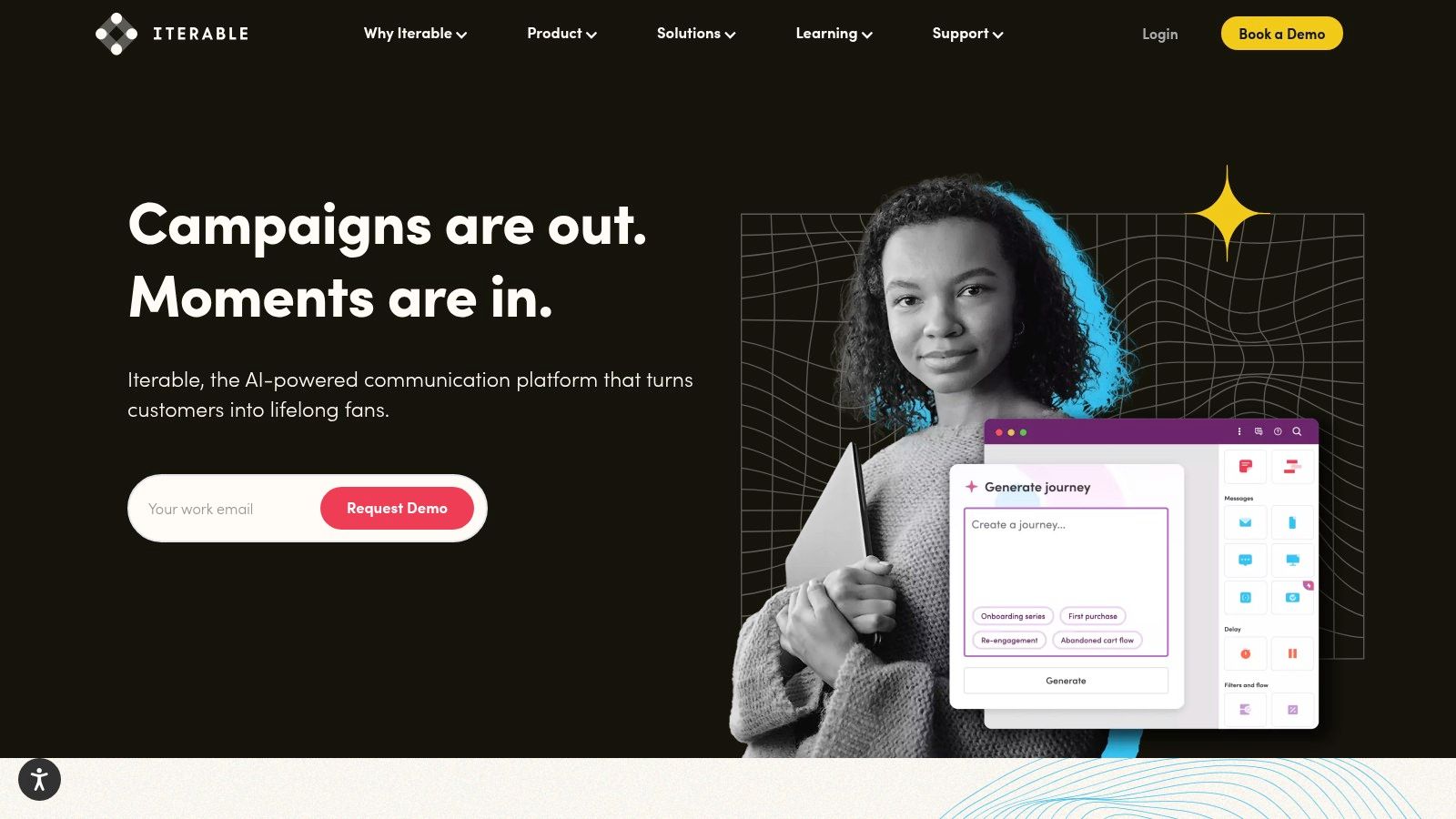
What truly distinguishes Iterable is its AI-driven optimization suite, which helps determine the best channel, timing, and frequency for each message on an individual user basis. This capability moves beyond static segmentation to predictive personalization, aiming to maximize engagement and conversion. The platform’s architecture is built for speed and scale, processing massive volumes of data to trigger communications in the moment. For technical teams, Iterable provides extensive documentation and APIs, ensuring it can be deeply integrated into a sophisticated MarTech stack.
Key Considerations
- Ideal Use Case: Enterprise-level organizations with sophisticated data infrastructure and a need for real-time, cross-channel personalization at scale, particularly in B2C or high-velocity B2B environments.
- Pricing: Pricing is customized and available only through a direct sales quote. The model is built for enterprise clients, so it is not suited for small businesses or startups.
- Onboarding: Requires a well-resourced technical and marketing operations team to fully leverage its powerful, flexible data model and advanced journey-building capabilities.
| Pros | Cons |
|---|---|
| Highly flexible data model for deep personalization. | Pricing is opaque and available only via sales quote. |
| Powerful AI for channel and send-time optimization. | Requires significant data maturity to extract full value. |
| Robust cross-channel orchestration capabilities. | Primarily enterprise-focused, not SMB-friendly. |
Website: https://iterable.com/
9. Oracle Eloqua
Oracle Eloqua solidifies its place among top marketing automation platforms as an enterprise-grade solution designed for large, complex B2B organizations. It excels in managing sophisticated global marketing operations where data governance, scalability, and advanced segmentation are paramount. Eloqua is best suited for businesses deeply integrated into the Oracle ecosystem, allowing them to leverage the full power of Oracle’s Customer Experience (CX) Cloud to orchestrate intricate, multi-channel customer journeys.
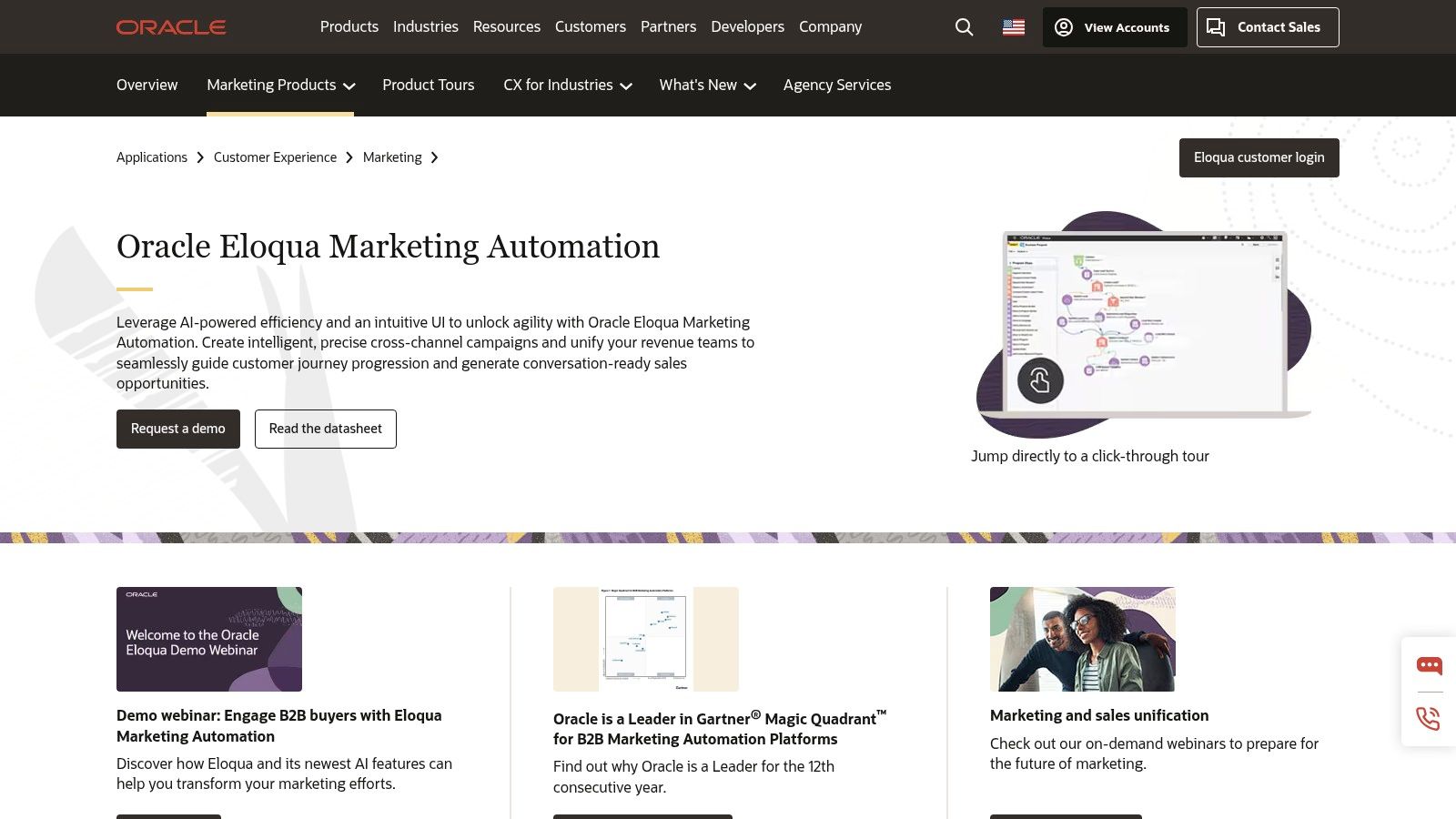
What distinguishes Eloqua is its powerful data modeling and audience segmentation engine, which enables marketers to build highly specific target lists based on complex behavioral and firmographic data. This is crucial for executing precise account-based marketing (ABM) campaigns at scale. The platform also offers robust security and compliance features, making it a trusted choice for regulated industries. Its capacity to handle massive contact databases without performance degradation and its extensive integration library make it a foundational component of a mature MarTech stack.
Key Considerations
- Ideal Use Case: Large enterprises, particularly those in finance, manufacturing, or technology, that require a highly scalable and customizable platform with stringent data governance and deep integration into an existing Oracle CX stack.
- Pricing: Oracle does not disclose Eloqua’s pricing publicly. It is a premium-priced solution with costs typically based on contact database size and feature tiers, requiring a custom quote from their sales team.
- Onboarding: Implementation is a significant undertaking, often requiring specialized internal administrators or certified implementation partners. The platform has a steep learning curve compared to more user-friendly competitors.
| Pros | Cons |
|---|---|
| Highly scalable with enterprise-grade control and governance. | Pricing not publicly disclosed; tends to be higher cost. |
| Strong compliance and permission management. | Longer implementation cycles requiring specialist administrators. |
| Rich ecosystem of technology and implementation partners. | Steep learning curve and less intuitive user interface. |
Website: https://www.oracle.com/cx/marketing/automation/
10. Customer.io
Customer.io secures its place among top marketing automation platforms by focusing on developer-friendly lifecycle messaging for tech-savvy businesses. It is engineered for companies, particularly in SaaS and product-led growth sectors, that need to trigger communications based on granular user behavior and event data. The platform empowers both marketers and developers to collaborate, offering a visual workflow builder alongside the ability to inject custom code and leverage powerful API capabilities for maximum flexibility.
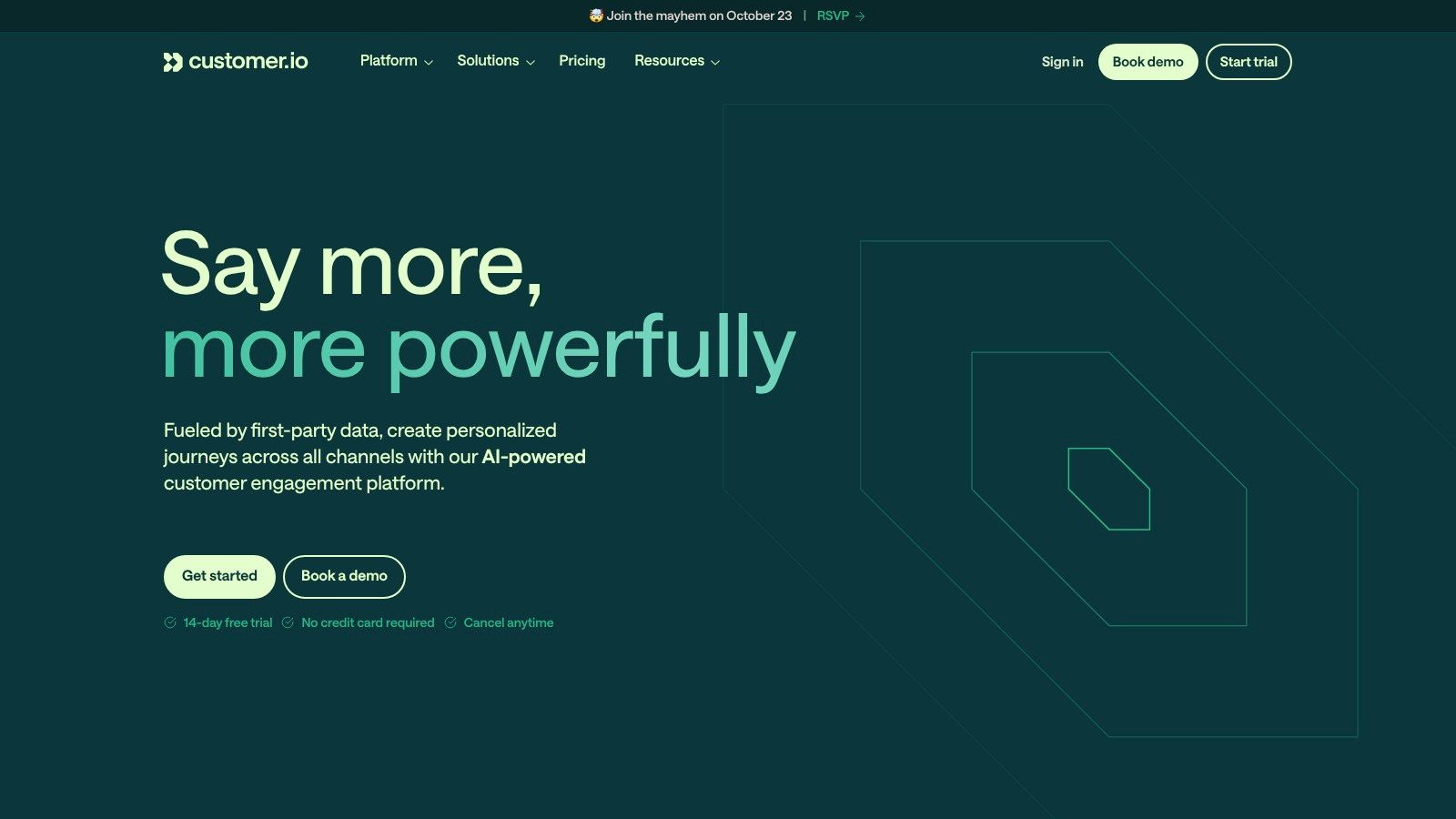
What sets Customer.io apart is its powerful event-driven architecture. Unlike platforms that primarily rely on contact properties, Customer.io excels at initiating complex workflows from real-time user actions within a product or website. This allows for highly contextual and timely messaging across email, push notifications, SMS, and in-app messages. Its support for data pipelines, custom data objects, and unlimited webhooks makes it a central hub for orchestrating sophisticated, data-rich customer journeys without the limitations found in more traditional marketing clouds.
Key Considerations
- Ideal Use Case: Product-led B2B and B2C tech companies that require deep integration with their product data to drive user engagement, onboarding, and retention campaigns.
- Pricing: Features transparent, tiered pricing based on profiles. The structure includes published overage rates and a startup program, providing predictability as you scale. SMS costs are variable and may require separate configuration.
- Onboarding: The platform is designed for self-service, with extensive documentation for developers and marketers. Higher-tier plans offer dedicated support for more complex implementation needs.
| Pros | Cons |
|---|---|
| Clear pricing with published overage rates and startup program. | Essentials plan lacks some enterprise governance features. |
| Flexible platform suited for product-led and SaaS companies. | SMS costs vary and may require extra configuration. |
| Generous API and messaging limits in fair-use policies. | Can have a steeper learning curve for non-technical users. |
Website: https://customer.io/
11. Brevo (formerly Sendinblue)
Brevo positions itself as a powerful, budget-friendly marketing and sales platform, making it one of the top marketing automation platforms for small to medium-sized businesses. It consolidates email, SMS, WhatsApp, push notifications, and live chat into a single accessible interface. The platform is designed for businesses needing a cost-effective way to engage customers across multiple channels without committing to the high-entry costs typical of enterprise-level solutions.
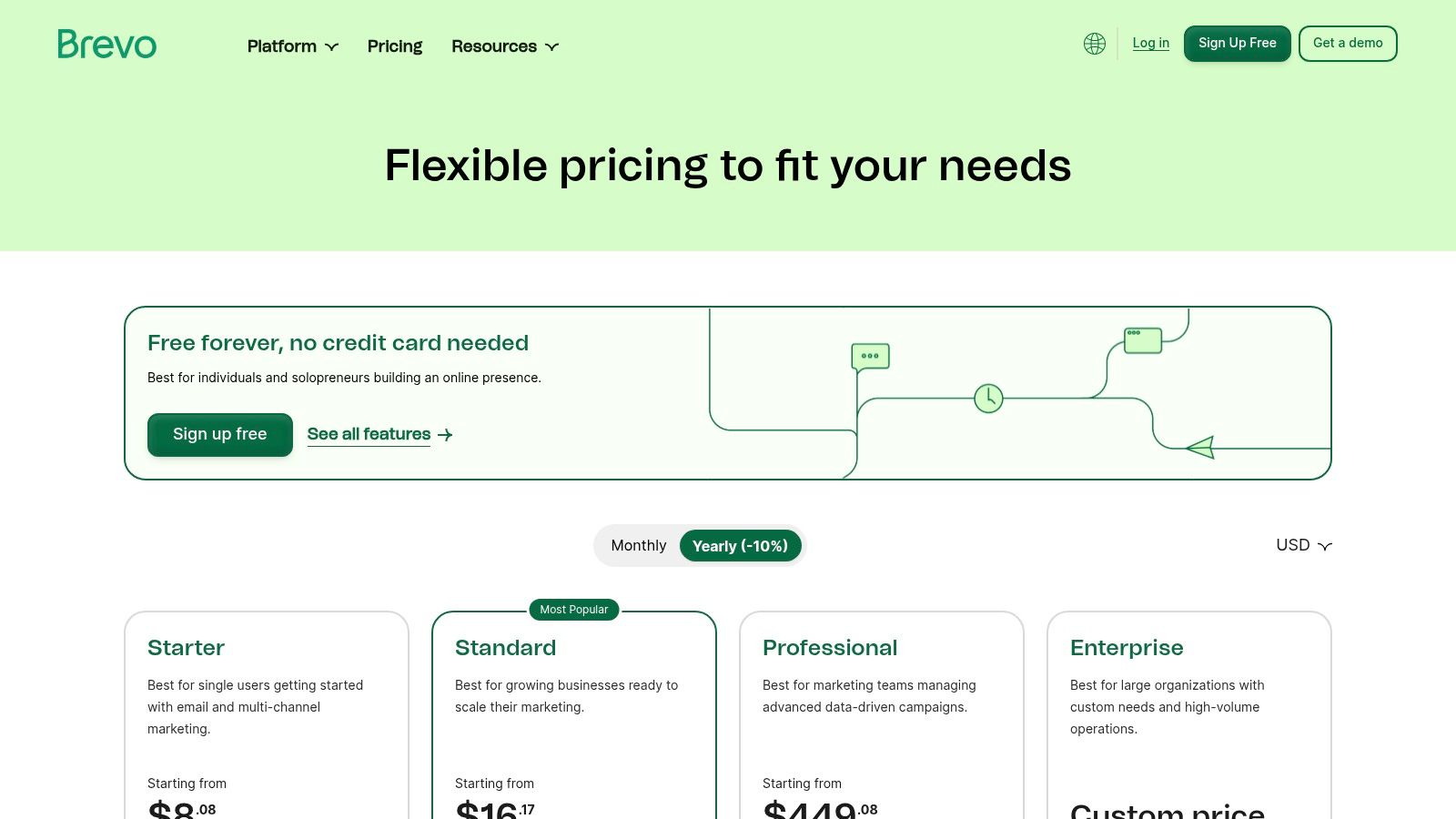
What makes Brevo unique is its generous free tier and volume-based pricing model, which contrasts sharply with the contact-based pricing of many competitors. This approach allows businesses to grow their audience without an immediate and direct impact on cost, paying instead for the volume of messages sent. Its automation builder is straightforward, enabling users to create workflows for lead nurturing, transactional messaging, and customer onboarding. The inclusion of transactional email capabilities via its Messaging API at a low cost is a significant advantage for businesses with e-commerce or SaaS components.
Key Considerations
- Ideal Use Case: Small to mid-sized businesses (SMBs) and startups looking for an affordable, multi-channel marketing automation tool that can handle both marketing campaigns and transactional messaging.
- Pricing: Brevo offers a free plan with a daily send limit. Paid plans are structured in tiers based on monthly email volume rather than contact count, with options for add-ons like dedicated IP addresses.
- Onboarding: The platform is designed for self-service onboarding with an intuitive interface. Phone support becomes available on the Business tier and above for teams needing more direct assistance.
| Pros | Cons |
|---|---|
| Very low entry cost with a robust free plan. | Some advanced features require separate add-ons. |
| Flexible pricing based on email volume, not contacts. | Mobile channel pricing can vary by geographic destination. |
| All-in-one platform with email, SMS, and chat. | Automation capabilities are less complex than enterprise tools. |
Website: https://www.brevo.com/pricing/
12. G2 – Marketing Automation Software Category
While not a platform itself, G2’s Marketing Automation category is an indispensable resource for any B2B company navigating the complex vendor landscape. It functions as a comprehensive marketplace where marketing operations leaders can compare the top marketing automation platforms based on verified user reviews, detailed feature grids, and real-time satisfaction scores. This peer-driven approach provides an unbiased layer of validation that is often missing from vendor-produced marketing materials.
What makes G2 uniquely valuable is its granular filtering and segmentation. Users can drill down into specific subcategories, such as enterprise or small business solutions, and filter results based on features, company size, industry, and user ratings. This allows teams to create a highly relevant shortlist of potential vendors before initiating any demo requests. The detailed reviews often include practical insights into implementation challenges, customer support quality, and the true cost of ownership, providing a realistic preview of the user experience.
Key Considerations
- Ideal Use Case: B2B marketing and RevOps teams in the initial evaluation or vendor comparison stage of their MarTech procurement process. It is essential for due diligence and building a business case for a new platform.
- Pricing: Access to G2’s reviews and comparison tools is free for buyers. Pricing information for the listed platforms is often vendor-submitted and may be an estimate, requiring direct confirmation.
- Onboarding: N/A as it is a research platform. However, G2 facilitates direct connections to vendors for demos, trials, and onboarding discussions.
| Pros | Cons |
|---|---|
| Enables direct, side-by-side platform evaluation. | Pricing information can be approximate or outdated. |
| Provides real, verified user feedback and scores. | Sponsored listings can influence vendor visibility. |
| Allows filtering by company size, features, and ratings. | Review depth can vary significantly between platforms. |
Website: https://www.g2.com/categories/marketing-automation
Top 12 Marketing Automation Platforms Comparison
| Platform | Core Features | Target Audience | Unique Selling Points | User Experience & Quality Metrics | Pricing Model |
|---|---|---|---|---|---|
| HubSpot Marketing Hub | Visual journey automation, native CRM, attribution | SMBs to enterprises | Fast time-to-value, transparent pricing | Deep analytics at higher tiers | Tiered by contacts, onboarding fees at Pro+ |
| Salesforce MCAE (Pardot) | Lead scoring/grading, B2B marketing analytics | B2B Salesforce users | Deepest native Salesforce CRM integration | Strong governance, sales/marketing alignment | Tiered by contacts and features |
| Adobe Marketo Engage | Lead/account scoring, journey analytics | Enterprise B2B/B2C | Advanced ABM, integration within Adobe CX | Scalable, strong analytics | Quote-based pricing |
| Mailchimp | Email, customer journeys, templates, SMS add-ons | SMBs | Low-barrier free plan, wide integrations | Transparent pricing, easy for beginners | Free + pay-as-you-go + monthly plans |
| ActiveCampaign | Visual automation, cross-channel orchestration | SMB to mid-market | Competitive pricing, free migrations | Quick implementation, broad integrations | Month-to-month, pricing scales with contacts |
| Klaviyo | E-commerce focused, segmentation, credits model | E-commerce & consumer | Deep Shopify integration, ROI focus | Flexible plans for email/SMS | Based on active profiles + message credits |
| Braze | Real-time cross-channel, mobile SDK support | Enterprise | Industry-leading mobile engagement | High security, enterprise uptime standard | Quote-based, higher total cost |
| Iterable | Real-time behavioral triggers, AI optimization | Enterprise | Complex personalization, rich onboarding | Positive enterprise reviews | Quote-based |
| Oracle Eloqua | Advanced segmentation, governance, ABM support | Large enterprises | Scalable, strong compliance and ecosystem | Enterprise-grade control | Quote-based, high cost |
| Customer.io | Lifecycle messaging, code/no-code workflows | SaaS & product-led growth | Transparent pricing, HIPAA option | Flexible platform, strong API limits | Tiered pricing with overage rates |
| Brevo (Sendinblue) | Multi-channel, A/B testing, transactional email | SMBs | Very low entry cost, free daily send limits | Flexible volume tiers | Volume-based monthly plans |
| G2 – Marketing Automation | Reviews, feature matrices, segmentation | Buyers & decision-makers | Verified user feedback, side-by-side eval | Frequent updates, filtering options | Vendor-submitted/approximate pricing |
From Platform to Performance: Your Next Steps
Navigating the landscape of the top marketing automation platforms can feel like a monumental task. As we’ve detailed, each platform, from the comprehensive ecosystems of HubSpot and Salesforce to the targeted precision of tools like Klaviyo and Braze, offers a distinct set of capabilities tailored to specific business models and operational needs. The critical takeaway is that the “best” platform is not a universal title; it is the one that most closely aligns with your unique go-to-market strategy, technical infrastructure, and team expertise.
This decision marks the beginning, not the end, of your journey toward revenue optimization. Simply acquiring a powerful tool is not enough. The real return on investment is unlocked through meticulous implementation, seamless integration with your CRM, and a commitment to continuous process improvement. Your choice should be a strategic one, grounded in a deep understanding of your operational workflows and long-term business goals.
Synthesizing Your Decision: Key Factors to Revisit
Before making a final commitment, distill your analysis down to a few core pillars. Re-evaluate the platforms you’ve shortlisted against these essential criteria to ensure your selection is robust, scalable, and strategically sound.
- CRM Integration and Data Sync: How deeply and reliably does the platform integrate with your core CRM, whether it’s Salesforce, HubSpot, or another system? In B2B organizations, a flawless bidirectional data sync is non-negotiable for aligning sales and marketing, enabling accurate lead scoring, and maintaining a single source of truth for all customer interactions. A faulty integration can cripple your entire RevOps framework.
- Team Skillset and Adoption: Be honest about your team’s current capabilities. An advanced platform like Adobe Marketo Engage or Oracle Eloqua offers immense power, but it also demands a steep learning curve and specialized expertise. If your team is smaller or less technical, a more intuitive platform like HubSpot or ActiveCampaign may deliver a faster time-to-value and higher user adoption.
- Scalability and Future Needs: Consider your company’s growth trajectory over the next three to five years. Will your chosen platform support expansion into new markets, the launch of new product lines, or the increasing complexity of your customer journeys? A platform that fits perfectly today could become a significant bottleneck tomorrow if it lacks the necessary scalability.
From Selection to Implementation: A Strategic Roadmap
Once you have selected your ideal platform, the focus must shift to execution. A poorly planned implementation can negate the benefits of even the most sophisticated technology. To ensure a smooth transition and maximize your platform’s potential from day one, prioritize the following steps:
- Conduct a System Audit: Before migrating, perform a thorough audit of your existing MarTech stack and processes. Identify data cleanliness issues, redundant workflows, and process gaps that need to be addressed. This ensures you are building on a solid foundation, not migrating existing problems into a new system.
- Define Your MVP (Minimum Viable Product): Avoid a “boil the ocean” approach. Identify the most critical marketing automation workflows that will drive the biggest impact, such as lead nurturing, MQL routing, and a welcome series. Launch with this core functionality first, then iterate and expand over time.
- Establish Clear Governance: Document everything. Create clear guidelines for data management, campaign creation, naming conventions, and user permissions. Strong governance is essential for maintaining system integrity and ensuring your data remains a reliable asset for decision-making.
Ultimately, choosing from the top marketing automation platforms is a strategic investment in your company’s revenue engine. It’s a decision that impacts every stage of the customer lifecycle, from initial awareness to long-term loyalty. By focusing on alignment with your core business processes and committing to a thoughtful implementation strategy, you can transform your chosen platform from a simple marketing tool into a predictable, scalable driver of growth.
Selecting, implementing, and optimizing a marketing automation platform is a complex process that requires deep expertise. The team at MarTech Do specializes in turning MarTech investments into revenue-generating assets, with a core focus on HubSpot and Salesforce Marketing Cloud Account Engagement (Pardot). If you need help auditing your current system or ensuring your next platform is perfectly aligned with your RevOps strategy, contact us for a consultation.