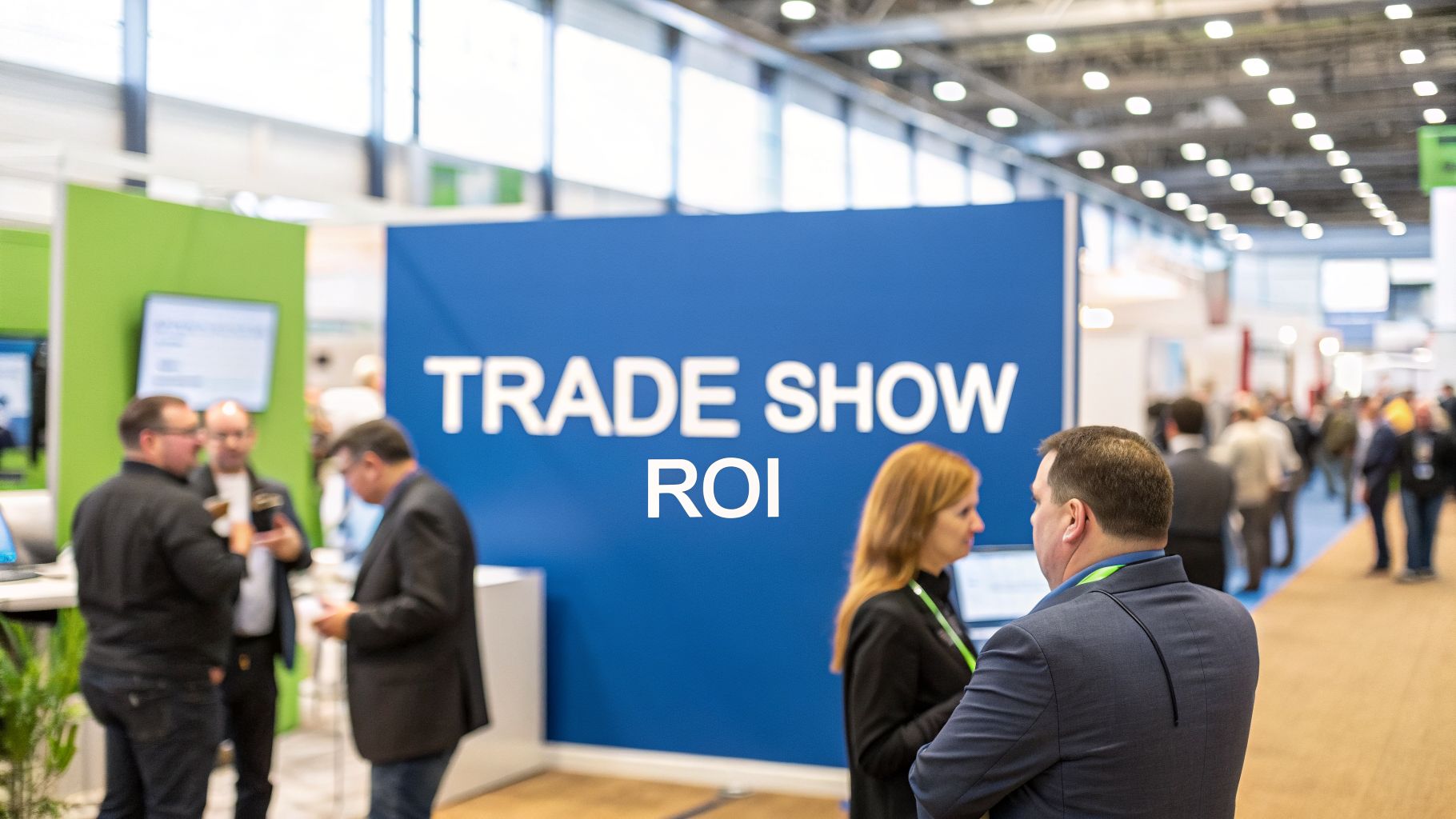
Forget the dictionary definition for a moment. For a B2B company using Salesforce or HubSpot, a trade show is a powerful, focused marketplace where you can showcase your solutions to a captive audience of potential buyers. This is more than just an event; it's a critical RevOps opportunity to source high-intent leads, accelerate sales cycles, and prove marketing's direct impact on revenue.
What Is a Trade Show in Modern B2B Marketing?

Let's dig deeper than the simple "booth and banner" idea. For B2B RevOps and marketing operations teams working in platforms like Salesforce or HubSpot, a trade show is a strategic play. It’s an organized gathering where businesses converge to demonstrate, discuss, and ultimately sell their latest innovations.
This isn't like casting a wide net with digital ads. Trade shows provide direct, face-to-face time with a concentrated pool of high-value prospects. These individuals haven’t just scrolled past your content; they’ve invested time and money to be there because they are actively seeking solutions. This makes them ideal candidates for your pipeline, and every interaction is a valuable data point that must be tracked back to your CRM.
The Role of Trade Shows in Your Go-to-Market Strategy
Think of a trade show as a temporary, high-stakes hub built entirely for connection. It’s your chance to move beyond endless email chains and build genuine relationships that accelerate deals. For marketing operations and RevOps leaders, the true value lies in tying every event activity to specific, measurable business outcomes in Salesforce or HubSpot.
A successful trade show strategy isn’t just about collecting a stack of business cards. It's about engineering a system that turns a booth conversation into measurable pipeline influence and, ultimately, closed-won revenue you can attribute directly within your CRM.
This is where our understanding of what is a trade show shifts from a simple event to a strategic revenue driver. It becomes a prime example of experiential marketing, where you're not just selling a product—you're creating a memorable brand interaction.
Every handshake, every demo, every badge scan is a crucial piece of data. The challenge for modern B2B marketers isn’t just showing up; it’s systematically plugging these in-person touchpoints into your revenue engine to prove ROI through marketing influence tracking.
Key activities at a trade show include:
- Generating High-Intent Leads: Attendees pay to be there, signaling a strong interest in finding a solution.
- Accelerating Sales Cycles: A five-minute in-person chat can build more trust and overcome more objections than a dozen emails.
- Building Brand Authority: A polished, professional presence helps establish your company as a go-to expert in the field.
Trade show attendees are not your average leads. They are a self-qualified, highly motivated group. The table below breaks down exactly why this audience is so valuable for your RevOps team.
Why Trade Show Attendees Are High-Value Prospects
| Statistic | What This Means for Your RevOps Strategy |
|---|---|
| 81% of trade show attendees have buying authority. | The person you're speaking with is likely a decision-maker, allowing conversations to move from discovery to evaluation much faster. |
| 46% of attendees are in executive or upper management. | You get direct access to senior leaders who are often difficult to reach through standard cold outreach channels. |
| 78% of attendees travel more than 400 miles to attend an event. | This commitment signals they are serious about finding solutions and making valuable connections. |
Ultimately, what matters is proving the event’s impact. To do that, you need a solid framework for tracking marketing’s influence and attributing revenue directly back to the show—a process that starts and ends right inside your CRM.
Why Trade Shows Are a Goldmine for Revenue Teams
For any revenue team, the fundamental question about trade shows is simple: what’s the ROI? While digital channels are essential, the unique power of face-to-face events builds trust and significantly accelerates the sales cycle. The key is proving it with data in Salesforce and HubSpot.
Think about it. Trade shows bring your entire target audience together under one roof, giving your sales team direct, in-person access to decision-makers who are actively seeking solutions.
Instead of spending weeks chasing meetings, your team can have multiple, high-impact conversations in a single afternoon. These aren't cold leads; they are opportunities to hear customer pain points firsthand, run live demos, and build genuine rapport. This is an advantage you can't replicate with an email campaign alone, and it's why accurate marketing influence tracking is non-negotiable.
The Financial Case for Face-to-Face Interaction
The numbers don't lie. When tracked correctly, the financial returns from trade shows can outperform other marketing channels. For B2B companies, especially those with complex sales cycles, these events are a cornerstone of a robust go-to-market strategy.
When tracked properly in Salesforce or HubSpot, the ROI from a single event can justify a significant portion of your annual marketing budget. The key is connecting the dots between a badge scan and a closed-won deal using campaign influence models.
The data makes a compelling argument. Companies report an average ROI of $20.98 for every $1 spent on trade shows, and a staggering 81% of attendees show up with direct purchasing authority. The cost per lead averages just $112—a bargain compared to the $259 for a traditional field sales call.
Plus, 72% of attendees say they are more likely to buy from an exhibitor they meet at an event. You can dig deeper into these trade show statistics on Kande Photo Booths' blog. This is precisely why RevOps leaders need a rock-solid plan for capturing, processing, and tracking event leads within their CRM.
Turning Booth Traffic into Pipeline Velocity
High-quality leads are the fuel for your revenue engine, and trade shows are a premium source. These leads have higher intent because they've invested time and money to attend, signaling an immediate need.
When that lead data flows cleanly into your Salesforce or HubSpot instance, the impact on your pipeline is immediate. You can instantly trigger automated follow-up sequences in Marketing Cloud Account Engagement (MCAE) or HubSpot Marketing Hub, assign hot leads to the right sales rep in real-time, and nurture them while the conversation is still top of mind.
To make this work, you need a clear system for qualifying prospects on-site. Our guide on what is lead scoring can help you build a model to surface the most promising leads for your sales team. This ensures those valuable conversations from the show floor get the immediate attention needed to shorten the sales cycle and accelerate revenue.
From Planning to Payoff: Executing Your Trade Show Strategy

Trade show success is determined long before your team steps onto the event floor. A winning game plan connects every activity—from pre-show email campaigns to post-show follow-up calls—back to your revenue operations framework. This isn't just about booking flights and ordering swag; it's about engineering a strategy that produces clean, actionable data for ROI analysis in Salesforce or HubSpot.
It all starts with setting clear, measurable goals. Forget vague objectives like "brand awareness." Instead, define specific KPIs you can track directly within your CRM. For example, aim to generate 150 qualified leads that meet your MQL criteria, book 20 on-site demos with target accounts, or directly influence $500,000 in new pipeline. Concrete targets provide a clear benchmark for success and simplify ROI reporting.
Designing a Booth That Actually Converts
Think of your booth as more than just real estate. It's your lead generation engine for the event, designed to stop people in their tracks and pull them into a meaningful conversation. This is crucial because 48% of exhibitors say an eye-catching display is their most effective tool for attracting visitors. With 95% of people favouring in-person events over virtual ones, the pressure to make a great impression has never been higher.
To ensure your booth stands out, explore game-changing interactive exhibition stand ideas. Hands-on product demos, quick assessment tools, or even simple games do more than draw a crowd. They create natural openings for your team to engage with prospects and begin the qualification process on the spot.
Your booth's primary job isn't to display your logo—it's to be a conversion point. Every element, from lighting to layout, should guide a visitor from being a curious passerby to becoming a documented lead in your CRM system.
Nailing Lead Capture for Clean Data
This is where many trade show strategies unravel. When each sales rep captures lead info differently—some on business cards, others in a notebook—you create a data nightmare in Salesforce or HubSpot. That messy data makes timely follow-up difficult and accurate attribution reporting impossible. For any serious RevOps team, a standardized, digital lead capture process is non-negotiable.
Your on-site process must be built for both speed and accuracy. Here’s how:
- Go Digital: Equip your team with badge scanners or a mobile app that feeds new contacts directly into your marketing automation platform or CRM. Eliminate manual entry.
- Define a "Qualified Lead": Before the event, train your team on a consistent set of qualifying questions. This helps them quickly separate high-intent prospects from those just grabbing free pens.
- Use Standardized Fields: Ensure every lead record captures essential data: What is their primary pain point? Do they have budget authority? What is their desired next step? This is the data that will fuel your automated follow-up sequences in Marketing Cloud Account Engagement (formerly Pardot) or HubSpot and provide context for sales.
By committing to a disciplined, tech-forward process, you guarantee that every lead is captured cleanly, enriched efficiently, and ready for immediate action from your sales team. This sets the stage for a follow-up campaign that converts.
Weaving Trade Show Leads into Your Revenue Engine

A trade show doesn’t end when the last banner is packed away. That’s when the most critical work for marketing and sales operations begins. Those conversations and scanned badges are just data points until you integrate them into your tech stack. This is how you transform a busy booth into measurable pipeline and prove marketing influence.
If you're still exporting leads to a spreadsheet for manual upload days later, you're losing critical momentum. Hot leads turn cold fast. The objective is to flow data from the event floor into your CRM instantly and automatically, enabling your team to follow up while your company is still top-of-mind.
Building a Bridge to Your CRM
Before your team sets foot in the convention center, your first move is creating a dedicated Salesforce Campaign or HubSpot Campaign. This acts as the digital container for the event, housing every lead, contact, and eventual opportunity to provide a single source of truth for ROI reporting.
Next is integration mapping. Your lead capture tool must communicate seamlessly with your CRM. Map the fields directly so that crucial context—like a prospect’s primary challenge or their budget—flows into the corresponding fields in Salesforce or HubSpot. Nailing this technical foundation is paramount; you can learn more about a solid CRM and marketing automation integration to master the basics.
Speed-to-lead isn't just a buzzword; it's a critical success factor for event follow-up. A prospect's interest fades with every hour. Your integration must trigger the next step in minutes, not days.
To achieve this, configure automated lead assignment rules. As soon as a lead from the event campaign hits your system, it should be instantly routed to the correct sales rep based on territory, industry, or your established rules. This eliminates leads sitting in a queue waiting for manual assignment.
Turning Leads into Conversations with Automation
Once leads are in your system, engage them with purpose. This is where Campaign Member Statuses in Salesforce or HubSpot become your secret weapon. Move beyond generic 'Sent' and 'Responded' statuses and customize them for the event.
For example, create custom statuses like:
- Booth Visit: A general status for anyone who stopped by.
- Demo Request: For high-intent prospects who want to see the product in action.
- Meeting Scheduled: For those who booked a follow-up call at the booth.
These statuses are more than just labels; they are automation triggers. Using a platform like Marketing Cloud Account Engagement (MCAE) or HubSpot, you can build unique nurture paths for each status. A 'Demo Request' lead should receive an immediate, personalized follow-up from a sales rep, while a 'Booth Visit' lead could get a "great to meet you" email with relevant content.
To give your sales team an even greater advantage, enrich these leads the moment they're captured using GTM engineering tools like Clay.com. By integrating Clay into your workflow, you can automatically append key details like company size, recent funding, or industry news before the lead even lands in a rep's queue.
Here's a look at how a tool like Clay can help you build highly targeted prospect lists and enrich data automatically.
This real-time, automated enrichment provides your team with the context needed for a more relevant first conversation, dramatically boosting their chances of booking the next meeting and maintaining momentum.
Measuring True Trade Show ROI with Marketing Attribution

Simply counting scanned leads is a vanity metric. To truly understand—and justify—your event spend, you must connect those handshakes and badge scans directly to the pipeline and revenue they create. This is the core of proving trade show ROI in Salesforce and HubSpot.
The good news is your CRM is already designed to do this heavy lifting. By properly configuring marketing attribution in a platform like Salesforce or HubSpot, you can track every single touchpoint. This ensures the trade show receives proper credit, even if it was the first conversation in a sales cycle that took six months to close.
Building Dashboards That Prove Value
Your ultimate goal is to build reports that answer leadership's key questions: How much pipeline did this event actually influence, and what was the final return on investment? This requires looking beyond the simple "lead source" field.
True ROI is found by tracking influence across the entire customer journey. A trade show might be the first touch that opens the door, and your attribution model must be set up to recognise and value that critical interaction.
Effective dashboards tell a story with data that matters to the business, not just the marketing team. Your reports in Salesforce or HubSpot should clearly highlight:
- Pipeline Influenced: The total dollar value of all open opportunities where a key contact was a member of your trade show campaign.
- Opportunities Created: The number of new sales opportunities generated directly from event leads.
- Revenue Closed: The final amount of closed-won deals attributed to prospects who attended the show.
This hard data makes it easy to build a business case for next year's event budget.
Giving Credit Where It's Due with Campaign Influence
If you're running on Salesforce, the Campaign Influence feature is your best friend. It allows you to connect a single opportunity to multiple marketing campaigns, distributing credit across various touchpoints. This is absolutely critical, as a trade show is often an early-stage touch that influences a deal much later.
Without a solid multi-touch attribution model, credit often defaults to the last touch—like a demo request form—completely ignoring the trade show that initiated the relationship. By configuring your models correctly, you ensure that crucial in-person conversation receives the recognition it deserves. For a deeper dive, our guide on Salesforce Campaign Influence is a fantastic starting point. It will help you build a framework that provides the undeniable data needed to defend and grow your event strategy.
Answering the Tough Questions on Trade Show Strategy and ROI
As a RevOps or marketing leader, securing budget for a major event requires answering tough questions. Let's tackle the most common ones with a data-backed approach centered on Salesforce and HubSpot.
How Fast Do We Really Need to Follow Up with Leads?
The short answer? Immediately. Ideally, your automated nurture sequences in a tool like Marketing Cloud Account Engagement (MCAE) or HubSpot should fire within 24 hours of a badge scan.
For high-intent leads—those who requested a demo or discussed specific buying signals—an SDR should be reaching out the same day. Speed is your primary competitive advantage, and your CRM automation should facilitate it.
What’s the One Metric That Truly Defines Success?
While lead count is easy to track, it's a vanity metric. The single most important metric is Pipeline Influenced. This figure cuts through the noise to show exactly how the event contributed to tangible sales opportunities. It elevates the conversation from "booth traffic" to revenue impact.
It's easy to fixate on Cost Per Lead, but this can be misleading. A trade show lead may cost more than a Google ad lead, but if event leads convert into six-figure deals, the ROI isn't just better—it's in a different league. That's what influence tracking reveals.
How Can We Avoid a Data Disaster After the Event?
Clean data begins long before the first badge is scanned. Standardization is key. Mandate a single lead capture app for the entire team that syncs directly with your CRM.
Before packing your bags, set up a dedicated Campaign in Salesforce or HubSpot. Map the fields from your capture app directly to the corresponding fields in your CRM. This crucial step eliminates soul-crushing manual data entry, prevents costly errors, and ensures the data you collect is clean enough for accurate ROI reporting and marketing influence analysis.