Account-Based Marketing (ABM) is a strategic B2B growth framework that aligns marketing and sales teams to target, engage, and close specific, high-value accounts. It inverts the traditional marketing funnel. Instead of casting a wide net for individual leads, you concentrate all your resources on engaging companies that represent the best fit for your business.
The Strategic Shift from Lead Volume to Account Value
For B2B teams running on platforms like Salesforce or HubSpot, the pressure to generate leads is constant. Traditional demand generation operates like fishing with a large net—you catch a lot, but you spend significant time sorting through the leads that don't fit your ideal customer profile.
Account-Based Marketing, or ABM, is the opposite. It’s a targeted approach, akin to spearfishing. You identify your ideal accounts, aim with precision, and focus all your energy on those valuable targets.
This represents a fundamental shift from a volume-based to a value-based GTM motion. Rather than broadcasting a message to a wide audience and waiting for qualified leads to self-identify, ABM begins by identifying the key accounts you want to win. From there, you architect highly personalized marketing and sales campaigns designed to engage the entire buying committee within those specific organizations.

A Unified Go-to-Market Motion
At its core, ABM isn't just a marketing tactic; it's a comprehensive go-to-market strategy. It requires tight collaboration between sales, marketing, and customer success teams. Everyone aligns on which accounts to pursue, the messaging to deliver, and how success will be measured—collectively.
This shared focus eliminates the classic friction where marketing delivers leads that sales deems unqualified. For RevOps professionals, this is the operational ideal. A well-executed ABM program provides a single, unified view of the customer journey, from the first touchpoint to contract signature and beyond. Your CRM and marketing automation tools, like MCAE (fka Pardot), become the central nervous system for this coordinated effort.
ABM compels marketing and sales to share the same goals and metrics. Instead of debating lead quality, both teams become accountable for generating pipeline and revenue from a specific list of target accounts, creating a powerful engine for predictable growth.
The Impact on Your Pipeline
When you achieve this level of focus, the results are tangible. Companies that master ABM often report a significantly higher ROI compared to traditional marketing tactics.
Furthermore, ABM-targeted accounts tend to move through the sales pipeline much faster. This acceleration occurs because you are engaging accounts that are pre-qualified as a strong fit and delivering a buying experience that is relevant and personalized.
It's a direct route to a higher-quality pipeline, larger deal sizes, and improved close rates. This is why understanding what is target account selling is a critical first step for any team considering this strategic approach.
Choosing Your ABM Playbook
Adopting an account-based strategy is a significant first step. The next is not to immediately start mass outreach to your dream accounts. Effective ABM requires a deliberate methodology. It's about selecting the right approach—or playbook—for the right account.
Think of it as a coach's game plan; you wouldn't use the same play in every situation. Your ABM program needs a flexible framework that adapts to your goals, budget, and the potential value of the accounts you're pursuing.
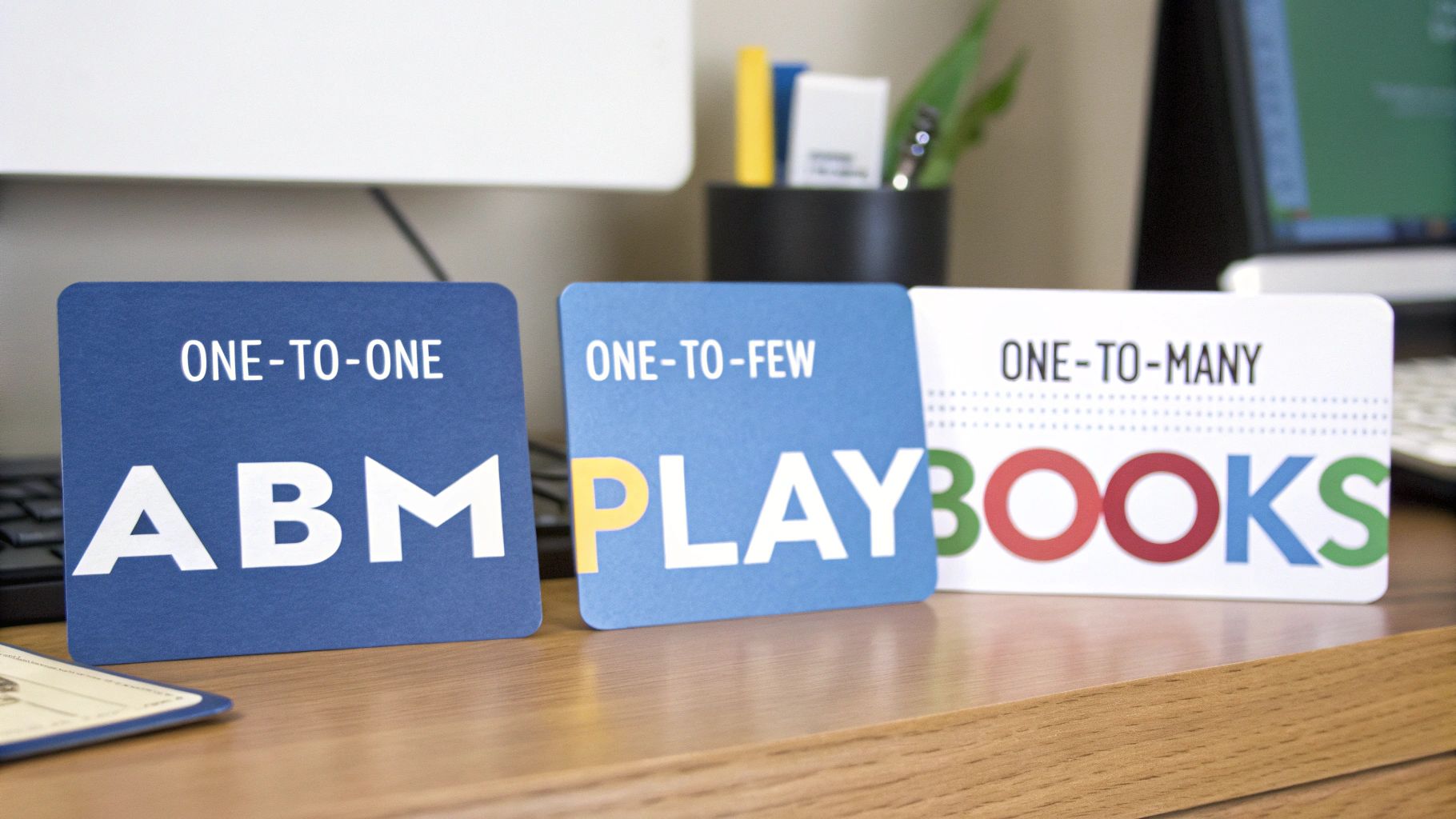
Three primary models form the backbone of most successful ABM programs. Each offers a different blend of personalization and scale, allowing you to calibrate your efforts for maximum impact. These are not rigid rules but strategic starting points to be mixed and matched to fit your business needs.
One-to-One ABM: The Strategic Bet
This is the most resource-intensive version of ABM, often called “strategic ABM.” In this playbook, you treat a single, high-value account as its own market. Your sales and marketing teams collaborate to create deeply bespoke campaigns, content, and outreach aimed squarely at the key decision-makers within that one organization.
This approach is reserved for your highest-value accounts—the logos that could fundamentally alter your company's trajectory. Every touchpoint, from ad copy to the sales presentation, is crafted specifically for their known challenges, strategic goals, and unique company culture. It represents the pinnacle of personalized engagement.
Best for:
- Enterprise-level accounts where the deal size can reach seven figures.
- Companies with long, complex sales cycles involving multiple stakeholders.
- Entering a new strategic vertical or geography by landing a landmark client.
One-to-Few ABM: The Clustered Approach
The One-to-Few model balances deep personalization with practical scalability. Instead of targeting a single account, you group a small cluster of accounts—typically 5 to 15 companies—that share common attributes, such as similar business challenges, industry, or technology stack.
You then build a campaign that addresses their shared pain points but layer in light customization for each company. For example, you might create a webinar for "CFOs in Canadian SaaS companies" and then personalize follow-up emails with company-specific data points. This approach lets you scale efforts without sacrificing the relevance that makes ABM effective.
By focusing on small, homogenous groups, the One-to-Few model allows you to reuse 80-90% of your content and campaign logic while still delivering an experience that feels tailored and relevant to each account in the cluster.
One-to-Many ABM: Scaling with Technology
Often called "ABM at scale," the One-to-Many model applies the principles of personalization across a much larger list of target accounts, sometimes numbering in the hundreds or thousands. This approach relies heavily on technology to deliver customized experiences based on firmographics, industry trends, or buyer intent signals.
Here, personalization might involve dynamic website content that changes based on a visitor's industry or targeted ad campaigns on LinkedIn that speak to the specific challenges of a certain job role within your target accounts. You use your marketing automation platform (like HubSpot or Account Engagement (Pardot)) and CRM (like Salesforce) to orchestrate this broad yet targeted outreach. This model is an excellent entry point into ABM and a powerful complement to a wider go-to-market strategy framework.
Choosing the right playbook—or a combination of them—is critical. A mature ABM program often integrates elements of all three, allowing you to focus intensive resources on the highest-value accounts while engaging a wider set of best-fit companies efficiently and meaningfully.
Building Your ABM Tech Stack in Salesforce and HubSpot
Your ABM strategy is only as effective as the operational engine that powers it. A successful program isn't about acquiring a dozen new tools; it's about optimizing your existing systems—like Salesforce and HubSpot—to work smarter, together. For most B2B teams, the real challenge is shifting their operational mindset from a lead-centric to an account-centric model.
This foundational setup is what enables your sales and marketing teams to operate from a unified playbook. It allows you to track engagement across an entire buying committee, coordinate plays across channels, and measure what truly drives results. Without it, even the most brilliant strategy will falter due to disconnected data and misaligned efforts.

Core System Configuration for ABM
Before adding new software, the most critical step is to configure your CRM and marketing automation platform for account-based operations. This ensures data flows freely and provides the necessary visibility.
1. Build a Framework for Your Target Account List
Everything in ABM starts with your Target Account List (TAL). In Salesforce, this can be as simple as creating a custom field on the Account object, such as a "Target Account" checkbox or an "ABM Tier" picklist (Tier 1, Tier 2). This identifier is the key to unlocking segmentation, reporting, and automation.
2. Ensure Flawless Data Synchronization
The connection between HubSpot and Salesforce must be robust. Lead, contact, and account information must sync bidirectionally in near real-time, providing both teams with a complete view of account activity. Properly mapping fields, especially new ABM-specific ones, is non-negotiable. For a deeper dive, explore the nuances of the HubSpot and Salesforce integration and how to optimize it for revenue success.
3. Create Custom Properties to Track Account-Level Activity
In ABM, individual lead scores are insufficient. You need to understand engagement across the entire account. This requires creating custom properties in both systems to roll up activity from all associated contacts.
- Account Engagement Score: A dynamic score combining activities like email clicks, website visits, and content downloads from everyone at the account.
- Buying Committee Role: A custom contact field to tag key players like "Decision Maker," "Influencer," or "Champion."
- Last Marketing Engagement Date (Account): A field that automatically updates whenever any contact at the account engages with a marketing campaign.
Expanding Your Stack with Essential Integrations
Once your Salesforce and HubSpot foundation is solid, you can layer in specialized tools to amplify your ABM programs. These integrations provide the data and channels needed to find, engage, and win target accounts with precision.
An integrated tech stack transforms ABM from a manual, siloed effort into an automated, orchestrated GTM motion. It's the difference between guessing which accounts are in-market and knowing exactly who to engage and when.
The table below outlines essential technologies that complement a Salesforce and HubSpot setup, turning it into a powerful ABM machine.
Essential ABM Tech Stack Components and Purpose
| Technology Category | Purpose in ABM | Example Tools |
|---|---|---|
| Data Enrichment & Intent | Fills data gaps and identifies which accounts are actively researching solutions like yours. This provides the "who" and the "when." | ZoomInfo, Bombora, 6sense |
| GTM Engineering & Orchestration | Automates complex, multi-step plays required for personalization at scale. This is the brain coordinating all campaign components. | Clay.com, Demandbase |
| Advertising Platforms | Delivers targeted "air cover" and personalized ads to the right people within your target accounts on the professional networks they frequent. | LinkedIn Ads, Google Ads |
| Direct Mail & Gifting | Creates memorable, real-world touchpoints that cut through digital noise and help build genuine relationships with key decision-makers. | Sendoso, Alyce |
These tools are not just add-ons; they are critical components that each play a specific role in executing a modern ABM strategy effectively.
Weaving It All Together
A high-performing ABM tech stack is a living ecosystem. For any RevOps leader, the primary goal is to ensure data from these tools flows seamlessly back into Salesforce and HubSpot, enriching account records with actionable intelligence.
Imagine this scenario: ZoomInfo flags an account on your TAL as showing "intent" for your product category. A workflow should immediately update a field in Salesforce. This update can then trigger a task for the account owner to follow up while enrolling key contacts from that account into a targeted HubSpot email sequence. This is how you transform technology from a simple tool into a strategic revenue driver.
Measuring the Metrics That Actually Matter in ABM
In traditional marketing, the primary question is often, "How many leads did we generate?" In Account-Based Marketing, that question is largely irrelevant. A successful ABM program is not about flooding the top of the funnel; it's about deliberately guiding the right accounts through the pipeline more efficiently.
This requires a complete overhaul of how you measure success. You must replace vanity metrics with KPIs that demonstrate tangible business impact. The mission is to prove that by concentrating efforts on fewer, higher-value accounts, you generate more predictable revenue. For RevOps professionals, this is your opportunity to connect marketing and sales activity directly to the bottom line, using data from your Salesforce or HubSpot instances.

Shifting from Lead-Based to Account-Based KPIs
The first step is a mental one: redefine what constitutes a "good" metric. Instead of focusing on individual lead scores, you need to monitor engagement across the entire buying committee within a target account. This is a crucial pivot, as large B2B deals are rarely won by a single individual but by building consensus among a group of stakeholders.
These core metrics should form the foundation of your ABM reporting:
- Target Account Coverage: What percentage of your ideal accounts have accurate, usable contact data? This indicates your readiness to execute.
- Target Account Engagement: Are the right companies paying attention? This is often a blended score that aggregates website visits, content downloads, and email clicks from all contacts at a given company.
- Buying Committee Penetration: How many key players (VPs, Directors, end-users) have you engaged within a target account? The goal is to build multiple threads of conversation, not just a single point of contact.
The heart of ABM measurement is tracking progression, not just one-off conversions. The question to answer is: "Are our most valuable accounts becoming more engaged and moving closer to a deal over time?" This shift from static snapshots to dynamic trends is what proves ROI.
Measuring Pipeline and Revenue Impact
Ultimately, the executive team cares about revenue. Engagement scores are excellent leading indicators, but they are insufficient if you cannot tie them to pipeline and sales outcomes. Building reports that filter specifically for your target account list is key to making this connection undeniable.
Your goal should be to track the following metrics for your ABM accounts and compare them against your non-ABM baseline. This contrast will showcase the power of a focused strategy.
Key Financial and Sales Velocity Metrics
- Pipeline Velocity: How quickly are target accounts moving through your sales stages? A well-executed ABM strategy should significantly shorten your sales cycle.
- Average Deal Size: Are the deals closed from ABM accounts larger than your company average? Focusing on best-fit clients almost always leads to higher contract values.
- Close Rate: What percentage of opportunities from your target list become closed-won deals? Higher-quality, better-nurtured accounts should naturally close at a higher rate.
- Pipeline Sourced or Influenced: How much of your total pipeline can be attributed directly to your ABM marketing efforts? This metric demonstrates marketing's direct contribution to revenue.
Creating dashboards that bring these KPIs to life isn't just a reporting task; it's a strategic necessity. When you can draw a clear line from increased account engagement to a faster, more valuable sales pipeline, you have built an iron-clad business case for ABM. This data-driven narrative secures the buy-in and budget needed to scale.
Navigating Common ABM Pitfalls
Embarking on an Account-Based Marketing program can feel like a direct path to a better pipeline and larger deals. However, even the most well-devised plans can be derailed by common, critical mistakes. Understanding these pitfalls in advance is key to building a resilient ABM program.
Think of it like building a house: you can have beautiful architectural plans, but a weak foundation compromises the entire structure. Similarly, a brilliant ABM strategy built on shaky operational ground is destined for frustration.
This is your field guide to avoiding the most common traps, with practical advice to keep your program on track.
The Misalignment Chasm Between Sales and Marketing
This is the most significant pitfall. The primary reason ABM programs fail is a lack of genuine alignment between sales and marketing. When these teams operate from different playbooks, with different goals and definitions of success, the entire initiative collapses.
Marketing ends up creating highly personalized campaigns while sales continues with its standard outreach. The result is a disjointed buyer experience and wasted effort.
The solution is not just another meeting but a formal, documented agreement.
Establish a concrete Service Level Agreement (SLA) that outlines exactly who does what. This document should define roles, responsibilities, and shared metrics. It must be crystal clear on what marketing will deliver (e.g., a specific level of engagement from top-tier accounts) and what sales will do in return (e.g., timely, personalized follow-up on those accounts).
Relying on Dirty or Incomplete CRM Data
Your ABM program runs on data. If the data in your Salesforce or HubSpot is inaccurate, outdated, or incomplete, your execution will suffer.
You will target the wrong people at the right companies or, worse, the right people with the wrong message. This not only wastes money but also erodes trust from the outset.
A one-time data cleanup is insufficient. You need an ongoing system.
- Implement rigorous data hygiene processes. This includes regular data validation, deduplication, and enrichment using tools like ZoomInfo.
- Standardize data entry. Create clear rules and use validation settings in your CRM to ensure all new information is clean from the start.
- Assign data ownership. Designate a person or team to be responsible for maintaining the health of your account and contact data.
Creating Personalization That Feels Generic
Another significant pitfall is "personalization" that is merely a mail merge in disguise. Inserting a first name and company name into a template is not true ABM.
Real personalization goes deeper. It speaks to the specific pain points, strategic goals, and industry challenges of your target account. Sending a generic email to a hand-picked list is not ABM; it's targeted spam.
To get this right, you must shift your thinking from individual contacts to the entire account's context. Do your research. Understand what matters to their business. Then, tailor your message, content, and outreach to demonstrate that you've been paying attention.
It’s the difference between "Hi [Company Name]" and "We saw your recent expansion into the APAC region and have helped similar SaaS firms navigate the associated data compliance challenges." One is noise; the other is a conversation starter.
Rushing to Scale Before Proving the Model
The excitement around ABM can tempt teams to scale too quickly. However, launching a massive, company-wide program before validating your approach is a surefire way to burn through your budget and goodwill with little to show for it.
You must prove the concept works on a smaller scale before seeking a larger investment.
Start with a focused experiment. Launch a pilot program targeting just 5-10 high-value accounts. Use this pilot to test your messaging, refine your workflows, and gather early data. This small, controlled test allows you to learn, adapt, and build a powerful business case based on real results before committing to scaling your what is abm strategy.
Launching Your First ABM Pilot Program
Theory and planning cannot replace real-world application. The most effective way to learn is by doing. Instead of a massive, company-wide rollout, the smarter approach is to start with a small, controlled pilot program. Think of it as a test flight that allows you to validate assumptions, refine processes, and gather data to justify a larger investment.
Running a pilot is about de-risking your ABM initiative. It's a focused experiment to prove the concept works for your business before committing significant budget.
Assembling Your Cross-Functional Pilot Team
First, you need a small, dedicated team. This is not just another marketing campaign; it requires a tight-knit, unified effort from the beginning.
Your core pilot team should include:
- A Marketing Lead: This individual will orchestrate the plays, manage content, and handle the marketing automation setup in a platform like HubSpot or Account Engagement (Pardot).
- A Sales Lead: A dedicated Account Executive or sales manager who will own the outreach and build relationships with the pilot accounts. They are on the front lines.
- RevOps/SalesOps Support: This technical linchpin will configure the custom fields, workflows, and reporting dashboards in Salesforce.
This small group acts as the command center for your pilot, ensuring marketing and sales move in lockstep.
Selecting Your Pilot Accounts and Defining Success
With your team assembled, it's time to select your targets. The goal is quality, not quantity.
- Define Your ICP: Start with your Ideal Customer Profile. Get crystal clear on the firmographic and technographic details of a perfect-fit account.
- Choose a Small Group: Select a list of 5 to 10 high-value accounts that precisely match your ICP. It is critical that both sales and marketing are 100% aligned on this list.
- Set Clear Pilot Goals: Define what a "win" looks like for this test. It may not be "closed revenue" initially. Instead, track leading indicators that show progress, such as:
- Higher Account Engagement Scores: A measurable increase in activity from your target accounts.
- Deeper Buying Committee Penetration: The number of new, relevant contacts identified and engaged.
- Meetings Booked: The ultimate early signal—securing those first discovery calls.
Executing a Coordinated Campaign
Now it's time to run the multi-channel play. This is where your RevOps foundation in HubSpot and Salesforce pays dividends, allowing seamless coordination.
A typical pilot campaign might involve:
- Hyper-Targeted Digital Ads: Running LinkedIn ad campaigns aimed exclusively at employees within your pilot companies.
- Personalized Email Outreach: Crafting a custom email sequence that addresses the specific challenges of that account or industry.
- Smart Sales Follow-Up: Automatically triggering tasks in Salesforce for your sales lead to follow up with a personalized note as soon as an account shows a spike in engagement.
Case Study in Action: We worked with a Canadian FinTech company testing a One-to-Few ABM strategy. They selected seven enterprise banking targets and ran a focused three-month pilot, tracking every interaction in Salesforce. The result? They booked meetings with four of the seven accounts—a 57% success rate—and easily secured the internal buy-in to scale the program.
By running a pilot, you move beyond the theory of what ABM is. You start generating tangible proof of its impact on your pipeline, building the momentum and confidence needed to transform your go-to-market approach.
A Few Common ABM Questions We Hear All the Time
Even after you've got the basics down, a few questions always pop up when teams start seriously considering Account-Based Marketing. Let's tackle some of the most common ones head-on.
Isn't This Just a Fancy Name for Targeting Key Accounts?
That's a fair question, but no. While targeting key accounts is definitely part of it, true ABM is a whole different ball game.
Think of it this way: traditional key account targeting is often a sales-led effort where reps chase a list. ABM, on the other hand, is a fully orchestrated play involving marketing, sales, and even customer success. The goal isn't just to reach one person; it's to engage the entire buying committee within that account with personalized, relevant experiences across every touchpoint. It’s a unified mission, not just a sales tactic.
How Long Until We Actually See Results?
Patience is a virtue with ABM. This is a long-term play, not a get-rich-quick scheme. You'll likely see promising early signs within the first 90 days—things like more web visits from your target list or higher engagement with your content. These are great indicators that you're on the right track.
But for the big stuff—actual pipeline and closed deals—you should typically plan for a 6 to 12 month runway, especially if you have a complex sales cycle.
Why so long? Because you're not just closing a single lead; you're building deep relationships and consensus across an entire organization to win a significant deal. The key is to track those early engagement metrics to know your efforts are paying off long before the revenue hits.
We're a Small B2B Company. Can We Realistically Do This?
Absolutely. In fact, being small can be your superpower. Smaller companies are often more nimble and can execute a focused ABM strategy incredibly well without getting bogged down in bureaucracy.
The trick is to start smart, not big. Here’s how a small team can win with ABM:
- Go with a "One-to-Few" approach: Don't try to target 100 companies at once. Start by putting all your energy into your top 10 or 20 dream accounts.
- Run a small pilot: Pick a handful of accounts and test your strategy. Prove the concept works before you go all-in with more resources.
- Work with the tools you have: You don’t need to buy a dozen new platforms. A well-configured CRM like Salesforce or a marketing platform like HubSpot can be the engine for a surprisingly powerful ABM program.
It’s all about quality over quantity. By focusing your efforts, even a small B2B company can run high-impact campaigns that deliver a serious return.
Ready to build an ABM foundation that drives real revenue? MarTech Do specializes in configuring Salesforce, HubSpot, and your entire GTM tech stack to power a scalable, measurable ABM strategy. Learn how we can help you align your teams and optimize your operations for growth.