When you're running digital advertising, you're buying something. But what exactly are you paying for? With Cost Per Impression (CPI), you're paying for eyeballs—the price you pay each time your ad appears on a user's screen. This is a foundational metric in digital advertising, especially for B2B campaigns where the primary goal is building brand awareness and ensuring your message is seen by key accounts.
Understanding Cost Per Impression In B2B Marketing

For marketing operations, sales operations, and RevOps managers, a firm grip on Cost Per Impression is critical for building a solid top-of-funnel strategy. Think of it as renting digital billboard space on a highly targeted highway. You're paying for visibility—the sheer number of times your ad is shown—not for a direct action like a click or a download.
This model is the foundation of brand awareness campaigns. It’s perfect for warming up a cold market or announcing a new product. The objective isn't to generate a lead today. Instead, it's about ensuring your brand name sticks in the minds of your target accounts long before they're ready to buy. To fully leverage this, you must be clear on the difference between an impression and a click, which involves understanding what drives real PPC growth through impressions and clicks.
The Role Of CPM In RevOps
In practice, you don't buy impressions one by one. They are bought and sold in bundles of one thousand. This is where you'll see the term Cost Per Mille (CPM). "Mille" is Latin for thousand, so CPM is the cost for every 1,000 impressions. It has become the standard currency for buying ad visibility.
For RevOps teams operating within Salesforce or HubSpot, tracking these top-of-funnel metrics is ground zero for building a predictable revenue engine. It's how you connect those initial "hello, we exist!" moments to the pipeline and revenue they eventually help create down the line.
In a B2B context, impressions are rarely about a single view. They represent a strategic effort to achieve message saturation within key accounts, ensuring your brand is top-of-mind when a buying cycle begins. This is a vital component of successful demand generation strategies.
This initial visibility is a crucial piece of the RevOps puzzle. To see how it fits into the bigger picture, explore our guide on demand generation vs lead generation.
Setting Realistic Budget Expectations
Calculating your CPM is straightforward. The formula is: (Total Ad Spend ÷ Total Impressions) × 1,000.
So, what should you expect to pay? On the Google Display Network, CPMs can hover between $3 and $10 for broader audiences. But B2B is a different beast. If you're targeting niche sectors like fintech or enterprise SaaS, the competition for those valuable eyeballs gets fierce, pushing costs up to anywhere between $10 and $40.
This significant jump highlights the importance of knowing your market inside and out before you lock in a budget.
Key B2B Advertising Models At A Glance
To help you decide where to allocate your budget, here’s a quick comparison of the most common advertising models. Consider your immediate objective to find the right fit for your B2B goals.
| Pricing Model | What You Pay For | Primary B2B Goal | Common Acronym |
|---|---|---|---|
| Cost Per Impression | Every 1,000 times your ad is displayed | Brand Awareness, Reach, Visibility | CPM |
| Cost Per Click | Each time someone clicks on your ad | Website Traffic, Lead Generation | CPC |
| Cost Per Acquisition | A specific conversion (e.g., signup, download) | High-Intent Leads, Sales, Demos | CPA |
Each model has its place in a well-rounded marketing strategy. CPM builds awareness, CPC drives initial engagement, and CPA secures qualified leads. Choosing the right one—or the right mix—is all about matching your budget to your campaign's strategic objective.
How to Calculate and Benchmark Your Impression Costs
Let's move from theory to application. It's one thing to know what an impression costs, but it’s another to measure it properly and put that figure into the context of your go-to-market strategy. For anyone in RevOps, this is about turning raw ad spend into a clean, reportable metric you can benchmark.
The calculation itself is refreshingly simple. The industry standard is to use Cost Per Mille (CPM), a practical way of bundling impressions into groups of one thousand. This makes it much easier to compare performance across different channels and campaigns.
Here's the formula: CPM = (Total Ad Spend / Total Impressions) x 1,000
Let's walk through a B2B-specific example. Imagine your SaaS company spends $5,000 on a LinkedIn campaign announcing a new integration. That campaign generates 200,000 impressions among your target audience of IT directors.
Plug those numbers into the formula, and you get a CPM of $25. That number is your baseline for analysis and optimization.
What Is a Good CPM for B2B?
A "good" CPM isn't a universal number pulled from a textbook. It depends entirely on your industry, target audience, and campaign objectives. A rock-bottom CPM is meaningless if you're reaching the wrong people. Conversely, a high CPM can be a brilliant investment if it ensures your message reaches a list of high-value target accounts.
For B2B marketers, the benchmarks are almost always higher than in B2C. For example, the average LinkedIn ad CPM hovers around $6.59, but that figure can escalate quickly for competitive keywords or in-demand job titles.
As a RevOps professional, your goal isn't just a low CPM. The mission is to find an efficient CPM—one where every dollar spent on visibility strategically warms up the accounts that matter to your pipeline.
To achieve this, you need to understand the variables driving your costs. These are the levers you can pull to manage your budget effectively without sacrificing necessary reach.
Key Factors That Influence Your Impression Costs
Several key variables directly impact how much you pay for visibility. Mastering these is crucial for optimizing your ad spend and campaign performance.
- Audience Precision: The more specific your targeting, the higher the cost. Aiming for C-level executives in financial services will command a premium CPM compared to a broader campaign targeting all marketing managers.
- Ad Placement and Quality: Not all ad placements are created equal. Premium placements, like the top of the LinkedIn feed or a banner on a major industry publication, cost more. Concurrently, platforms often reward high-quality, engaging ads with better placement and sometimes lower costs.
- Geographic Targeting: Advertising in hyper-competitive markets, like major tech hubs, will always drive up your impression costs. A campaign targeting San Francisco will almost certainly have a higher CPM than one targeting a smaller city.
- Seasonality and Competition: Costs fluctuate with demand. Expect CPMs to spike during major industry events or near the end of the quarter when companies rush to spend their remaining budgets. More competition for the same eyeballs means higher prices.
By analyzing these factors, you can make smarter decisions that balance cost with impact. This strategic approach ensures your brand awareness budget is a calculated investment in future revenue, directly influencing your overall acquisition costs. For a deeper dive, see how these top-of-funnel metrics connect to bottom-line results in our guide on customer acquisition cost calculation.
Choosing The Right Metric: CPM vs. CPC vs. CPA
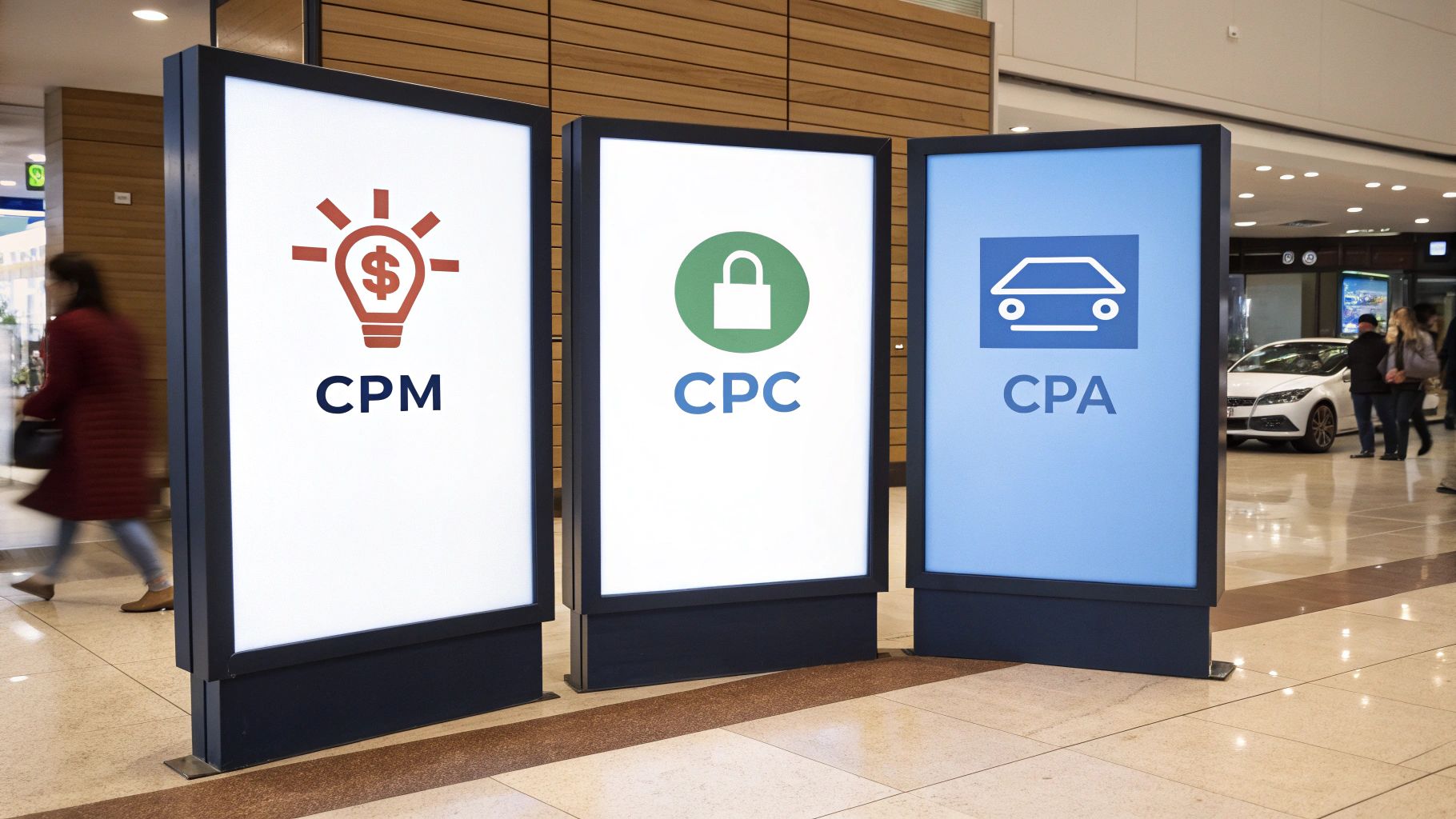
As a RevOps or marketing operations leader, you know every dollar of your budget is under a microscope. Justifying ad spend means choosing the right metric isn't a preference—it's a strategic necessity. The core question is always: are we paying for eyeballs, for genuine interest, or for direct action?
Understanding the differences between Cost Per Mille (CPM), Cost Per Click (CPC), and Cost Per Acquisition (CPA) is the first step toward intelligent budget allocation.
Think of it like exhibiting at an industry conference. Each pricing model aligns with a different objective on the event floor:
- CPM (Cost Per Mille): This is the equivalent of plastering your company’s logo on every banner and sign in the conference hall. You're paying for pure visibility to ensure every attendee sees your name. The goal is brand recognition.
- CPC (Cost Per Click): Imagine you only paid when an attendee stopped at your booth to grab a brochure or ask a quick question. That's CPC. You're paying for a clear signal of interest, driving traffic to your specific offering.
- CPA (Cost Per Acquisition): This is like paying a commission only when someone books a demo or signs up for a trial at your booth. You're paying for a tangible, high-intent action that feeds directly into your pipeline.
Each metric has its place. A mature B2B marketing strategy doesn't pick one over the others; it uses a smart mix of all three, tailored to different stages of the buyer's journey.
Mapping Metrics to the B2B Buyer Journey
To make your budget work within your Salesforce or HubSpot ecosystem, you must align pricing models with your funnel stages. This prevents you from measuring a brand awareness campaign with lead gen metrics—a classic recipe for skewed data.
Top of Funnel (Awareness): This is CPM's home turf. When the goal is breaking into a new market, launching a product, or running an Account-Based Marketing (ABM) play to saturate target accounts, you need to maximize reach. You are getting your message in front of the right people, repeatedly.
Middle of Funnel (Consideration): At this point, CPC starts to shine. Your prospects know they have a problem and are actively seeking solutions. A click on an ad for a whitepaper, webinar, or case study is a strong signal that they've moved from passive awareness to active consideration.
Bottom of Funnel (Decision): This is where CPA is the star player. The goal here is driving conversions—demo requests, free trial sign-ups, consultation bookings. You’re willing to pay more for these actions because they represent high-quality, sales-ready leads that you can track as real opportunities in your CRM.
The Rising Cost of Action and the Value of Efficiency
Choosing the right metric is also a direct response to the ever-increasing cost of advertising. As platforms become more crowded, the price you pay for both attention and action goes up.
For instance, the legal industry sees an average $6.75 cost-per-click, which completely dwarfs the overall average of $2.69. That premium directly inflates CPM costs for anyone competing in tough B2B verticals.
When you consider that the average cost-per-lead (CPL) across all industries is around $198, and digital ad costs are climbing by about 5% annually, efficiency becomes paramount. These numbers highlight why B2B companies need sophisticated marketing operations—not just to track CPM, but to connect initial impression costs all the way through to an eventual lead. You can find more insights on industry pricing benchmarks over at Clutch.co.
In a RevOps context, the choice between CPM, CPC, and CPA is a strategic decision about resource allocation. It’s about asking: "Do we need to build our audience, engage our audience, or convert our audience right now?" Your answer determines where the budget flows.
Ultimately, your MarTech stack is built to provide this full-funnel view. By understanding which metric fits each stage, you can build campaigns that guide prospects from their first impression all the way to a closed-won deal—and prove the ROI of every dollar spent.
Connecting Impression Data to Your RevOps Dashboard
Impressions are often dismissed as a soft, top-of-funnel vanity metric. But for a seasoned revenue operations leader, that’s a significant missed opportunity. To get a complete picture of your go-to-market engine and justify brand spend, you must pipe that impression data directly into your CRM.
The real challenge isn’t just counting ad views. It’s understanding how those first touchpoints influence a cold account's journey toward becoming a closed-won deal. This is where your marketing automation and CRM platforms transform from simple databases into core attribution tools.
Integrating Ad Data Into HubSpot
If you're using HubSpot, connecting the dots is remarkably straightforward. The native ads tool integrates directly with major platforms like Google Ads, LinkedIn, and Facebook, pulling impression and cost data right into your portal.
This integration allows you to see which ads and campaigns specific contacts saw, even if they never clicked. You can finally answer key strategic questions:
- How many times did a contact at a target account see our ads before their first website visit?
- Which ad creative generates the most impressions with our ideal customer profile?
- What is the total ad spend associated with contacts in our current sales pipeline?
This level of integration moves impression data from a standalone ad platform into a tangible data point attached to a contact record within your CRM.
Leveraging Salesforce for Advanced Attribution
For teams running on Salesforce, connecting impression data typically requires a more hands-on approach. While there isn't a single out-of-the-box solution, Salesforce Campaign objects are your key to success.
The standard workflow involves using a third-party integration tool or a custom API to feed data from your ad platforms into Salesforce. You can set up campaigns to mirror your ad initiatives, then use Campaign Members to tag the leads and contacts who were exposed to those ads.
With this setup, you can:
- Track Influence: Log each impression as a specific campaign touchpoint on a contact's activity history.
- Build Smarter Reports: Create Salesforce reports that show how many contacts in a new opportunity were part of an impression-based ad campaign.
- Attribute Real Revenue: Apply campaign influence models to assign a portion of revenue back to the awareness campaigns that warmed up the account initially.
Structuring your data this way is how you finally break free from the limitations of last-touch attribution and start giving credit where it's due.
Embracing Multi-Touch Attribution Models
The real magic happens when you pair this integrated impression data with multi-touch attribution. A simple last-click model is a non-starter; it will almost never give credit to an ad impression because seeing an ad is rarely the final action before a conversion.
Instead, RevOps teams should champion models that recognize the value of these crucial early-stage interactions.
- Linear Model: Spreads credit evenly across every touchpoint, including initial ad impressions.
- Time-Decay Model: Gives more weight to recent touchpoints but still assigns value to the first impressions that started the conversation.
- U-Shaped Model: Puts heavy emphasis on the very first touch (often an impression) and the final lead conversion touch, highlighting what started the journey and what closed the loop.
Choosing the right model helps you prove that the $6.59 CPM you spent on LinkedIn wasn't just an expense—it was a strategic investment that helped source a $50,000 pipeline opportunity six months later. To dig deeper into connecting these dots, check out our complete guide on how to measure marketing ROI.
By building a dashboard that visualizes this entire journey, you give your organization the confidence to make smarter decisions about brand spend. You prove that every impression truly counts.
When to Use Impression-Based Campaigns in B2B
It's tempting to chase clicks and conversions, and metrics like CPC and CPA are crucial for capturing existing demand. But a mature marketing strategy knows you must create demand first. This is where impression-based campaigns, leveraging a Cost Per Mille (CPM) model, become the best tool for the job.
From a go-to-market engineering standpoint, think of impression campaigns as a tool for precision and saturation. It’s about ensuring the right message reaches the right accounts frequently enough to build familiarity and trust—long before they start a buying journey.
Let's examine the key B2B scenarios where this approach shines.
Launching a New Product or Entering a New Market
When you’re the new player in a market, you can’t afford to be quiet. Your first objective isn't generating leads; it's ensuring your ideal customers know a better solution has arrived.
An impression-based campaign is perfect for this. It lets you broadcast your message and brand across a specific audience segment. By concentrating on getting your name, logo, and core value proposition seen repeatedly, you lay the groundwork for brand recall that will make all future lead-gen efforts more successful.
An impression-based launch is the digital equivalent of a grand opening. You're not counting how many people walk in on day one; you're making sure everyone in town knows you're open for business.
Executing an Account-Based Marketing Strategy
Account-Based Marketing (ABM) is arguably the most powerful use case for impression-based advertising. Here, the goal isn't to reach the most people; it's to ensure your message is seen by every key stakeholder within a hand-picked list of target companies.
In an ABM play, a higher CPM can be a positive indicator. It often means you're successfully reaching a valuable, niche audience. The goals are clear:
- Surround the Buying Committee: Ensure everyone from decision-makers to end-users within a target account sees your ads.
- Create Internal Buzz: When multiple people at the same company see your brand, it sparks internal conversations that can kickstart a buying cycle.
- Warm Up Accounts for Sales: An impression campaign paves the way for your sales team. When they make contact, they’re met with a familiar name, not a cold shoulder.
Running High-Value Retargeting Campaigns
A prospect who visited your pricing page or downloaded a key resource is highly valuable. You cannot let them forget about you. Impression-based retargeting is how you stay top-of-mind during their decision-making process.
By showing these engaged prospects relevant ads across the web, you constantly reinforce your message and remind them why they were interested. This is vital in B2B, where sales cycles can last for months. A simple display ad can be the nudge that keeps you from being forgotten while they evaluate competitors.
Budgeting for Competitive Markets
It’s important to remember that not all impressions are priced equally. Costs can vary dramatically by geography, particularly in major tech hubs. For B2B companies targeting California, for example—one of the most competitive tech markets in North America—you should expect to pay a premium CPM. Factoring these higher rates into your budget is essential for accurate forecasting and ROI analysis. To understand how much costs can vary, explore Facebook CPM rates across different regions.
Ultimately, using impression-based ads effectively means tying the metric to a clear business goal. Whether you’re building brand awareness, executing a targeted ABM campaign, or nurturing warm leads, CPM is a fundamental part of a powerful, full-funnel marketing engine.
Got Questions About Cost Per Impression? We've Got Answers.
Even for seasoned RevOps and marketing professionals, the details of impression-based advertising can be complex. Let's clarify some of the most common questions that arise when planning strategies and analyzing performance data.
Is a Lower CPM Always Better?
No, not in B2B. A rock-bottom Cost Per Mille (CPM) might feel like a win, but it often means your ad is being shown to a broad, unfocused audience. If your goal is general brand exposure, a low CPM can work.
However, in the B2B world, a higher CPM is often a signal of precision. It means you're paying a premium to get your ad in front of a specific, high-value audience—like C-suite executives in the fintech space or a curated list of target accounts. A "good" CPM isn't about being cheap; it's about being efficient.
The best CPM aligns with your campaign goals and the value of the audience you’re trying to reach. The focus should be on efficient spending, not just cheap spending.
Consider this: a $5 CPM that hits an audience with zero interest in your product is $5 wasted. A $40 CPM that ensures your top ten target accounts see your message multiple times could be the best investment you make all quarter.
How Do Impressions Actually Help with Lead Generation?
Impressions are the foundational, top-of-funnel work that sets the stage for future leads. An impression alone won't make someone fill out a form, but it builds the brand familiarity and trust essential for them to take the next step.
Think of it as laying the groundwork for a relationship. A prospect who has seen your company's ads across different channels is far more likely to:
- Recognize your brand when a sales representative reaches out.
- Click on a later ad for a webinar or a guide because your name is already familiar.
- Choose your solution from a search results page because your brand feels more credible and established.
With multi-touch attribution models in your CRM, you can trace this influence and see how many "impression" touchpoints a contact had before they became a lead. This data proves how top-of-funnel visibility directly feeds the sales pipeline.
Can I Actually Track Impressions in Salesforce or HubSpot?
Absolutely. Both HubSpot and Salesforce are designed to connect your top-of-funnel ad data with bottom-of-funnel revenue. They approach it differently, but the objective is the same: to provide a complete picture of performance.
How HubSpot Handles It:
HubSpot simplifies this with its native Ads tool. You can directly connect it to major ad platforms like Google, LinkedIn, and Facebook. Once connected, it automatically pulls in impression, click, and cost data and links this information directly to contact records, so you can see which ads an individual saw on their journey.
The Salesforce Approach:
Tracking impressions in Salesforce typically requires a more custom setup. The standard method involves using Campaign objects and an integration to pipe in your ad data. You create Salesforce Campaigns that mirror your ad campaigns, allowing you to log impression data as touchpoints against lead and contact records. This setup is incredibly powerful for building reports that show how ad visibility on target accounts drives new opportunities.
What's the Real Difference Between CPI and CPM?
While these terms are often used interchangeably, there is a small technical difference between Cost Per Impression (CPI) and Cost Per Mille (CPM).
- Cost Per Impression (CPI) is the literal cost for a single ad view. The math is simple:
Total Ad Spend / Total Impressions. - Cost Per Mille (CPM) is the industry-standard pricing model, representing the cost for one thousand impressions. The formula is
(Total Ad Spend / Total Impressions) x 1,000.
In practice, you will almost always work with CPM. Dealing with fractions of a cent for a single impression (CPI) is impractical for buying or reporting. When building your budget or analyzing performance, CPM is the metric that matters.
At MarTech Do, we help B2B companies build the operational foundation needed to connect every marketing dollar to real revenue. Whether you need to audit your Salesforce setup, implement HubSpot for the first time, or engineer a full-funnel GTM strategy, our team has the expertise to drive measurable growth. Learn how we can help you optimize your RevOps engine.