Demand generation isn’t about chasing leads. It’s the art and science of making your ideal customers want what you sell—often before they even realize they need it. It’s a comprehensive marketing strategy designed to build awareness and educate your market, creating a pipeline of prospects who are already familiar with and trust your brand.
What Is Demand Generation In B2B

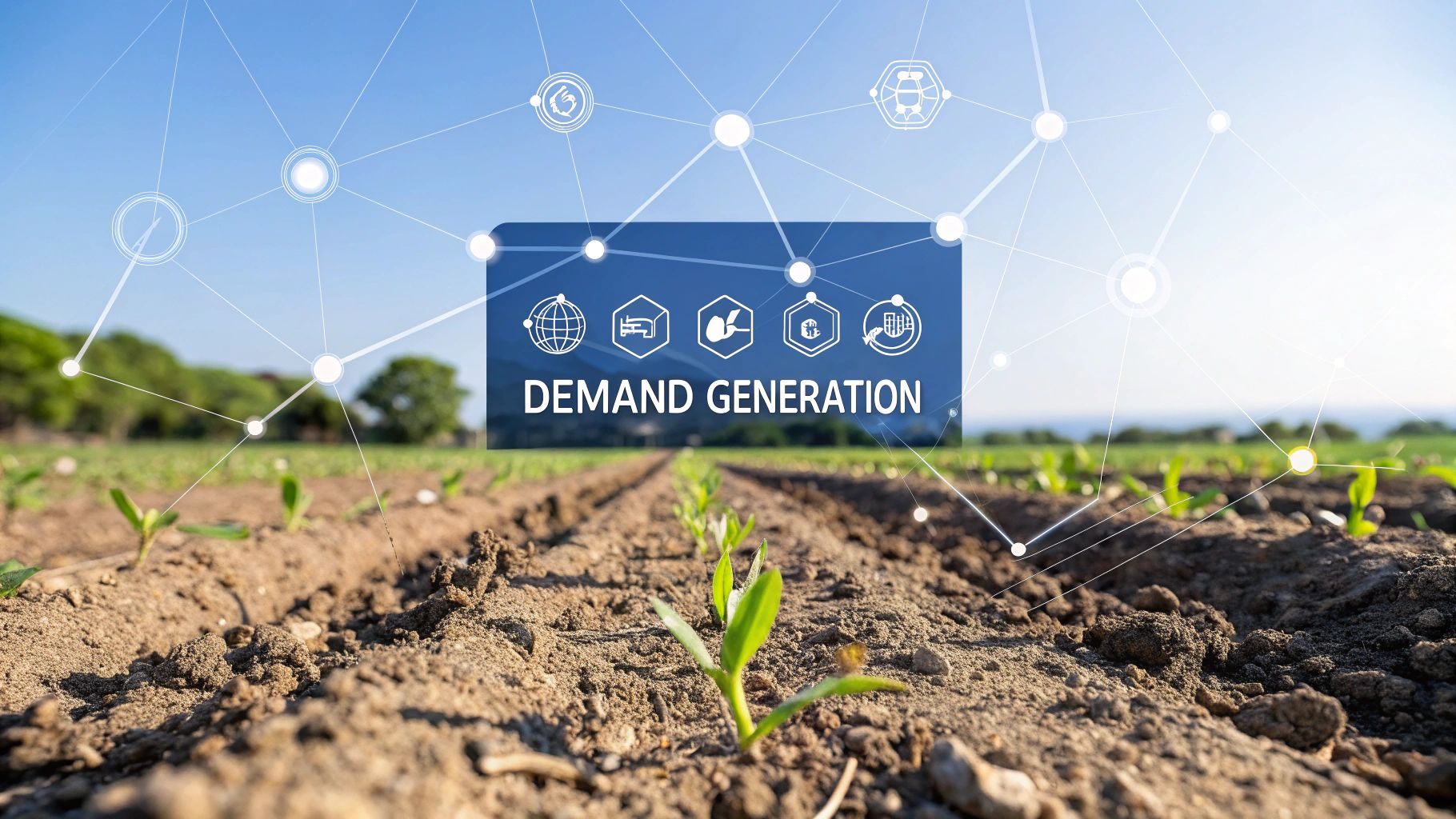
Think of demand generation as preparing fertile ground long before planting seeds. You’re creating an environment where future sales can flourish. This is a long-term play, focused on building authority and trust so that when a buyer is ready to make a decision, your company is the obvious choice.
This isn’t about quick wins or immediate conversions. It’s a full-funnel strategy that nurtures relationships over time by guiding potential customers with genuinely valuable, educational content that solves their problems. The goal is simple: when a buyer starts their research, your company is already on their mental shortlist. After all, studies show that 86% of enterprise buyers end up choosing a solution they were aware of before their formal search even began.
A Shift From Pushing To Pulling
Traditional marketing was all about interrupting prospects and pushing for a sale. Demand generation completely flips that script. It’s about pulling customers in organically by being a helpful, authoritative resource—not a pushy salesperson.
This strategy is built on a few core principles:
- Educate First, Sell Later: You share real value through insightful blogs, webinars, and expert guides without asking for anything in return upfront.
- Build Brand Authority: The aim is to position your company as a thought leader, becoming the go-to source for reliable information in your niche.
- Nurture Relationships: It’s about using automation tools like Salesforce Account Engagement or HubSpot to deliver consistent, relevant messaging that keeps you top of mind.
This “pull” approach is fundamentally different from its more direct cousin, lead generation. While the two are often used together, it’s critical to understand how they differ. You can explore a full breakdown in our detailed comparison of demand generation vs. lead generation.
Demand generation isn’t just a marketing function; it’s a comprehensive go-to-market strategy. It aligns marketing and sales to create a cohesive experience that builds trust and drives predictable revenue by making your brand the preferred choice long before a sales conversation ever begins.
The Modern GTM Engineer’s Role
In this framework, the role of the Go-to-Market (GTM) Engineer has become indispensable. These are the technically-minded RevOps and marketing operations professionals who bridge the gap between marketing strategy and execution.
Using powerful data enrichment and automation platforms like Clay.com, GTM Engineers construct sophisticated workflows that spot high-intent signals and trigger hyper-personalized outreach at scale. This allows B2B companies to move beyond generic, one-size-fits-all campaigns. Instead, they can build intelligent, data-driven motions that continuously fuel the demand generation engine. As Clay.com explains, this role is about transforming how companies go to market by automating everything from lead sourcing and enrichment to personalized outreach, ensuring the right message reaches the right person at exactly the right moment.
How the B2B Buyer Journey Shapes Your RevOps Strategy

The old TOFU/MOFU/BOFU funnel is too rigid for the non-linear way B2B buyers actually make decisions. They don’t march neatly from one stage to the next; they conduct their own research, consult with peers, and form opinions long before they ever want to engage with a salesperson.
For RevOps, sales ops, and marketing ops professionals, this means we can’t build a simple, straight-line process in our CRM. We need to architect a more fluid and intelligent journey. Instead of a rigid funnel, let’s map our demand generation efforts to the three core stages of the modern buyer’s journey: Awareness, Consideration, and Decision. This framework helps us align our content, automation, and sales plays with what buyers actually need, turning an anonymous visitor into a qualified opportunity in Salesforce or HubSpot.
The Awareness Stage: Earning Trust, Not Leads
In the Awareness stage, your potential customer is just starting to realize they have a problem. They aren’t looking for your product yet—they’re trying to understand their business pain. Your goal here is to be the most helpful, educational resource available.
This is not the time for a hard sell or a “request a demo” CTA. Your entire focus should be on building authority and trust.
- Content That Works: Think high-level, ungated content. Insightful blog posts, original research reports, and sharp industry analysis are perfect here.
- Where to Share It: Go where your ideal customers already are. Share this content on LinkedIn, in niche online communities, or through industry podcasts.
- The RevOps Angle: Use your marketing automation platform (like Salesforce Account Engagement or HubSpot) to track engagement. Identify which topics are getting the most attention from your target accounts. This data is invaluable for planning your next content move.
The Consideration Stage: Shaping the Solution
Once a buyer has a clear handle on their problem, they enter the Consideration stage. Now, they’re actively researching how to solve it, comparing different methodologies and approaches. They aren’t quite comparing vendors yet, but they’re getting close.
Your content needs to shift from defining the problem to detailing the solution. This is where you can start introducing your company’s unique point of view on how to tackle their challenge.
The real magic of demand generation happens here. You’re not just selling a product; you’re educating buyers on the best way to solve their problem. By doing this effectively, you build a strong preference for your type of solution before they even look at your competitors.
This is the time for more in-depth, interactive content. A detailed webinar that walks through a specific framework or a comprehensive guide can help a buyer visualize what success looks like. Your goal is to shape their buying criteria in your favor.
The Decision Stage: Proving Your Value
Finally, in the Decision stage, the buyer knows what kind of solution they want and is actively evaluating specific vendors. They’re building a shortlist and looking for proof that your product will deliver. Credibility and trust are paramount.
Your job is to make the purchasing decision feel as safe and easy as possible, especially for the internal champion who has to sell it to their team.
- Content That Converts: This is where you bring out the heavy hitters: detailed case studies, powerful customer testimonials, and ROI calculators. Offering a free trial or an interactive product demo lets them see the value for themselves.
- Connecting Sales and Marketing: A seamless link between your marketing automation and CRM is non-negotiable here. High-intent signals, like someone visiting your pricing page, should immediately trigger an alert for your sales team in Salesforce, enabling them to reach out with timely, relevant information.
- Orchestration in Action: In HubSpot or Salesforce Account Engagement, you can build automation that serves up case studies based on a prospect’s industry. A GTM Engineer could even use a tool like Clay.com to enrich lead data on the fly, ensuring every touchpoint is personalized and helps move the deal forward.
Here in the San Francisco tech scene, mastering this journey is key. A staggering 87% of B2B marketers confirm that content strategies are highly effective for demand generation. This shows just how much California’s top SaaS firms have shifted their go-to-market playbooks to focus on educating buyers at every single stage. To see more trends, check out these B2B marketing insights on Single Grain.
Picking Your Demand Generation Channels And Tactics
A solid demand generation strategy isn’t about being everywhere at once. It’s about being in the right places, consistently. The key is to zero in on the channels where your ideal customers are already spending their time, looking for answers to their problems. For B2B companies running on platforms like Salesforce and HubSpot, the goal is to build a cohesive engine that creates, captures, and converts demand—without wasting budget on channels that don’t perform.
Forget the “spray and pray” method. The most effective strategies involve picking a few core channels and dominating them. This focused approach ensures your message lands and builds the authority and trust that demand generation is all about. Take California’s B2B scene, for example. It’s fiercely competitive. A recent look shows 87% of businesses still swear by email as their top channel, and 89% now use LinkedIn, with a staggering 62% reporting it’s highly effective for getting leads. For more on that, check out some B2B growth insights at Pepper Insight.
Content Marketing And SEO: The Foundation Of Trust
Think of content as the fuel for your entire demand gen machine. It’s how you educate your market, demonstrate expertise, and build an audience that trusts you long before they consider buying. Your content plan should mirror the buyer’s journey, offering real value at every step.
What does that look like in practice?
- Educational Blog Posts: Don’t just skim the surface. Write the definitive guides and deep-dive articles that solve the tough problems your audience faces.
- Original Research And Reports: Nothing establishes authority like publishing your own unique data. Create reports that get people talking, sharing, and citing your brand.
- Webinars And Virtual Events: These are perfect for tackling complex topics. They create a space for genuine interaction and learning, putting a human face to your brand.
All of this must be built on a solid SEO foundation. When you target the right keywords and truly understand search intent, you create a natural, steady flow of organic traffic. It’s a “pull” strategy—drawing people in because you have the answers they’re looking for.
The secret to great demand gen content is simple: give away your best ideas for free. When you consistently deliver value without asking for anything in return, you build a loyal following that will come to you first when they’re finally ready to buy.
Email Nurturing With Salesforce And HubSpot
Once you’ve sparked someone’s interest with your content, email is how you sustain that engagement. Tools like Salesforce Account Engagement (fka Pardot) or HubSpot Marketing Hub are built for this, letting you create smart, automated sequences that deliver the right message at the right moment.
The goal here isn’t to hammer prospects with sales pitches. It’s about using marketing automation to guide them. For instance, if someone downloads a guide on a particular challenge, your system can automatically follow up with a related case study or an invitation to a webinar on that same topic. It feels helpful, not pushy.
This targeted nurturing keeps your brand top-of-mind and builds credibility over time. Your RevOps team can track all this engagement in your CRM, spotting the buying signals that indicate a prospect is ready for a real conversation. That’s when you get a warm, well-informed handoff to sales.
LinkedIn Engagement And Social Selling
For any B2B company, LinkedIn is non-negotiable. It’s the digital town square where everyone from front-line practitioners to C-level executives is talking shop.
A winning LinkedIn strategy has two parts:
- Your Company Page: This is your home base. Share your best educational content, celebrate your customers’ wins, and plant your flag with a strong point of view on where the market is headed.
- Your People: This is your secret weapon. Encourage your in-house experts to build their own personal brands. When they share authentic insights and have real conversations, they build a level of trust that a corporate logo just can’t match.
Remember, LinkedIn is for listening as much as it is for talking. Monitor relevant hashtags and join conversations where you can offer genuine help. To ensure you capture interest whenever it strikes, consider adding a lead generation chatbot to your site. It can provide answers and capture leads 24/7, even when your team is offline.
How The GTM Engineer Scales Demand Generation

As demand generation programs mature, a new kind of operator is becoming essential: the Go-to-Market (GTM) Engineer. This isn’t just a new title for a marketing technologist. It’s a different way of thinking about how B2B companies drive growth.
A GTM Engineer is a unique blend of strategic marketer and technical problem-solver. They operate at the intersection of high-level strategy and tactical execution, building the automated, data-centric systems that allow demand generation to break free from manual work and scale effectively.
From Manual Effort To Automated Intelligence
Think about how teams used to find high-intent buyers. It was a manual grind of digging through LinkedIn for job changes or funding announcements, then dumping findings into a spreadsheet for sales. The process was slow, error-prone, and impossible to do consistently at scale.
This is where the GTM Engineer flips the script. Using powerful data orchestration tools, they build intelligent workflows that automate that manual labor. They connect different data sources to pinpoint timely buying signals, enrich account details, and automatically kick off personalized outreach in platforms like HubSpot or Salesforce Account Engagement.
A GTM Engineer’s primary role is to turn go-to-market strategy into an operational reality. They take a business goal—like finding companies with new leadership—and build an automated machine to execute it perfectly, every single time. It’s about turning ideas into measurable pipeline.
For any business serious about revenue growth, understanding the principles of GTM Engineering is no longer optional.
A Practical Example: Building An Automated GTM Play
Let’s make this tangible. Imagine your strategy is to connect with companies that just hired a new VP of Marketing, since that’s a perfect time to pitch your services.
Here’s how a GTM Engineer automates that entire motion from start to finish:
- Identify the Trigger: First, they set up a workflow that constantly monitors LinkedIn Sales Navigator. It’s looking for companies in your ideal customer profile (ICP) where someone with the title “VP of Marketing” started in the last 90 days.
- Enrich the Data: As soon as a match is found, the system gets to work. It automatically finds the company’s domain, the new VP’s professional email and direct-dial phone number, and even pulls in extra context like the company’s tech stack or recent news.
- Personalise at Scale: Next, the workflow uses all that rich data to draft a highly personalized welcome email. It can mention the new hire by name, their company, and even reference a recent company milestone to show you’ve done your homework.
- Automate Outreach: Finally, the system pushes the new contact and the personalized message straight into a HubSpot or Salesforce sequence. The new VP is enrolled in a tailored welcome campaign without a single person having to lift a finger.
This is the kind of system that separates good demand generation from great demand generation. It’s how modern teams stop blasting generic messages and start creating intelligent, data-driven programs that run 24/7, turning a smart idea into a predictable revenue engine.
Building Your B2B Demand Generation Tech Stack

Think of your technology as the central nervous system for your entire demand generation engine. For those of us in RevOps, marketing ops, or sales ops, the game isn’t about collecting shiny new tools. It’s about building an integrated system that provides a single source of truth, breaks down data silos, and maps the entire customer journey.
A powerful tech stack isn’t a luxury; it’s what pulls you out of guesswork and into data-driven decision-making. When done right, it ensures marketing and sales are perfectly in sync, creating a seamless path from a prospect’s first click to their renewal.
Core Foundational Platforms
At the heart of any effective B2B tech stack are two non-negotiable platforms. These are your command centers, the systems that hold customer data and manage engagement from start to finish.
- Customer Relationship Management (CRM): Your CRM is the definitive record for all customer and prospect data. Whether you’re using Salesforce Sales Cloud or HubSpot Sales Hub, this is where you track every interaction, manage deal stages, and see revenue outcomes. It’s the bedrock of sales operations and forecasting.
- Marketing Automation Platform: This is where your campaigns come to life. Tools like Salesforce Account Engagement (fka Pardot) or HubSpot Marketing Hub handle everything from email nurturing and lead scoring to campaign attribution. For a closer look, check out our guide on the top marketing automation platforms.
Data Enrichment and GTM Engineering
Great demand generation runs on great data. Generic, one-size-fits-all messaging fails because it lacks context. This is precisely why data enrichment and Go-to-Market (GTM) engineering tools are essential for personalizing outreach at scale.
These platforms feed your core systems with accurate, up-to-date information, effectively turning anonymous website visitors into detailed account profiles.
A well-integrated tech stack is more than just a set of tools; it’s a strategic asset. It transforms raw data into actionable intelligence, enabling you to identify high-intent accounts, personalise engagement, and prove the direct revenue impact of your marketing efforts.
Platforms like ZoomInfo lay the groundwork with essential firmographic and contact data. But GTM engineering tools like Clay.com take things to a whole new level. They let you build sophisticated workflows that spot real-time buying signals—like a target company hiring for a specific role or adopting a new technology—and then trigger automated, hyper-relevant outreach.
Analytics and Content Tools
To round out your stack, you need tools that help you understand what’s working and create the content that fuels your entire engine.
- Analytics and Attribution: Your CRM and marketing automation platforms have their own reporting, but dedicated analytics tools can give you much deeper insights. They help you unravel multi-touch attribution, showing you which channels and campaigns are really driving your pipeline.
- Content and Engagement: This category is broad, covering everything from webinar platforms to your content management system. As you build out your B2B demand generation tech stack, it’s also smart to look into advanced AI content generation tools to help produce content more efficiently and improve your SEO.
The right technology makes your strategy come alive. AI-driven tools are already making a huge impact in this space, with some California B2B firms reporting 30% faster pipeline growth and up to 5x higher engagement rates. You can find more details on these trends and learn about the latest demand generation tools that are shaping the industry.
Measuring The KPIs and Revenue Impact
If you can’t measure it, you can’t improve it. It’s an old saying, but it’s the gospel truth in demand generation. It’s easy to get caught up in vanity metrics like website traffic or social media likes, but experienced RevOps leaders know the real story is told in pipeline and revenue. To prove your strategy is working, you must look past surface-level numbers.
The end goal isn’t just a report; it’s building a dashboard in Salesforce or HubSpot that gives leadership a clear view of how marketing’s efforts are fueling growth. That means zeroing in on the key performance indicators (KPIs) that tie your demand generation engine directly to financial results.
Core Metrics That Matter
To demonstrate real impact, your reporting needs to center on a handful of powerful metrics. These are the KPIs that shift the conversation from “marketing is a cost center” to “marketing is a revenue driver.”
Here are the essentials you need to track:
- Marketing Sourced Pipeline: This is the big one. It’s the total dollar value of every sales opportunity that started with a marketing campaign. This metric directly measures how well you’re creating new, qualified business for the sales team.
- Pipeline Velocity: How quickly are deals moving from the first conversation to a signed contract? Pipeline velocity is the pulse of your sales funnel; it tells you how healthy and efficient the process is and shines a light on bottlenecks slowing down cash flow.
- Customer Acquisition Cost (CAC): Simply put, how much does it cost in sales and marketing spend to win a new customer? A well-oiled demand generation program should steadily drive this number down over time by creating a more efficient, predictable path to purchase.
- Lifetime Value (LTV): This metric projects the total revenue you can expect from a single customer over their entire account life. When you compare it to CAC (the LTV:CAC ratio), you get a powerful snapshot of your long-term profitability and whether your growth strategy is sustainable.
A strong demand generation program doesn’t just fill the top of the funnel; it improves the entire revenue equation. By tracking metrics like pipeline velocity and LTV:CAC, you can prove that you’re not just generating leads, but creating profitable, long-term customer relationships.
Navigating Marketing Attribution
Attribution is one of the trickiest puzzles in B2B marketing, but getting it right is critical. Today’s buyer journey isn’t a straight line—it’s a winding road with multiple touchpoints. A simple “last-touch” model that gives all credit to the final click is no longer sufficient. It completely ignores everything that came before.
That’s why it’s so important to set up more sophisticated attribution models inside your CRM. This is how you start to understand the full impact of your campaigns.
- First-Touch Attribution: This model gives 100% of the credit to the very first interaction a prospect had with your brand, whether it was a blog post, a webinar, or a social ad. It’s fantastic for figuring out which channels are best at sparking initial awareness and bringing new people into your ecosystem.
- Multi-Touch Attribution (e.g., W-Shaped): This is where things get more insightful. A multi-touch model spreads credit across several key milestones in the buyer’s journey—like the first touch, lead conversion, and opportunity creation. A W-shaped model, for example, gives you a far more balanced picture of how different activities work together to guide a prospect from stranger to customer.
By adopting a multi-touch attribution model, you can finally connect the dots and show how your early-stage awareness efforts (like that podcast or LinkedIn post) are just as vital as the demo request form they filled out last week. This complete picture empowers you to make smarter budget decisions and tune your entire demand generation strategy for what really matters: maximum revenue impact.
Frequently Asked Questions
When you’re knee-deep in building a demand generation strategy, questions are inevitable. Here are straightforward answers to some of the most common ones we hear from RevOps, sales ops, and marketing ops leaders.
How Long Until We See Results?
Let’s set the right expectation: demand generation is a marathon, not a sprint. While you can get some quick hits from paid ads, a solid, content-led strategy needs time to mature. You should plan for about six to nine months before you start seeing a meaningful impact on your pipeline.
In the early months, monitor leading indicators. Are you seeing more organic traffic? Is content engagement increasing? Is your newsletter subscriber list or social following growing? These are the early signs that you’re building a solid foundation, which will eventually turn into a steady stream of qualified opportunities and revenue.
Can Small B2B Companies Actually Succeed With Demand Generation?
Absolutely. In fact, it can be their secret weapon. For smaller teams, the game isn’t won with a huge budget; it’s won with focus. Don’t try to be everywhere at once. Instead, pick one or two channels where your ideal customers live, and aim to completely own that space.
Your goal should be to create the absolute best content for a very specific, high-value problem in your niche. When it comes to demand generation, quality and relevance will always beat quantity. This laser-focused approach lets you build a powerful growth engine without needing the massive resources of an enterprise company.
The smartest demand generation plays for smaller teams are hyper-focused. They win by becoming the go-to expert in a narrow field. That deep trust they build with a core audience is what turns early followers into their biggest champions.
What’s The Difference Between Demand Generation And Demand Capture?
This is a great question, and it’s helpful to think of them as two parts of a whole. You can’t have one without the other for a healthy pipeline.
- Demand Generation is about creating demand. You’re educating the market, making people aware of a problem they might not have had a name for, and showing them why they need a solution like yours. It’s the top-of-funnel work.
- Demand Capture is about being there when someone raises their hand. It’s ensuring that when a buyer finally decides to look for a solution, you’re easy to find. This is where tactics like paid search ads for specific keywords and a strong SEO presence come in, catching those who are ready to engage.
Essentially, demand generation fills the funnel by building brand awareness and trust. Demand capture converts that trust into real sales opportunities when the buyer is ready to act.
Ready to build a demand generation engine that drives measurable revenue growth? MarTech Do specialises in aligning your marketing operations, sales processes, and technology stack. We help B2B companies using Salesforce and HubSpot to design and implement strategies that turn marketing efforts into predictable pipeline.