
Revenue forecasting is the process of estimating a company’s future revenue over a specific period—be it a month, quarter, or year. For B2B organizations, this involves a rigorous analysis of historical sales data, current pipeline health, and broader market trends to produce a reliable financial projection.
Understanding Revenue Forecasting Beyond the Numbers

Moving beyond the textbook definition, revenue forecasting is your company’s strategic compass. It transforms raw pipeline data from your CRM into a reliable map for future growth. This isn’t just a financial chore; it’s the operational heartbeat that aligns your entire go-to-market team—from marketing to sales and customer success.
Think of it as a ship’s navigation system. It uses historical data (past performance) and current conditions (market shifts, deal velocity) to chart the most efficient course toward your revenue targets. Mastering this process is fundamental to making the smart, data-driven decisions that propel the business forward.
The Strategic Role in RevOps
For a RevOps leader living in platforms like Salesforce or HubSpot, an accurate forecast is the single source of truth. It’s the bedrock of any sound go-to-market strategy. A well-constructed forecast directly informs:
- Resource Allocation: Justify marketing spend on specific campaigns by projecting their downstream impact on pipeline and revenue.
- Sales Quotas: Set challenging yet achievable targets for sales teams, which is critical for morale and high performance.
- Strategic Hiring: Plan headcount additions with confidence, ensuring you have the right people in place to manage future demand.
- Investor Confidence: Demonstrate predictable growth and operational control to stakeholders and your board.
Revenue forecasting transforms raw CRM data into business intelligence. It’s the bridge between what your sales team is doing today and where the company will be next quarter.
Connecting Internal Data with External Factors
A strong forecast cannot exist in a vacuum; it must account for external market dynamics. For instance, revenue forecasting in Canada is often influenced by shifts in Gross Domestic Product (GDP). When GDP figures are revised, it directly affects economic growth projections, which in turn helps refine the accuracy of a company’s revenue models.
Ultimately, a solid grasp of forecasting is crucial for all forms of business planning. This understanding is essential when building detailed financial projections within a feasibility study for a new project, as it reveals the true potential beyond just top-line numbers. By weaving together internal metrics from your marketing automation and CRM platforms with the realities of the external economy, your forecast becomes a much more powerful and reliable strategic tool.
Choosing Your B2B Forecasting Model
Selecting the right revenue forecasting model is not a one-size-fits-all decision. The optimal approach depends on your company’s maturity, the quality of your CRM data, and the predictability of your sales process. For marketing, sales, and RevOps leaders, the objective is to choose a method—or a blend of methods—that provides the most realistic picture of future revenue.
Think of these models as different lenses for viewing your sales pipeline. Each offers a unique perspective, highlighting different strengths and weaknesses within your revenue engine. Let’s break down the four most common models that B2B companies rely on.
Historical Forecasting
This is the most straightforward model. Historical forecasting operates on a simple premise: future performance will mirror past results. To implement it, you would take the revenue from a previous period—such as the same quarter last year—and use that figure as a baseline. You might then adjust it for expected growth, for example, adding 10% if that’s your target.
This method is easy and requires minimal complex data, making it a common starting point for new businesses or companies with highly stable, predictable sales cycles. However, its simplicity is also its primary weakness. It completely ignores critical factors like market shifts, new competitors, changes in sales team performance, or the health of your current pipeline.
Opportunity Stage Forecasting
This is a classic, CRM-driven model and a favorite among teams operating in platforms like Salesforce or HubSpot. Opportunity stage forecasting works by assigning a close probability to each stage of your sales pipeline. For example, an opportunity in the “Discovery” stage might have a 10% close probability, while a deal in “Contract Negotiation” could have an 80% probability.
The forecast is calculated by multiplying each opportunity’s value by its stage-based probability and summing the results.
For example: If you have a $50,000 deal in the “Proposal Sent” stage (50% probability) and another $100,000 deal in “Verbal Commitment” (90% probability), your weighted forecast would be ($50,000 * 0.50) + ($100,000 * 0.90) = $115,000.
This model is far more dynamic than historical forecasting because it reflects your active pipeline. However, its accuracy is entirely dependent on your team’s discipline in updating the CRM and the clarity of your sales stage definitions.
Sales Cycle Length Forecasting
For businesses with a consistent and predictable sales motion, sales cycle length forecasting offers a time-based perspective. This model predicts when deals are likely to close based on the average time it takes for an opportunity to move from creation to a signed contract.
It functions by analyzing the age of each open opportunity. If your average sales cycle is 90 days, a deal created 80 days ago is considered a strong candidate for closing within the current quarter. This method is particularly useful for SaaS companies or any business with a well-defined customer journey. It’s also excellent for identifying deals that are stalling and require intervention.
Intuitive Forecasting
Often called “judgmental forecasting,” this is a qualitative method that relies on the experience and insights of your sales team. Sales reps provide their personal estimates on which deals they believe will close, and managers aggregate this feedback to build the forecast.
This approach introduces a critical human element that quantitative models can miss. An experienced salesperson often detects nuances—like buyer-side internal politics or the identity of the true budget champion—that are not captured in CRM fields. The downside is its subjectivity; it can be skewed by bias, such as overly optimistic reps or conservative managers. It is most effective when combined with a data-driven model to ground intuition in reality.
Comparison of Revenue Forecasting Methodologies
Each methodology provides a different lens through which to view future revenue. This table breaks down the four main approaches to help you determine the best fit for your B2B organization.
| Methodology | Core Concept | Best For | Pros | Cons |
|---|---|---|---|---|
| Historical Forecasting | Assumes future revenue will be similar to past revenue periods. | Stable businesses with predictable, recurring revenue streams. | Simple to calculate; requires minimal data. | Ignores current pipeline health and market changes. |
| Opportunity Stage | Calculates a weighted pipeline value based on deal stage probabilities. | Companies with a well-defined sales process in Salesforce or HubSpot. | Reflects current pipeline activity; dynamic. | Relies heavily on accurate data entry and stage definitions. |
| Sales Cycle Length | Predicts close dates based on the average time to close a deal. | Businesses with consistent and predictable sales cycles. | Identifies pipeline velocity and stalled deals effectively. | Less effective with variable or complex sales processes. |
| Intuitive Forecasting | Gathers subjective input and judgment from the sales team. | Situations with complex deals or when adding qualitative context. | Incorporates valuable on-the-ground intelligence. | Prone to human bias (optimism or pessimism). |
Ultimately, many experienced RevOps leaders find that the most accurate forecast comes from blending two or more of these models. For instance, you could use an opportunity stage forecast as your baseline and then layer on intuitive feedback from your top sales reps to refine the final number.
Turning Your CRM into a Forecasting Powerhouse
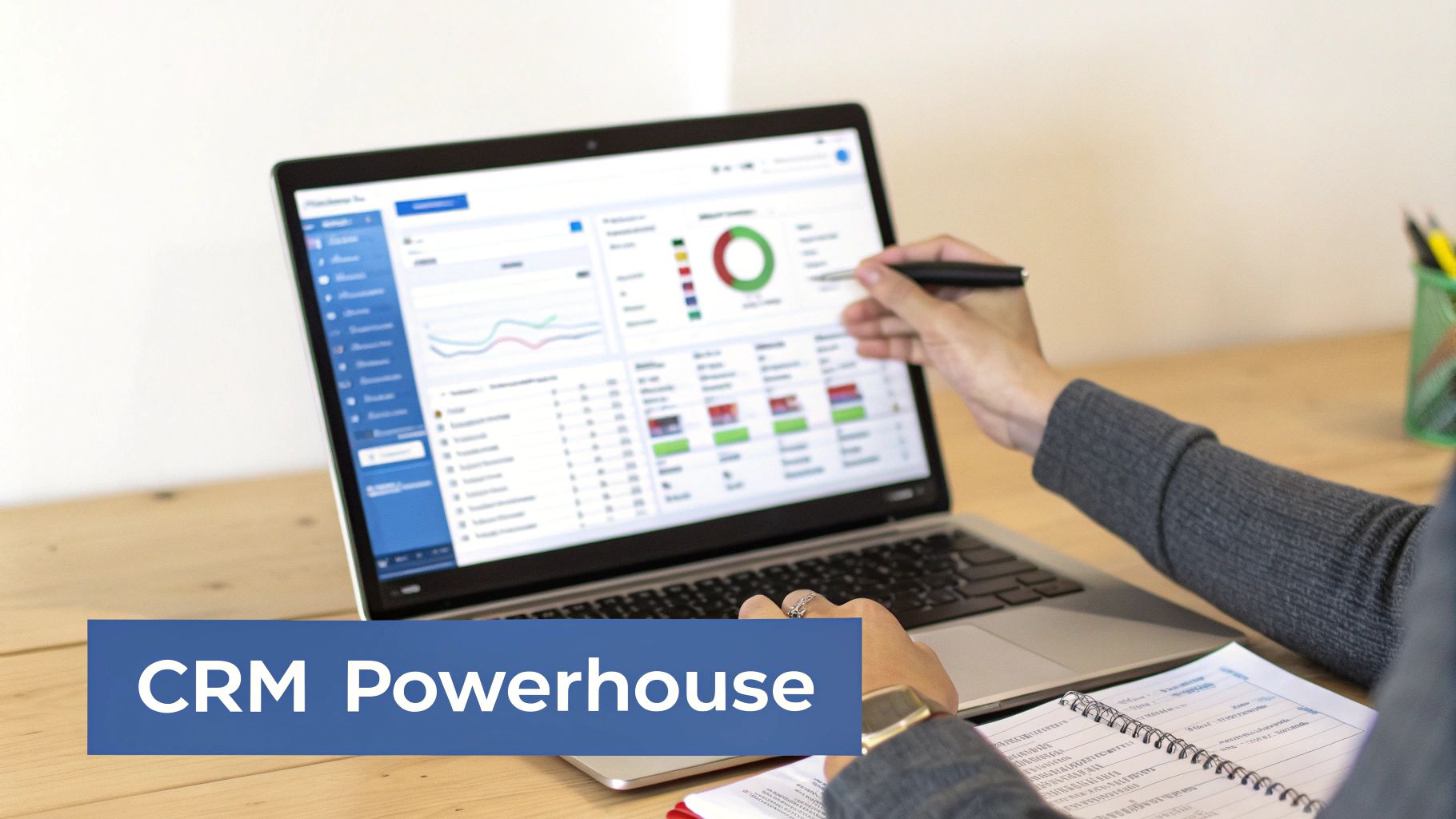
Your CRM, whether it’s a platform like Salesforce or HubSpot, should be the engine driving your entire revenue forecast. It’s far more than a digital address book. However, it only becomes a reliable source of truth if you configure it for success. An unmanaged CRM quickly becomes a liability, producing forecasts that are little more than guesses.
Transforming your platform into a forecasting powerhouse requires a deliberate, system-level approach. It’s about establishing governance, creating consistency, and ensuring the data flowing in is clean, structured, and trustworthy. For any professional in RevOps or marketing operations, this is the non-negotiable foundation for building predictable growth.
Enforce Impeccable Data Hygiene
The old adage “garbage in, garbage out” is the first law of revenue forecasting. Inaccurate or incomplete CRM data will invariably lead to a flawed forecast, regardless of your model’s sophistication.
This necessitates clear standards for data entry and team accountability. Key fields like deal size, estimated close date, and key contacts must be mandatory and consistently updated. In a platform like Salesforce, you can use validation rules to prevent reps from advancing an opportunity without populating critical information, thereby systemizing your data quality standards.
Standardise Your Sales Process and Opportunity Stages
An accurate opportunity stage forecast is impossible without a standardized sales process. Every member of your sales team must understand the precise criteria for moving a deal from one stage to the next. Ambiguity is the enemy of predictability.
Collaborate with sales leadership to define clear, objective entry and exit criteria for each stage. For example:
- Discovery: An initial qualification call has occurred, and a clear pain point has been identified.
- Solution Demo: A tailored demo has been delivered to key stakeholders.
- Proposal Sent: A formal, priced proposal has been sent to the decision-maker.
- Negotiation: Terms, pricing, and contract details are under active discussion.
Once defined, lock these stages into your CRM. From there, assigning an accurate probability weighting to each stage provides the mathematical backbone for your forecast, transforming a subjective pipeline into a quantifiable prediction.
A well-defined sales stage is a milestone, not a feeling. It represents a completed set of actions that verifiably moves a deal closer to closing, providing a solid foundation for what is revenue forecasting.
Connect Marketing Engagement Data for Deeper Insights
The most effective RevOps teams enrich their forecasts by integrating marketing engagement data. Your CRM knows what the sales team is doing, but your marketing automation platform—such as MCAE (formerly Pardot) or HubSpot—knows how engaged your prospects truly are. Integrating these systems provides another layer of critical intelligence.
Consider this: a deal in the proposal stage is promising. But what about a deal where the key stakeholders have recently attended a pricing webinar, downloaded a case study, and visited your pricing page three times in the last week? That opportunity has significantly more momentum.
This integration helps you distinguish genuinely qualified, engaged deals from the hopefuls cluttering the pipeline. It adds essential qualitative context to your quantitative data, allowing you to spot deals with real momentum and—just as importantly—those that are stalling. This unified view is a core benefit to consider when deciding how to choose a CRM that can support a mature RevOps function.
Tracking the Metrics That Actually Matter
A robust revenue forecast isn’t built on a single, high-level number. Focusing solely on total pipeline value is like driving while staring at the speedometer—you see your speed but miss what’s happening on the road around you.
To gain a complete picture, RevOps leaders must track a strategic mix of metrics. These are the vital signs that indicate the health of your revenue engine, providing the context needed to transform a hopeful guess into a reliable prediction.
Leading Indicators: Your Early Warning System
Leading indicators are forward-looking metrics that act as an early warning system, signaling future revenue potential based on today’s activities. Monitoring them allows you to spot trends long before they impact the bottom line.
Essential leading indicators to track in your CRM include:
- MQL-to-SQL Conversion Rate: This metric reflects the alignment between your marketing and sales teams. A declining rate is a red flag, suggesting potential issues with lead quality or the handoff process that could lead to future pipeline gaps.
- Pipeline Coverage Ratio: This simple yet powerful ratio compares your open pipeline to your sales quota. For example, a 3x coverage ratio means you have three times the pipeline value needed to hit your target, indicating whether you have sufficient opportunities in development.
- Deal Velocity: This measures the speed at which deals move through your pipeline. A slowdown can indicate friction in your sales process or buyer hesitation, signaling that deals forecasted for this quarter might slip.
A healthy forecast depends on more than just the value of your deals; it requires a deep understanding of their momentum. Leading indicators tell you if your revenue engine is accelerating or stalling out.
Lagging Indicators: The Reality Check
While leading indicators predict the future, lagging indicators confirm what has already happened. They serve as a reality check, providing the hard data needed to validate the assumptions in your forecasting models, such as win probabilities and sales cycle estimates.
Key lagging indicators include:
- Average Sales Cycle Length: This is the average time from opportunity creation to close. Knowing this figure helps set realistic expectations for when new opportunities will convert to revenue.
- Stage-by-Stage Win Rates: Analyzing the percentage of deals that advance from one stage to the next helps pinpoint bottlenecks. If deals consistently stall at the proposal stage, it’s a clear sign your forecast for that stage may be overly optimistic.
- Customer Acquisition Cost (CAC): This financial metric measures the cost to acquire a new customer. A rising CAC can signal inefficient spending or market saturation, both of which can eventually constrain revenue growth.
Tying Your Internal Performance to the Real World
The most reliable forecasts connect internal performance data with external economic conditions. Your business does not operate in isolation.
For example, broad economic indicators like Canada’s tax revenue as a percentage of GDP can offer clues about the overall business climate. Reported figures of 13.81% in 2023 and 14.25% in 2024 reflect shifts that could influence buyer budgets and confidence. Monitoring such trends, like the insights on Canadian tax revenue from Trading Economics, helps ground your forecast in reality.
By weaving together these internal metrics and external factors, you build a much richer, more holistic view. You can dig deeper into how to structure this kind of analysis with our guide to B2B marketing analytics. This approach elevates your forecast from a simple financial exercise to a strategic tool that truly reflects your team’s performance and the market you operate in.
Getting Past Common Forecasting Roadblocks
Even the most disciplined RevOps teams eventually encounter challenges with their revenue forecasting. When the numbers are inaccurate, it’s more than just frustrating—it undermines strategic planning and erodes leadership’s confidence in the process. Fortunately, most forecasting issues stem from a few common and fixable problems.
Think of your forecast as a high-performance engine. If it sputters, you don’t scrap the car; you diagnose the problem. Is it dirty fuel (bad data)? A faulty sensor (overly optimistic reps)? Or are you ignoring road conditions (seasonality)? By identifying the root cause, you can tune your forecast and transform it into a powerful asset.
The Problem of Messy, Inconsistent Data
The most common culprit behind an unreliable forecast is poor data quality, which often traces back to inconsistent CRM usage by the sales team. When reps forget to update deal sizes, continuously push out close dates, or neglect key fields, the entire forecast is built on a shaky foundation. This isn’t a minor issue; it’s a significant risk to your entire predictive model.
The solution is a commitment to data hygiene. If your team uses a platform like Salesforce, you have the tools to enforce discipline:
- Set Up Validation Rules: Prevent a rep from moving a deal to the next stage until crucial fields like “Next Steps” or “Budget Confirmed” are completed.
- Make Fields Required: Ensure essential details like deal value and expected close date are mandatory from the moment an opportunity is created.
- Automate Cleanup: Use tools to periodically scan your CRM for duplicate records or stale information.
Implementing these guardrails is a critical first step. Building a solid foundation requires a clear strategy, and you can learn more about how to improve data quality to get started.
Dealing with “Happy Ears” and a Bloated Pipeline
Another classic forecasting pitfall is “happy ears”—the natural tendency for sales reps to be overly optimistic about a deal’s chances of closing. This bias can seriously inflate the pipeline, leading to forecasts that look strong on paper but consistently fall short. A deal at 90% probability feels great until it vanishes on the last day of the quarter.
The antidote to wishful thinking is a disciplined pipeline review process. This is not about micromanaging; it’s about introducing objectivity and rigorous analysis.
A pipeline review shouldn’t be a storytelling session. The conversation needs to change from, “So, how are you feeling about this deal?” to “What evidence in the CRM shows us this deal is going to close?”
During these reviews, managers must ask probing, specific questions: “Has the economic buyer signed off on the proposal?” or “What are the concrete next steps scheduled in their calendar?” This forces the team to base their confidence on verifiable actions tracked in the CRM, not just a gut feeling. To overcome these common hurdles and make your predictions more reliable, you must constantly work to improve forecast accuracy.
Factoring in Business Seasonality
Finally, many forecasts go off track because they ignore the predictable ebbs and flows of the business calendar. Forgetting seasonality is like planning a beach vacation in January without checking the weather. Most B2B industries have distinct buying cycles, such as the year-end rush to spend remaining budgets or the common summer slowdown.
Your CRM’s historical data is your secret weapon here. Analyze win rates and sales cycle lengths from the same quarter in previous years to identify patterns. If your data reveals that deals consistently take 15% longer to close in Q3, you can build that reality into your current Q3 forecast. This transforms seasonality from an unknown threat into a predictable factor you can plan around.
The Strategic Impact of a Predictable Revenue Engine

While we’ve focused on the “how” of revenue forecasting, it’s the “why” that truly drives business value. An accurate, reliable forecast is more than just a number for the board; it’s the bedrock of intelligent, forward-thinking decisions that separate market leaders from followers.
When you have a predictable revenue engine, guesswork gives way to calculated strategy across the entire organization.
This predictability creates a ripple effect, enabling confident, data-backed business outcomes. A trustworthy forecast allows you to execute a hiring plan with conviction, knowing future revenue will support new team members. It gives marketing leaders the solid data needed to allocate budgets and justify spend with a clear line of sight to the pipeline they are building.
Fostering Alignment and Resilience
For RevOps and sales operations professionals, an accurate forecast is the ultimate validation of a well-oiled revenue machine. It signals that marketing, sales, and customer success are aligned and guided by a single source of truth—your CRM. This alignment is the core ingredient for predictable growth.
This strategic clarity also makes your business far more resilient. Markets will always have their ups and downs. For instance, after the initial shock of the pandemic, retail sales in Canada surged by an unprecedented 55.50% year-over-year in April 2021. You can explore more of these Canadian retail sales trends from Trading Economics.
The ability to identify and understand such trends, which often signal broader shifts in spending, allows you to adjust your strategy proactively rather than reactively.
A reliable forecast isn’t about having a crystal ball. It’s about building a business so well-instrumented that it can confidently navigate market volatility and continue to scale.
Ultimately, forecasting is not just about hitting a quarterly number. It’s about instilling the discipline required to build a scalable and resilient company. When your forecast is dependable, every major decision—from your product roadmap to sales territory planning—is made with greater confidence and precision. It demonstrates a true understanding of your own growth mechanics.
Answering Your Top Revenue Forecasting Questions
Even with the best models and processes, putting revenue forecasting into practice always raises questions. Here are some of the most common ones I hear from B2B marketing, sales, and RevOps leaders.
How Often Should We Update Our Forecast?
The right cadence is a balancing act that depends on your sales cycle length and market velocity. For most B2B companies I work with, a weekly review combined with a formal monthly update is the sweet spot.
Weekly pipeline check-ins are crucial for staying on top of ground-level activity, helping managers identify risks and capitalize on opportunities quickly. The formal monthly rollup then provides leadership with a stable, predictable number for higher-level planning, budgeting, and resource allocation.
What’s the Difference Between a Forecast and a Quota?
These terms are often confused but serve distinct purposes. A quota is a target. It’s the goal set for a sales representative or team, designed to be aspirational and drive performance.
A revenue forecast, conversely, is a prediction. It is your most objective estimate of what the business will actually generate, based on all available data. While a challenging quota can motivate the sales team, the forecast must remain grounded in reality.
Think of it this way: The quota is the destination you’ve plugged into your GPS. The forecast is the estimated time of arrival, which constantly updates based on traffic, your speed, and any detours you take.
Can We Rely on AI for Forecasting?
Yes, but AI is not a magic bullet. AI-powered tools are brilliant at processing vast amounts of data to spot subtle patterns that a human might miss. They can analyze CRM data, marketing engagement from platforms like MCAE (Pardot), and external economic trends simultaneously.
The catch is that AI is entirely dependent on your data quality. If your CRM is a repository of incomplete and inconsistent records, an AI tool will simply produce a very confident—and very wrong—answer. Before investing in AI forecasting software, you must get your data house in order. Prioritise establishing impeccable data hygiene and a standardized sales process in Salesforce or HubSpot. This clean foundation is what makes AI-driven predictions trustworthy.
How Do We Start if We Have No Historical Data?
Starting from scratch is a common challenge for new businesses or product lines. Without past performance data, you must build a driver-based forecast from the bottom up.
This involves making educated assumptions about your sales and marketing funnel:
- Top-of-Funnel Activity: Start with controllable inputs. How many outbound emails can your team send? How many MQLs do you realistically expect to generate?
- Conversion Rates: Research industry benchmarks for conversion rates at each stage (e.g., MQL-to-SQL, SQL-to-Opportunity).
- Average Deal Size: Determine the target value for an average contract.
By multiplying your planned activities by these conversion rates and your target deal size, you can build a logical, bottoms-up forecast. As soon as you begin generating real data, you can replace these assumptions with your actual performance metrics, progressively improving your model’s accuracy.
At MarTech Do, we help B2B companies build predictable revenue engines by optimising their CRM and marketing automation platforms. If you’re ready to move from guesswork to a reliable, data-driven forecast, let’s talk. Learn more about our RevOps services.